
The Way of Humility: St. Augustine’s Theology of Preaching
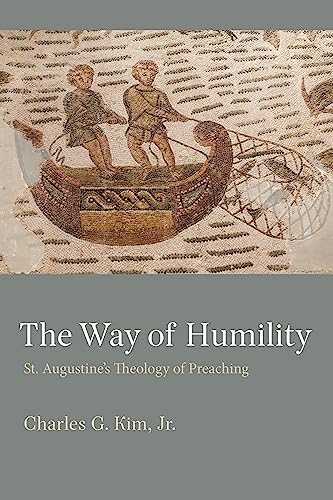
Written by Charles G. Kim Jr Reviewed By Peter SanlonThe past fifteen years has seen a welcome and necessary clarification of Augustine’s significance in church history and theology. Back in 2001, The Cambridge Companion to Augustine (edited by Eleonore Stump and Norman Kretzmann could dismiss his sermons as ‘short and scrappy.’ Other academic writings dismissed Augustine’s preaching as ‘banal.’ When I began work on a PhD in Augustine’s theology of preaching in 2007, there were no full-length English studies of that topic. Subsequently, numbers of works have been published recognising that the theology and life of Augustine is not fully appreciated if his preaching is overlooked. Examples of these include that by Paul Kolbet, Anthony Dupont, J. Patout Burns Jr., and Michael Glowasky.
Given that so many of Augustine’s unedited sermons are available, along with the commentaries that derive from the sermons, it may be surprising that so little attention had been paid to them in earlier generations of scholars. That situation has now been effectively addressed in the academy. The volume under review adds to recent renewed interest in Augustine’s preaching by explicating the doctrinal and ethical assumptions that shaped his preaching. Specifically, the thesis is that Augustine’s preaching was empowered by ‘humility, not only as a concept, but also as a practice’ (p. xxxii).
The first half of the book considers a contextual frame for Augustine’s preaching; the second half reflects on Augustine’s preaching from three vantage points: his Christology, ecclesiology, and soteriology. The opening chapter utilises Speech Act Theory to contextualise Augustine’s preaching as a ‘species of action’ (p. 38) distinguished from classical rhetoric by the preacher’s humility. Speech Act Theory derives from J. L. Austin’s book, How to Do Things with Words (1962). The insights it offers are true, but perhaps less significant for understanding Augustine’s preaching than the wider doctrinal framework examined in the rest of the book. Central to this is the virtue and ethos of humility, which enabled Augustine to ‘speak at a level which any could understand and all could enjoy’ (p. 120). The fourth chapter on Augustine’s Christology makes clear that the form of preaching must be humble if it is to present a Christ who is humble. When people get to know the humble Christ, they long to know more: ‘What Augustine the preacher wants is for his people to pray rightly and he wants to stir within them a desire for understanding’ (p. 161).
The concluding chapter on soteriology emphasises that for listeners to understand and benefit from a sermon, God must act:
It is through sharing in the humility of Christ that one has the possibility or power to see with deified eyes. Augustine teaches the virtue of humility, which he learned from Christ, through his words and deeds as preacher. The preaching moment also presents the possibility to rely humbly on God to give the increase, both for the preacher and the parishioner. (p. 177)
The book successfully demonstrates that Augustine had a doctrinal vision of preaching, which he sought to live out in the sermons he delivered. Humility was a core commitment in his vision of preaching. This meant that Augustine was able to utilise pagan insights to hermeneutics (for understanding Scripture) and rhetoric (for communication). Augustine was not too proud to learn from others, but the insights he gained had to be submitted to, and refined by, the message of the Bible. Humility was thus necessary in the preacher.
It was also what Augustine’s preaching aimed to cultivate in—and required from—listeners. Augustine wanted people to depend not on their own good works but the grace of the triune God. For this to be so, listeners would need to humbly accept the grace held out in sermons. Preacher, Scripture, and listeners were together united in their appreciation of humility. The great value, then, of this book is its consistent highlighting of the centrality of humility in Augustine’s preaching.
It is good to see academic dissertations such as this being produced that are of sufficient value to the church that they can be published. This study of Augustine’s preaching not only adds to our appreciation of Augustine’s preaching, but it also challenges our approach to preaching in general. Too many today view preaching as in effect merely a pragmatic or intellectual exchange of information. The role of the modern preacher is then to sell and market his interpretations. That this study places our focus on the spiritual virtue of humility reminds us that preaching cannot be adequately practised as a technique. It is rather a spiritual discipline that requires the humble Christ to be known in a heartfelt way by the preacher. Many of our contemporary efforts to train preachers implicitly appeal to and promote the idea that the preacher has within himself special skills and abilities. It is easy to imagine that one is on a higher spiritual plane than the congregation. Preaching well becomes an effort to draw upon inner strength and skills of interpretation and communication. Augustine therefore stands as a challenge to us: more foundational than skills or technique is the preacher’s humble dependence on God for insight. Cultivation of humility before God is needed before we deploy rhetorical skills in his service. If this book is right to see humility as central to preaching, then the preacher must be aware that how one views self and wider areas of life have a bearing on the health of one’s preaching. Congregations also need to cultivate humility to benefit from preaching. The sermon is not an opportunity to puff oneself up or engage in hyper-critical evaluation. A humble spirit will open listeners’ hearts to God’s Spirit as his Word is preached.
The renewed appreciation of Augustine’s preaching in the past 15 years is demonstrated in the fact that, while The Cambridge Companion to Augustine once dismissed the sermons as of little value, in May 2025 they were recognised as so vital for understanding Augustine that they were granted their own standalone Cambridge Handbook (edited by Andrew Hofer). There are lessons here for the evangelical church: we can also recommit to valuing the work of preaching as a crucial spiritual exercise discharged for the good of the church and glory of God. A good step towards that would be reading and pondering sermons from Augustine. They are available in eleven volumes of a contemporary translation (Saint Augustine, Sermons, ed. John E. Rotelle, trans. Edmund Hill, The Works of Saint Augustine [Hyde Park, NY: New City, 1990–1997]) and for those who wish to dip into them, there is a one-volume selection of sermons available (Essential Sermons, ed. Daniel E. Doyle, The Works of Saint Augustine [Hyde Park, NY: New City, 2007]).
Peter Sanlon
Peter Sanlon is minister of Tunbridge Wells Presbyterian Church in Tunbridge Wells, UK.
Other Articles in this Issue
This essay is the second of a two-part analysis of John’s use of the articular substantival participle...
Empathy and Its Counterfeits: Navigating The Sin of Empathy and a Way Forward
by Jonathan D. WorthingtonIn our families, churches, or neighborhoods; in political discussions, situations of accused abuse, or racially charged conversations; in polarizing times, compassion must be wed with relational exegesis, the well-established name for which is empathy...
Philosophical Foundations of a Transgender Worldview: Nominalism, Utilitarianism, and Pragmatism
by Anthony V. CostelloEvery social and political phenomenon has some prior, underlying philosophical basis...
This article explores the relationship between Tolkien’s angelology, as reflected in his fictional writings, and classical angelology, particularly as represented by Augustine and Thomas Aquinas...
The Role of the Regula Fidei in the Twenty-First-Century Religious Landscape: How the “Rule of Faith” Can Help Address the Existential Issues of the Postmodern Christian Community
by Roland WeisbrotThis article offers a historical-systematic analysis of the role of the rule of faith in establishing and maintaining the Christian metanarrative and orthodox scriptural interpretation...
Other Reviews in this Issue