
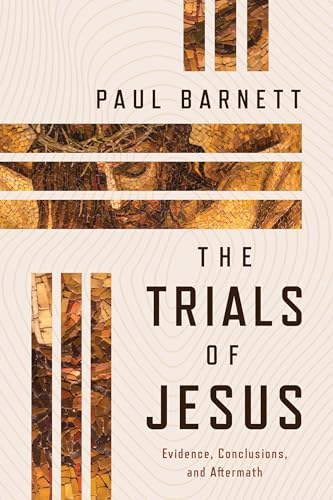
The Trials of Jesus: Evidence, Conclusions, and Aftermath
Written by Paul Barnett Reviewed By Melvin L. OteyIn The Trials of Jesus, Paul Barnett offers a wide-ranging and accessible survey of the historical and political circumstances surrounding the Jewish and Roman proceedings against Jesus. The heart of Barnett’s argument is his assertion that Jesus was crucified not merely as a religious dissenter but as a political and financial threat to the ruling Jewish elites—specifically, high priests Annas and Caiaphas. These leaders, according to Barnett, perceived Jesus’s popularity and influence as endangering both their authority and their advantageous relationship with the Roman occupiers. To neutralize this threat without provoking civil unrest during Passover, the high priests leveraged their wealth and influence—as well as Pontius Pilate’s political vulnerabilities—to orchestrate Jesus’s execution at Roman hands, thereby shielding themselves from direct culpability.
The book comprises twenty-seven brief chapters, most of which are six pages or fewer in length, and is divided into four main sections. The brevity of the chapters sometimes comes at the expense of depth and thematic development. However, the structure gives the work a digestible format that is accessible for general audiences and useful for quick reference.
The first section, titled “The Dynastic Background,” provides historical context for the world in which Jesus lived and was ultimately tried. Here, Barnett traces the succession of foreign powers in Palestine from the time of the Babylonians to the Romans. Seven chapters in this section address Persian, Greek, Maccabean, Roman, and Idumean influences that shaped Jewish political and religious life. This material effectively situates the reader within the complex landscape of Second Temple Judaism and sets the stage for the trial narratives.
The second section, “Kings, High Priests, and Other Officials,” is more narrowly focused on the immediate historical context of the passion narratives and key figures like Herod the Great, his son Archelaus, Herod’s grandson Herod Antipas, Annas, Caiaphas, and Pontius Pilate. Barnett explores their personal ambitions, political alliances, roles in maintaining the status quo in Judea, and the intricate web of relationships that underpinned Jewish and Roman authority during Jesus’s ministry.
In the third section, “The Trials of Jesus,” Barnett turns to the trials themselves. He examines the Jewish proceedings and the synoptic and Johannine accounts of Jesus’s Roman trial. He also briefly considers Jesus’s appearance before Herod Antipas and discusses Josephus’s Testimonium Flavianum. Although these five chapters aim to bring the earlier background material to bear on the events of Jesus’s final days, they tend to recapitulate content rather than develop new insights. Notably, Jesus’s appearance before Herod Antipas receives less than a full page of attention, which is surprising given the episode’s canonical and theological distinctiveness.
The final section, “After Jesus: The Birth of the Church,” extends the discussion beyond the crucifixion. Barnett surveys the persecution of Jesus’s followers, the eventual downfall or political demise of the various officials involved in his trials, and the emergence of the early Christian community. These chapters link the political implications of Jesus’s death with the founding of the church.
While The Trials of Jesus succeeds in presenting a compact and readable introduction to the broader historical and political environment of Jesus’s trials, its utility for academic audiences is limited. The book touches on critical scholarly questions but does not engage them in depth. This may reflect the author’s deliberate prioritization of accessibility and clarity for lay readers. However, scholars seeking rigorous analysis or fresh interpretive frameworks will likely find the book wanting in these respects. Such readers are also more likely to prefer fewer chapters with deeper explorations focused more squarely on New Testament reports of Jesus’s trials and their various issues.
Despite its limitations, Barnett’s volume represents a helpful entry point for students, ministers, teachers, and interested laypersons seeking to better understand the world of the New Testament, especially backgrounds relevant to the ministry and trials of Jesus. While the book’s title suggests a narrow focus on Jesus’s trials, the book is better appreciated as a general handbook on the socio-political background of Jesus’s final days. In that vein, it offers valuable context and insight, even if it stops short of providing the critical depth that more advanced readers might anticipate.
In sum, The Trials of Jesus is a readable and informative resource that sheds light on the intertwined political and religious forces that shaped Jesus’s path to the cross. It is not a comprehensive academic treatment, but it fills an important niche as a primer on New Testament backgrounds and is recommended for serious non-specialists interested in the historical underpinnings of the gospel narratives.
Melvin L. Otey
Melvin L. Otey is a professor of Law at Faulkner University’s Jones School of Law and a PhD student in Faulkner University’s Kearley Graduate School of Theology.
Other Articles in this Issue
This essay is the second of a two-part analysis of John’s use of the articular substantival participle...
Empathy and Its Counterfeits: Navigating The Sin of Empathy and a Way Forward
by Jonathan D. WorthingtonIn our families, churches, or neighborhoods; in political discussions, situations of accused abuse, or racially charged conversations; in polarizing times, compassion must be wed with relational exegesis, the well-established name for which is empathy...
Philosophical Foundations of a Transgender Worldview: Nominalism, Utilitarianism, and Pragmatism
by Anthony V. CostelloEvery social and political phenomenon has some prior, underlying philosophical basis...
This article explores the relationship between Tolkien’s angelology, as reflected in his fictional writings, and classical angelology, particularly as represented by Augustine and Thomas Aquinas...
The Role of the Regula Fidei in the Twenty-First-Century Religious Landscape: How the “Rule of Faith” Can Help Address the Existential Issues of the Postmodern Christian Community
by Roland WeisbrotThis article offers a historical-systematic analysis of the role of the rule of faith in establishing and maintaining the Christian metanarrative and orthodox scriptural interpretation...
Other Reviews in this Issue