
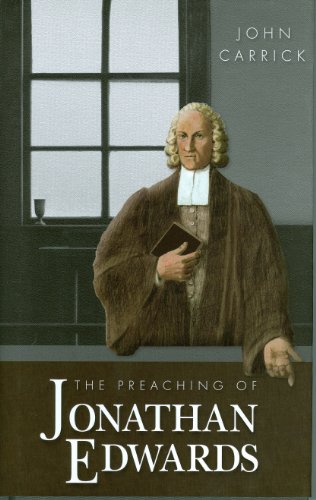
The Preaching of Jonathan Edwards
Written by John Carrick Reviewed By David P. BarshingerJonathan Edwards (1703–1758) is remembered for many reasons today. He is upheld as America’s greatest theologian and author of the influential Freedom of the Will. He is praised for his role in promoting revivalism and his teaching on “religious affections.” John Carrick reminds us in The Preaching of Jonathan Edwards that we ought also to remember him for his contributions as a preacher.
Carrick begins by showing that studies—even in Reformed circles—tend to focus on Edwards’s theology and intellect, not his preaching. In engaging the historiography, he acknowledges Wilson Kimnach’s analysis of Edwards to be “the most thorough and incisive” work on Edwards’s preaching, yet also charges that Kimnach’s work is hampered by its tendency to “reduc[e] Edwards’ preaching to rhetorical theory” (p. 20). Carrick aims to fill the lacuna by approaching Edwards’s preaching from a spiritual and homiletical, rather than literary, perspective. He seeks to provide “a comprehensive analysis of Jonathan Edwards’ preaching” and to “interact, both appreciatively and critically, with the now completed definitive edition of The Works of Jonathan Edwardsproduced by Yale” (p. 20). Carrick also evaluates Edwards’s preaching for pastors today, recommending some practices and criticizing others. As a Professor of Homiletics at Greenville Presbyterian Theological Seminary who spent fifteen years in pastoral ministry, Carrick brings his preaching background and a three-decade interest in Edwards to bear on this work.
In discussing major themes in Edwards’s sermons, Carrick emphasizes that Edwards preached from a theocentric perspective, firmly upheld God’s sovereignty, and focused on Christ, providing “some of the loveliest detailed descriptions of Christ in the whole range of homiletical literature” (p. 103). Edwards was not stuck in the clouds though. He also preached on man’s responsibility before God, warned of hell’s judgments, and extolled heaven’s blessings.
By juxtaposing a focus on God with a call to renewal, Edwards exhibits his desire for theology to inform daily living. This thinking is reflected in the structure of Edwards’s sermons, which adhere to the Puritan sermon form of text-doctrine-application. Carrick also demonstrates that Edwards employed a diversity of useful homiletical tools. He exposited biblical texts and grounded his doctrines in Scripture. He addressed his listeners according to their age, gender, or spiritual condition. He answered common objections, appealed to his hearers’ motives of love and fear, and presented biblical and historical examples to illustrate his teaching in flesh and blood. And Edwards used the interrogative, “one of his most powerful homiletical weapons,” to call people to examine themselves (p. 299).
Carrick goes on to argue against the reigning image of Edwards as a dull, monotone preacher, and points to “the overwhelming evidence from Edwards’ own manuscripts” that shows he increasingly moved in the direction of “diligent and extemporaneous delivery” (p. 410). Carrick further reminds us that Edwards understood his preaching to be effective only by the sovereign will of God. If the Holy Spirit did not move, his preaching would fail. Thus Carrick laments the “essentially naturalistic, indeed reductionistic, lines” along which Edwards is often interpreted among historians (p. 447).
Even so, Carrick warns against “the temptation to slavish imitation of Edwards” and specifically criticizes his limited practice of visitation and overly strict regimen of study (p. 457). Still, in the end Carrick calls Edwards “an intellectual, theological, philosophical, spiritual, and homiletical supernova, the brilliance of whose light still continues to illuminate and bless those that will sit at his feet two and a half centuries later” (p. 460).
Carrick’s volume is welcomed. While Edwards’s theological treatises are significant, he was foremost a pastor, and his preaching deserves far greater attention. He delivered hour-long sermons three times every week, and his extant corpus includes more than 1,200 sermons, a reality that testifies both to the importance of studying Edwards’s preaching and to the monumental task Carrick assumed.
The chapter on Edwards’s “Delivery” is perhaps Carrick’s most valuable contribution to Edwards studies, bringing to light the fuller evidence of Edwards’s ability to communicate from the pulpit. He also does well to draw attention to Edwards’s supernaturalist grid—the Word and Spirit serve as more foundational elements to his preaching than the socio-economic or psychological factors often cited.
The volume is deterred, however, by a lack of organization. The book’s twenty-eight chapters are not subdivided into sections, though some seem apparent (e.g., homiletical form, themes, and strategies). Chapters that would fit well together are not collected in order. With no obvious progression, the flow feels somewhat haphazard.
Finally, Carrick does not quite achieve his stated aim. While he engages extensively with Edwards’s published sermons, his volume does not constitute “a comprehensive analysis of Jonathan Edwards’ preaching.” The printed Yale Works provides only 158 sermons, just over one-eighth of Edwards’s extant sermon corpus. Carrick accesses some additional sermons through the Hickman Works (Banner of Truth Trust), but makes no mention—and evidently no use—of the hundreds of unpublished sermons available at Yale University’s Beinecke Rare Book and Manuscript Library (recently made available online: http://edwards.yale.edu/research/sermon-index). It is difficult thus to claim “a comprehensive analysis.”
Despite these drawbacks, Carrick provides a helpful volume both for considering how pastors can utilize Edwards’s methods and emphases in preaching today and for understanding Edwards as a preacher. For those who have the commonly propagated image of Edwards as a hellfire preacher, the collective impact of Carrick’s detailed descriptions paints a fuller, more accurate—even if not comprehensive—picture of the preacher Jonathan Edwards.
David P. Barshinger
David P. Barshinger
Trinity Evangelical Divinity School
Deerfield, Illinois, USA
Other Articles in this Issue
I didn’t come from an Evangelical home, and though he never told me outright, I’m sure my father never wanted me to become a pastor...
Does Baptism Replace Circumcision? An Examination of the Relationship between Circumcision and Baptism in Colossians 2:11–12
by Martin SalterReformed paedobaptists frequently cite Col 2:11–12 as evidence that baptism replaces circumcision as the covenant sign signifying the same realities...
New Commentaries on Colossians: Survey of Approaches, Analysis of Trends, and the State of Research
by Nijay GuptaNew Testament scholarship in its present state is experiencing a time of abundance, especially with respect to biblical commentaries of every shape, length, level of depth, theological persuasion, intended audience, and hermeneutical angle...
It might seem odd to write an editorial for a theological journal on the topic of not doing theology and how important that can be; and, indeed, perhaps it is contrarian even by my own exacting standards...
Most readers of Themelios will be aware that the word “perfectionism” is commonly attached in theological circles to one subset of the Wesleyan tradition...
Other Reviews in this Issue