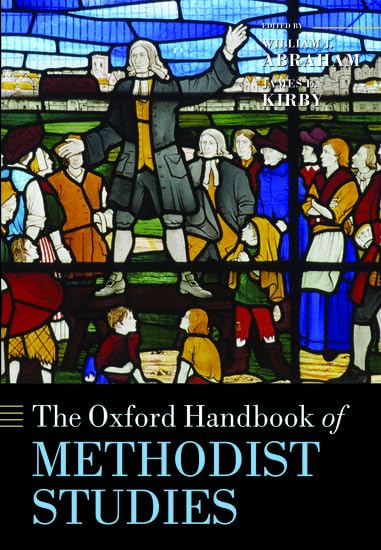

The Oxford Handbook of Methodist Studies
Written by William J. Abraham and James E. Kirby, eds. Reviewed By Thomas H. McCallWilliam J. Abraham and James E. Kirby have produced a massive and very helpful resource for the vast field of “Methodist studies.” Part 1 surveys the history of Methodism, and here essays include discussions of the eighteenth-century context, the history of the Wesley brothers (and their relationship), the importance of Francis Asbury and the beginnings of American Methodism, as well as the changes within Methodism during the nineteenth and twentieth centuries in Britain, the United States, and globally, the relationship of the Evangelical United Brethren to the Methodist movement, and the oft-neglected but important element of African-American Methodism.
Part 2 (“Ecclesial Forms and Structures”) deals with the sometimes messy and oft-perplexing challenges that early Methodism faced, and it helpfully overviews some of the decisions made and some of the diversity now evident with respect to church order and discipline. While the first two parts of the book are in the main quite well done, Part 3 (“Worship: Sacraments, Liturgy, Hymnody, Preaching”) is more of a mixed bag. Lester Ruth’s essay on “Liturgical Revolutions” discusses many of the major changes from the Anglican liturgical tradition that was favored and treasured by the Wesleys themselves to the low-church elements of primitive American Methodism. It is both illuminating and fascinating, and it is a highlight of the book. Similarly, Geoffrey Wainwright’s essay on the sacraments is very helpful, as is Karen Westerfield Tucker’s work on “Mainstream Liturgical Developments.” Swee Hing Lim’s essay on “Music and Hymnody,” on the other hand, gives an interesting overview of some contemporary developments within Asian Methodism, but somehow manages only to mention the hymns of the Wesleys themselves in two sentences (and with no discussion of the use and impact of these hymns in the development of the global Wesleyan movement).
Part 4 (“Spiritual Experiences, Evangelism, Mission, Ecumenism”) takes some steps toward exploring the thrust for evangelism and mission within Methodism, but despite an excellent contribution from Philip Meadows (“The Journey of Evangelism”), it nonetheless fails to give a clear vision of either the history or rationale of the historic Methodist commitment to evangelism and mission (“nothing to do but save souls”). Part 5 is focused upon theological issues, and here we are treated to essays on the doctrine of revelation and the nature and role of Scripture, the doctrine of the Trinity, original sin and grace, Christology, Pneumatology, as well as doctrines related to salvation: Christian perfection, assurance, and predestination and election. The essays by Elmer Colyer (Trinity), Jason Vickers (Christology), Barry Bryant (original sin), Kenneth Collins (assurance), Billy Abraham (perfection), and Jerry Walls (predestination) are all excellent contributions. Part 6 deals with “Ethics and Politics,” and here the standout essays are by D. Stephen Long and Stanley Hauerwas and David Bebbington.
This book leaves me with several nagging concerns and questions about it and, alas, a few critical observations. First, I observe that the scope of the book is not always obvious. Much of the book seems to be implicitly focused upon what is now called “United Methodism” (in the United States) and its immediate family (earlier relatives and global sister churches). This raises the question of the relation of Methodism to the broader “Wesleyan” tradition: Just what are we to make of the smaller groups within that tradition? Donald Dayton’s essay discusses the nineteenth-century holiness movement, and Abraham’s essay mentions the Church of the Nazarene, but much of the volume basically ignores such movements. Now this is perfectly understandable if the intent is to focus the discussion somewhat more narrowly. But just what (or who) is the referent of the label “Methodist?” There is as well an almost dizzying range of theological perspectives in the book. This accurately reflects contemporary Methodist theology, of course, and as such the range of views is in one sense helpful. But sometimes this is not so helpful, for it does not allow us to see the internal consistency of the various Methodist theological options. While the process Wesleyan understanding of, say, prevenient grace may be internally consistent, it is very different from prevenient grace as it is understood by orthodox Wesleyans. Worse yet, the differing theological perspectives contradict one another in the same volume, but without any explicit recognition of that fact and with both views claiming to represent “the” Wesleyan perspective. For instance, Marjorie Suchocki claims that Wesley held that humans suffer only corruption from original sin (rather than guilt) (p. 547), while Barry Bryant observes that Wesley understood his own view to be not a “hair’s breadth” different than Calvin (p. 534) on this point (Bryant is undoubtedly correct, for Wesley’s Original Sin defends the federalism of the Westminster Confession of Faith). More troubling, however, there is no treatment of the ordo (or via) salutis. There are discussions of various issues related to soteriology broadly conceived: predestination, sanctification, and other matters are addressed. But there is no treatment as such of what Wesley referred to as “the Scripture way of salvation.” Again this deficit may reflect the current state of Methodist theology, but it does not reflect Wesley’s own convictions (nor those of the historic Wesleyan tradition). Surely the book would benefit from a focused and penetrating discussion of justification and the new birth (and how these relate to the other important soteriological loci).
These criticisms should not, however, distract us from the several significant strengths of this book. Its breadth is impressive, and it is generally very well organized (although we could quibble with the placement of a few essays, and we are left unsure just what the difference is between “theological ethics” and “moral theology”). It addresses historical, missiological, liturgical, ethical, and theological matters, and it provides a very helpful overview and introduction both to the importance and the complexity of these issues. Abraham and Kirby have drawn together an impressive array of experts, and they have marshaled them well. In doing so, they have done a great service to all who wish to understand the massive but sometimes bewildering Methodist movement.
Thomas H. McCall
Thomas H. McCall
Trinity Evangelical Divinity School
Deerfield, Illinois, USA
Other Articles in this Issue
I didn’t come from an Evangelical home, and though he never told me outright, I’m sure my father never wanted me to become a pastor...
Does Baptism Replace Circumcision? An Examination of the Relationship between Circumcision and Baptism in Colossians 2:11–12
by Martin SalterReformed paedobaptists frequently cite Col 2:11–12 as evidence that baptism replaces circumcision as the covenant sign signifying the same realities...
New Commentaries on Colossians: Survey of Approaches, Analysis of Trends, and the State of Research
by Nijay GuptaNew Testament scholarship in its present state is experiencing a time of abundance, especially with respect to biblical commentaries of every shape, length, level of depth, theological persuasion, intended audience, and hermeneutical angle...
It might seem odd to write an editorial for a theological journal on the topic of not doing theology and how important that can be; and, indeed, perhaps it is contrarian even by my own exacting standards...
Most readers of Themelios will be aware that the word “perfectionism” is commonly attached in theological circles to one subset of the Wesleyan tradition...
Other Reviews in this Issue