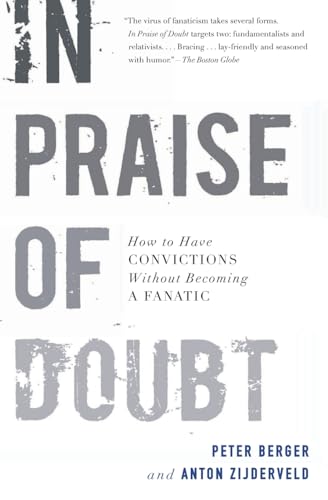

In Praise of Doubt: How to Have Convictions Without Becoming a Fanatic
Written by Peter L. Berger and Anton Zilderveld Reviewed By William EdgarTo paraphrase Mark Twain, the rumors of the death of religion were highly exaggerated. Through the 1960s a host of sociologists and pundits had predicted the slow disappearance of religious faith and the certain emergence of secularization in its stead. Simply stated, as mankind matured, religion would no longer serve the most pressing needs of a modern society. Modernity would lead to plurality, plurality would lead to pluralism and then to relativism, making any kind of religious or moral certainly unlikely.
Today, forty years later, that has all changed. Empirically, religion has never been more prevalent throughout the world. The only two possible exceptions are geographical (particularly Europe) and sociological (the intellectual elite found in various positions, universities, media, etc.). Not only are churches and mosques spreading at an unprecedented rate, but less formal religions are popping up all over the place, including New Age, Pentecostalism, the “health and wealth gospel,” churches meeting in homes, mix-and-match religions, etc. Further, religion is a prominent force in public life. The Roman Catholic church played a critical role in the overthrow of Communism from Poland and from much of Europe. Evangelical Protestantism has been a major factor shaping a part of the American political landscape. Several Muslim countries are ruled by clerics.
How did the earlier sociologists get it wrong? Certainly ideology played a role. Prescription is not far behind description in some cases. Sociology as a discipline owes much to Auguste Comte, whose eschatology included moving from ages of superstition to an age of science, followed by Utopia. Analytically, though, sociologists made a major mistake when they assumed that pluralization always leads to secularization. The logic seemed impeccable. In a globalizing world, the sheer volume of people living close together with neighbors who do not share their religious or cultural backgrounds was supposed to predict two trends: (1) the complete privatization of religion, thus its impotence in the public square, and (2) a lowest common denominator of beliefs and values. Believing that one way is true is implausible in a world where you daily confront people from vastly different horizons. Some of that leveling happened. But mostly, even though so many options became available, contrary to sociological predictions of secularization, people have made choices that are deeply religious.
So pluralization does not necessarily predict secularization. Still, something has changed with the present exponential increase in diversity. It is the temptation either to become relativistic or fundamentalist. Plurality is a social fact. It refers simply to the multiplication in the modern world of viewpoints, ethnic backgrounds, and options. Pluralization feeds into urbanization, and vice-versa. But pluralism is more value-laden. At the extreme it refers to an ideology of diversity. In reaction to this we face the other temptation: fundamentalist extremism. And that is the challenge of this fascinating book. Can we be plural without being pluralistic or fundamentalist?
Peter Berger, the preeminent sociologist of religion today, has been concerned to voice a “third way” between relativism and fundamentalism for a long time and has written voluminously on the subject throughout his productive career. The present volume, written with the collaboration of philosopher Anton Zilderveld, is surely one of his best efforts to date. Elegantly and provocatively written as always, the book boils down some rather sophisticated sociological and philosophical material into a most accessible form.
The opening chapter, “The Many Gods of Modernity,” explains how the pluralizing dynamic intrudes on everything. One of the features of our plural world is the increased pressure to choose. This in part is because of the lessening role of institutions. The Church is no longer a monopoly but a voluntary organization. People are no longer required to stay in the particular denomination they grew up in, but they can choose to opt out of one and into another. Indeed the very term “denomination” is a rather recent one, and aptly describes the diminishing monopoly of a single communion of faith. The change brings with it not only doctrinal confrontations, but more especially the clash of moral convictions. While sharp differences over the significance of the Eucharist are not likely to divide people, let alone lead to hostility between them, disagreements over abortion or gay rights are. Where many Westerners do not care very much about whether God is One or One in Three, they do care passionately about polygamy or wearing the Burqua in public.
In such an atmosphere where religion is a strong factor (though not as institutionalized as before) and where ethical convictions are volatile, the two easiest options seem to be relativism or fundamentalism. Either downplay any absolutes or else raise them to a collective status, imposing them on others.
The second chapter, “The Dynamics of Relativization,” brilliantly describes the first option. Simply put, “Relativization is the process whereby the absolute status of something is weakened or, in the extreme case, obliterated” (p. 26). The authors trace the shift from an era where the reaction to a question is “of course” to one where there is more tolerance. If you asked earlier whether one man should be married to one woman, the answer would have been “of course.” Today, the question receives a more open kind of answer: heterosexual marriage may be a preference or an option, but there are others. In matters of religion, there is an increasing tendency to move from exclusivism to inclusivism: my church, my truth, is not the only way to salvation.
The authors then show the impossibility and undesirability of relativism. The most prominent relativists, including the postmodernists and the ideologues, always manage to sneak in an absolute. It may be an “epistemological elite.” For Marx, it was the proletariat; for Lenin, the Communist Party; for the Third Worldists, the poor; for Gramsci, the intelligentsia. Needless to say, each of these not-so-hidden absolutes became oppressive to the point where any kind of claimed egalitarian relativism became implausible. The authors worry about the hidden whiplash of postmodern terms such as “narrative,” which appears to derive all values from a particular story, never a “metanarrative,” but in the end leads to a black hole. For our authors, this is not simply an intellectual inconsistency, but a sign of social decadence.
They then turn their guns on fundamentalism. After looking briefly at American fundamentalism’s history, they characterize it as reactive, if specifically modern. In addition, fundamentalism is anti-traditionalist. In an amusing illustration of the difference, they cite the episode where Napoleon III, accompanied by the Empress Eugenie, were hosted by Queen Victoria. Eugenie did not have an aristocratic background. Victoria took her to the opera one night, and after Eugenie appeared in the royal box and greeted the audience, she turned around to find her chair. Victoria then entered, greeted the audience, but simply backed into her chair. She did not have to look, for she knew it was there. Similarly, fundamentalists, the authors argue, are insecure about their “chair,” whereas true traditionalists take it for granted.
The ensuing pages I found to be somewhat mixed. The authors write probingly on totalitarianism, economic control, and theocracy. They rightly cite the failure of the Soviet Union to control the flow of information with the result that outside ideas filtered in and the regime opened up and eventually collapsed. They critique the sects that depend for their health on forbidding all communication with outsiders. They include NT Christians in their purview, citing Paul’s admonition not to be “unequally yoked together with unbelievers” (2 Cor 6:14). I don’t want to sound defensive here, but in the larger context of the Corinthian epistles, the point is not to enjoin sectarian separatism, but to avert moral compromise. In 1 Cor 5:9–10, the apostle explains that by not associating with immoral people he did not mean all sinners, “since then you would need to go out of the world.” Apologetics, say the authors, is a way to liquidate doubts “by immersion in a comprehensive theory that both explains and denies them” (p. 85). As someone who is paid to teach Christian apologetics, I take issue with the implications that our field is prone to liquidating others!
Things do not improve much in the following chapter, which treats certainty and doubt. The authors do admit of truths that should qualify as absolute, but on the whole they are so basic (Pythagorean math, for instance, and a vague idea of human rights) that no one will find them offensive. Most of the chapter is a series of warnings against the fanatical refusal of doubt. Communism once more comes in for scrutiny, as does the French Revolution. But so also does Calvinism. Again, while not wanting to be defensive, I do not think the authors have given brother Calvin his due. They call him a fanatic and his regime theocratic and disciplinarian. They parade the usual suspects as evidence: Castellio and Servetus. Of course, the sixteenth century was not the twenty-first, nor was Geneva completely free from the medieval confusion of church and state. But most historians, whether they like him or not, generally credit Calvin with preaching grace and in the bargain helping the West to take giant steps forward toward democracy, regulated capitalism, and mercy on refugees.
This overreach should not detract from the overall argument of the book, which is most valuable. The authors plead for a civil society in which honest debate replaces coercion. They lay out the contours of proper choice-making and celebrate the right kind of plurality. They finish with chapters on the limits of doubt and the politics of moderation. Certainty is based on fundamental human rights, whereas “doubt” is how to work out the details of living together when we don’t agree on secondary issues. In ethical matters they end up with a variant on natural law, with its own kind of certitude: “Such certitude is based on a historically developing perception of what it means to be human, which, once attained, implies universality” (p. 127). They give several examples of how certainty and doubt could help resolve moral issues. One of them encourages Europeans in the best way to live with Muslim immigrants. Certainty should rule in forbidding honor killings, genital mutilation, and violent jihad. Society should also be fully liberal on allowing prayer for Muslims during working hours, wearing veils in public, and so on. “Doubt” should be reserved for gray areas like coed sports, blasphemy laws, etc.
We might be tempted to ask our authors, how do you know what is certain and what is doubtful? They answer with a caution. Once you get to sharp rules, you are no longer allowing for any doubt. Doubt by definition is a work in progress. Democracy itself must never become absolute. Democratism is as dangerous an ideology as any “ism.” When that happens, we cannot attain the highest ideal, which is the “positive freedom to act creatively in all spheres” (p. 150).
In the end this provocative little book, full of insights and sound arguments, represents only a part of the picture. It cries out for some kind of transcendental foundation that promotes both the certainty of perennial moral values and the humility (a better term than doubt) to know how to work them out in a pluralizing world where we do not all agree on what it means to be human.
William Edgar
William Edgar is Department Coordinator and Professor of Apologetics at Westminster Theological Seminary in Philadelphia, Pennsylvania.
Other Articles in this Issue
I didn’t come from an Evangelical home, and though he never told me outright, I’m sure my father never wanted me to become a pastor...
Does Baptism Replace Circumcision? An Examination of the Relationship between Circumcision and Baptism in Colossians 2:11–12
by Martin SalterReformed paedobaptists frequently cite Col 2:11–12 as evidence that baptism replaces circumcision as the covenant sign signifying the same realities...
New Commentaries on Colossians: Survey of Approaches, Analysis of Trends, and the State of Research
by Nijay GuptaNew Testament scholarship in its present state is experiencing a time of abundance, especially with respect to biblical commentaries of every shape, length, level of depth, theological persuasion, intended audience, and hermeneutical angle...
It might seem odd to write an editorial for a theological journal on the topic of not doing theology and how important that can be; and, indeed, perhaps it is contrarian even by my own exacting standards...
Most readers of Themelios will be aware that the word “perfectionism” is commonly attached in theological circles to one subset of the Wesleyan tradition...
Other Reviews in this Issue