
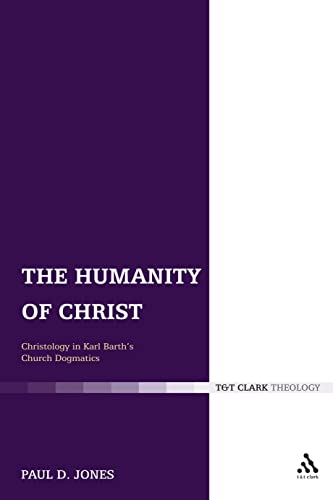
The Humanity of Christ: Christology in Karl Barth’s Church Dogmatics
Written by Paul D. Jones Reviewed By Adam J. JohnsonThe Humanity of Christ is a revision of Paul Jones’ dissertation, written at the Harvard Divinity School. While prudence may have counseled Jones to select a narrower and safer topic, it is good that he paid it no heed, for this book is a solid contribution to Barth studies, bearing the signs of a mature scholar.
Surveying the Christology of any great theologian is a significant task since, along with the doctrines of the Trinity and the atonement, it lies at the very heart of the Christian faith. In Barth’s case, however, the task is all the greater for several reasons. First, Barth’s thought develops considerably on this issue throughout his career, demanding familiarity with his corpus as a whole (as though mastering the CD weren’t a mammoth task by itself). Second, to make matters more complicated, the chief christological developments lie at the intersection of several doctrines, such that an adequate survey necessarily takes on the guise of a mini-systematic theology, including the doctrines of the Trinity, election, and reconciliation. Finally, Barth is in constant dialogue with a wide array of theologians, such that versatility with the history of church doctrine is vital for understanding the context of some of his more significant arguments. Jones intentionally structures his argument so as to take these factors into as full an account as possible, and does so with a consistently thorough analysis.
If the above task is not sufficiently daunting, it is also worth noting that Barth’s Christology is the most highly contested turf in today’s Barth studies, with McCormack, Hunsinger, Molnar, Hector, van Driel, and a host of others filling up the table of contents in many of the best theology journals. The self-confidence with which Jones navigates these waters, offering his own exposition without getting so caught up in the discussion as to forgo a due treatment of other issues, is of itself ample indication that Jones is a scholar in his own right and that his work will continue to be of value long after the current debates have lost their ardor.
While Jones surveys Barth’s mature Christology, he does so by paying particularly “close attention to his description of Jesus Christ as a human being” (p. 3), describing and analyzing “his construal of Christ as a human who lives and acts in ‘correspondence’ to God’s prevenient direction” (p. 5). The nuances and trajectories Jones exposits are so numerous that it is impossible to list them. Broadly speaking, however, Jones devotes the first chapter to Barth’s early thought, the second to Barth’s doctrine of election, and the third to expositing CD IV/2 and IV/1. The fourth chapter brings together many of the strands of the argument via an exploration of certain key elements of Barth’s primarily judicial or forensic understanding of the atonement, with a particular emphasis on Barth’s excursuses on Jesus in the garden of Gethsemane.
While the book covers a vast amount of material, I did notice one lacuna in particular concerning which I would have appreciated some exploration. Though Jones duly notes what Christ does for us in a substitutionary sense, he seems to pass by some of Barth’s stronger claims in which we are included in the work of Christ. Barth writes, for example, “then and there, in the person of Christ taking our place, we were present being crucified and dying with Him. We died. This has to be understood quite concretely and literally” (CD IV/1, 295). But what does such a claim entail for understanding both who Jesus Christ is and who we are? An engagement with this strand of Barth’s thought would be, I think, a significant contribution to understanding Barth’s Christology and, no doubt, an important step towards studies relating Barth’s thought with that of T. F. Torrance.
On a lighter note, Jones begins and ends his book by drawing comparisons between Barth’s CD and different novels (pp. 1, 264), but expresses some reserve that Barth would not appreciate “having his theological efforts compared with a novel” (p. 1). I doubt that Barth would mind this move in the least, as he jokingly referred to his Dogmatik as his “Moby Dick” in reference to the work of Kornelis Miskotte, which drew that parallel (Letters: 1961–1968, pp. 5–6, 57).
This book will be of particular interest to those who seek a thorough understanding of Barth’s Christology and come equipped with extensive background in Christology studies generally or a good working knowledge of Barth’s thought. Those who approach this book without being equipped in either of these ways face a difficult (though not insurmountable) task, though one that promises a deep and thorough introduction to this central aspect of Barth’s thought and thus his thought as a whole.
Adam J. Johnson
Adam J. Johnson
Cedarville University
Cedarville, Ohio, USA
Other Articles in this Issue
I didn’t come from an Evangelical home, and though he never told me outright, I’m sure my father never wanted me to become a pastor...
Does Baptism Replace Circumcision? An Examination of the Relationship between Circumcision and Baptism in Colossians 2:11–12
by Martin SalterReformed paedobaptists frequently cite Col 2:11–12 as evidence that baptism replaces circumcision as the covenant sign signifying the same realities...
New Commentaries on Colossians: Survey of Approaches, Analysis of Trends, and the State of Research
by Nijay GuptaNew Testament scholarship in its present state is experiencing a time of abundance, especially with respect to biblical commentaries of every shape, length, level of depth, theological persuasion, intended audience, and hermeneutical angle...
It might seem odd to write an editorial for a theological journal on the topic of not doing theology and how important that can be; and, indeed, perhaps it is contrarian even by my own exacting standards...
Most readers of Themelios will be aware that the word “perfectionism” is commonly attached in theological circles to one subset of the Wesleyan tradition...
Other Reviews in this Issue