
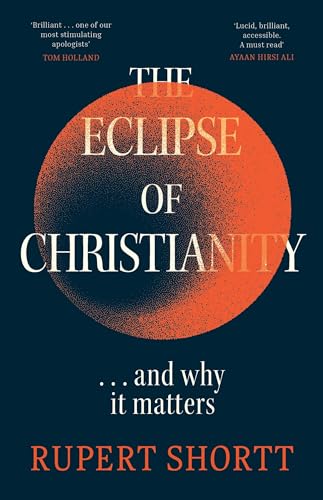
The Eclipse of Christianity: And Why It Matters
Written by Rupert Shortt Reviewed By Nathan WallaceThe Eclipse of Christianity: And Why It Matters by Roman Catholic journalist Rupert Shortt extends the growing bibliography of works on the social impact of Western secularization. Shortt’s book is not alarmist in tone but provides social criticism from a theologically liberal perspective on a wide range of issues for the West—especially Britain. In a high-brow journalistic style that knits together anecdotal evidence and interviews, deep reading in theology and philosophy, and important threads from his earlier works on Rowan Williams, Benedict XVI, the New Atheism, and Christian persecution, Shortt weaves considerable material into this book.
The Eclipse of Christianity contains three parts: “Faltering Faith,” “Earthen Vessels,” and “Cultural Fabric.” These provide an account of secularisation followed by ecclesiological and missional reflections before concluding with a forward-facing look at how the church can engage with topics such as AI and DEI. While arguing that “Europe’s historic faith deserves a more serious hearing than it usually receives from the mainstream” (p. 9), Shortt also makes liberalizing proposals to the church, including “[a] revisionist but theologically solid pro-gay case” (p. 187). Ultimately, Shortt’s liberal theological footing—confessing that the ethics of the world should shape church teaching—does not enable him to mount a robust Christian critique of “secularising impulses across contemporary British culture” (p. 8).
The opening chapter, “A Flight from Enchantment,” considers both reasons for and ways of understanding secularization. Two sociological factors that Shortt identifies as being behind the decline of British churches are welfarism and pluralism. He articulates how social structures relate to Christian faithfulness within society and how some social transformations have considerably eclipsed Christian witness in Britain. Shortt’s view of the subsequent challenges to social cohesion and personal freedom in the modern West is hued with Catholic Personalism. He calls for Christianity to have “some kind of anchor-like role” for society (p. 32). In important respects, it already does—tethering our national history, legal system, and so on—yet Shortt’s concern is sin and the conscience. Without Christian influence upon the individual conscience, “we lack something crucial” (p. 32). Shortt’s focus on sin is significant. He advances apologetics through cultural criticism in a theological register—his critique is not centered on “economic inactivity” or “democratic participation”—the stated concern is “sin” and its social consequences. This connects to his interest in ways of understanding secularisation. “Better forms of historiography,” Shortt writes, are developing an understanding of religion in Britain neither beholden to the secularisation thesis nor naïve about “ebbing numbers” (p. 23). These forms of historical writing, sensitive to both decline and renewal, must be informed by theological-hermeneutical concepts such as sin, judgement, and grace. However, this illustrates the tension in Shortt’s writing between the theological focus (sin) and the liberal philosophy of religion paradigm, implying Christianity is a mode of “enchantment.”
The tension remains when Shortt observes the Christian underpinnings of an egalitarianism that implicitly supplied John Rawls’s liberal political theory in chapter 2. He notes that “the Rawlsian paradigm is now unravelling” under “wokeism” (p. 41) and explores a parallel with the circumstances of the displacement of paganism by the cultural ascendency of the church in the fourth century. This is an oft-made but ill-judged comparison because—despite its success in institutional capture—it seems unlikely that poststructuralist critical theory will support a civilization for millennia. Yet Shortt confesses, “Christians (myself included) may say that they are liberal enough to welcome aspects of the new order, and to even accept its Christian roots” (p. 41). The welcome becomes warmer as the book progresses. Two chapters later, discussing the common good, Shortt acclaims Rowan Williams’s calls for procedural secularism and “interactive pluralism” (p. 108). He affirms Acton’s dictum, “every man shall be protected in doing his [religious] duty” (p. 108), but fails to see how this conflicts with his concerns that liberal relativism lacks “grounds … for opposing the suicide bomber who believes that by murdering others he is securing his place in paradise” (p. 106). How can the Actonian liberal rebut the suicide bomber who believes this act is his religious duty?
In part 2, Shortt addresses the Roman Catholic Church’s “pig-headed reluctance to accept LGBT equality” (p. 187). This frustration is the outworking of interactive pluralism, wherein “both Church and state can be influenced by a cross-fertilisation of debate” (p. 110). Shortt suggests, “Social consensus pushes the Church to rethinking aspects of its doctrine. This can be a blessing, a major example being the acceptance of same-sex relationships” (p. 110). Here, Shortt is not critiquing secularizing impulses, he is energising them. When he discusses transgenderism in part 3, he opts for a “middle course,” left of Francis’s encyclicals which condemned gender theory (p. 291). Instead, Shortt celebrates that transgender people embrace a binary identity and argues that their “inclusion in the life of the Church” facilitates their exploration of identity (p. 292).
Shortt’s three aims were to critique the “secularisation thesis” and “secularising impulses” yet also “map aspects” of “religious development” (p. 8). Overall, the book gives an accessible summary with some added texture to existing critiques of the secularisation thesis. Its challenges to secularizing impulses are lacking and the theological proposals are often counterproductive—interactive pluralism undermines the authority of the Bible and leaves the church swayed by the ethics of the surrounding culture. Readers should consult mapping of the religious landscape that tends to blend the terrain’s description with a theologically liberal prescription of what it should be.
While The Eclipse of Christianity tries to pull the church away from important ethical commitments, it also pulls the growing conversation about secularization into theological territory. This is timely, as AI-driven social disruption seems near. Chapter 9 considers AI, quoting laypeople who say, “we’re not psychologically equipped for it” and “unless we give people very deep support, they’re not going to make it” (p. 266). Interestingly, if the certainties and comforts of late twentieth-century social structures eclipsed faith, then who knows what might happen as they fall?
Nathan Wallace
The Christian Institute
Other Articles in this Issue
This essay is the second of a two-part analysis of John’s use of the articular substantival participle...
Empathy and Its Counterfeits: Navigating The Sin of Empathy and a Way Forward
by Jonathan D. WorthingtonIn our families, churches, or neighborhoods; in political discussions, situations of accused abuse, or racially charged conversations; in polarizing times, compassion must be wed with relational exegesis, the well-established name for which is empathy...
Philosophical Foundations of a Transgender Worldview: Nominalism, Utilitarianism, and Pragmatism
by Anthony V. CostelloEvery social and political phenomenon has some prior, underlying philosophical basis...
This article explores the relationship between Tolkien’s angelology, as reflected in his fictional writings, and classical angelology, particularly as represented by Augustine and Thomas Aquinas...
The Role of the Regula Fidei in the Twenty-First-Century Religious Landscape: How the “Rule of Faith” Can Help Address the Existential Issues of the Postmodern Christian Community
by Roland WeisbrotThis article offers a historical-systematic analysis of the role of the rule of faith in establishing and maintaining the Christian metanarrative and orthodox scriptural interpretation...
Other Reviews in this Issue