
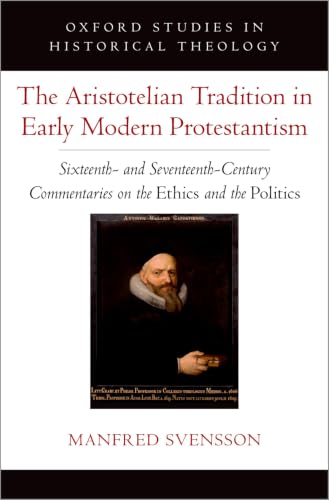
The Aristotelian Tradition in Early Modern Protestantism: Sixteenth- and Seventeenth-Century Commentaries on the
Written by Manfred Svensson Reviewed By Matthew MasonEarly modern Protestant reception of Aristotle’s Nicomachean Ethics and Politics might appear to be of marginal interest. It is still not unusual for historians and ethicists to view Protestantism as marking a decisive turn away from Aristotelian approaches to ethics. Indeed, according to some interpretations, an undue interest in Aristotle’s ethical and political writings runs a severe risk of undermining the gospel and damaging our souls. After all, in his Disputation Against Scholastic Theology (1517), Luther called Aristotle’s ethics ‘the worst enemy of grace’.
In this volume, Manfred Svensson, Professor of Philosophy at the Universidad de los Andes, Chile, demonstrates that this is a profound misunderstanding. Far from repudiating Aristotle and his ethics, early modern Protestants embraced him. Indeed, so ubiquitous was his influence that an exhaustive presentation of Protestant Aristotelianism would be impossible, because ‘Aristotle is everywhere’ (p. 10). Instead, Svensson focuses more narrowly on Protestant commentaries on the closely related Nicomachean Ethics and Politics, published between 1529 and 1670. The earlier date marked the first Protestant commentary on the Ethics by Philip Melanchthon. After the latter date, there was a hiatus until the end of the eighteenth century. But the intervening 140 years saw fifty-five Protestant commentaries on the Ethics and fifteen on the Politics, often in multiple editions. This is to say nothing of vast numbers of disputations on Aristotelian ethical themes and the presence of those themes across other Protestant ethical writings.
Svensson’s work represents an application of the historiography of Richard Muller to Reformation and Post-Reformation Protestant ethics. After an introduction, the first chapter locates the commentaries within the intellectual contexts of humanism and medieval traditions of commentary on Aristotle. Chapter 2 then introduces the most important institutional locations across Europe of Protestant Aristotelianism and the commentators themselves. Most of the Protestant commentators were philosophers, but some theologians also wrote commentaries, most notably the Lutheran Melanchthon (1497–1560) and, among the Reformed, Peter Martyr Vermigli (1499–1562) and Antonius Walaeus (1573–1639). The latter is of particular interest because, as a member of the theology faculty at Leiden, he was also one of the authors of the Synopsis of a Purer Theology (1625).
Chapters 3–6 then examine in some detail the substance of Protestant ethical Aristotelianism. Chapter 3 considers the relationship of Protestant Christianity and natural philosophy and notes how the law-gospel distinction enabled Protestant ethicists to treat moral philosophy as a relatively autonomous discipline, albeit one that was incomplete and ultimately crippled without Scripture and the gospel. Chapters 4 and 5 treat important themes from commentaries on the Ethics and the Politics, before chapter 6 analyses the question of the relationship between theoretical reason and practical reason. Each of these chapters provides insight into important questions of the interpretation of Aristotle’s moral philosophy and would be a useful orientation for those wanting to begin thinking about Aristotelian approaches to ethics and politics. Svensson offers carefully nuanced and historically aware readings, while never getting bogged down in details—the prose is admirably lucid. What becomes clear is that early Protestant interpretations of Aristotle were conducted in conversation with a wide range of scholarship and marked by an intellectual sophistication that parallels early Protestant work in dogmatics and the reading of Scripture.
Svensson demonstrates that Protestant commentators did not always feel obliged to evaluate Aristotle according to Scripture, although some did, notably Vermigli and Walaeus. Others compared him more closely to other ancient philosophers, for example, the Roman jurists on the question of justice and law, or Plato on the relationship of theoretical and practical knowledge. Others simply offered careful interpretations of the meaning of Aristotle’s writings considered in themselves.
Svensson establishes beyond doubt that, at least until 1670, Aristotelianism of one form or another was ubiquitous in Protestant ethical teaching. This does not mean that Protestant readings and appropriations of Aristotle’s ethical writings were uniform, nor that differences can be mapped along confessional lines, nor that approval of Aristotle’s ethics entailed a wholesale acceptance of his metaphysics. Moreover, the prevalence of Aristotle among early Protestants should not be taken to mean that early Protestants were all Thomists. In Svensson’s summary, ‘the study of Aristotle did not automatically turn everyone into a Thomist. Protestant Thomism was important; Protestant Aristotelianism was omnipresent’ (p. 9). Nevertheless, the early Luther aside, no Protestant regarded Aristotle’s Ethics as an enemy of grace. The myth of the Reformation as a repudiation of Aristotle’s moral philosophy is simply untenable; no serious interpreter of Reformation thought, or of the history of moral philosophy, has any excuse to treat it as anything more than an assertion based on ignorance of the primary sources.
Readers of this journal might naturally be led to ask whether early Protestant deployment of Aristotle’s moral philosophy should be reflected in contemporary ethical teaching. Each of us will have to draw our own conclusions. But a purely ‘biblical’ approach to ethics—even if such a thing be possible—was not the historic Protestant approach. This does not mean that contemporary Protestant ethicists are obliged to be Aristotelians. But it does mean that none of us should short-circuit careful reflection on the relationship of moral philosophy and moral theology and the relative contributions of philosophical, exegetical, and theological modes of reasoning to the task of evangelical ethics. And, as Svensson observes, those of us who are drawn to the contemporary revival of virtue ethics already have a rich and vibrant Protestant tradition on which we can draw.
Matthew Mason
Pastors’ Academy
Other Articles in this Issue
This essay is the second of a two-part analysis of John’s use of the articular substantival participle...
Empathy and Its Counterfeits: Navigating The Sin of Empathy and a Way Forward
by Jonathan D. WorthingtonIn our families, churches, or neighborhoods; in political discussions, situations of accused abuse, or racially charged conversations; in polarizing times, compassion must be wed with relational exegesis, the well-established name for which is empathy...
Philosophical Foundations of a Transgender Worldview: Nominalism, Utilitarianism, and Pragmatism
by Anthony V. CostelloEvery social and political phenomenon has some prior, underlying philosophical basis...
This article explores the relationship between Tolkien’s angelology, as reflected in his fictional writings, and classical angelology, particularly as represented by Augustine and Thomas Aquinas...
The Role of the Regula Fidei in the Twenty-First-Century Religious Landscape: How the “Rule of Faith” Can Help Address the Existential Issues of the Postmodern Christian Community
by Roland WeisbrotThis article offers a historical-systematic analysis of the role of the rule of faith in establishing and maintaining the Christian metanarrative and orthodox scriptural interpretation...
Other Reviews in this Issue