
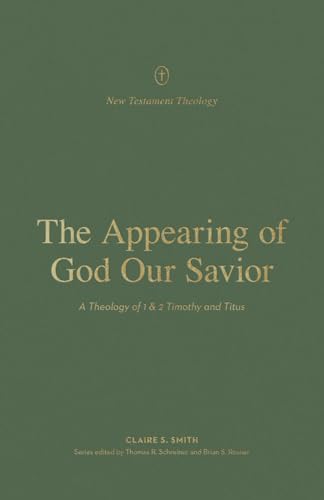
The Appearing of God Our Savior: A Theology of 1 and 2 Timothy and Titus
Written by Claire S. Smith Reviewed By David C. WrightAn hour up the expressway from where I live is an open plains zoo, where animals roam free. Visitors meander through the park on a bus, feeling completely safe from animals that could potentially eat them. They are afforded some wonderful closeups and at different points along the way the tour guide will stop the bus to highlight something important or special. Claire Smith’s new book, The Appearing of God Our Savior: A Theology of 1 and 2 Timothy and Titus, provides a similar experience of the letters to Timothy and Titus (LTT).
As Smith notes in her introduction, the LTT “divide readers perhaps more than any other books in the New Testament” (p. 1), and at the heart of these conflicts is the issue of authorship. She therefore advises all who study the LTT to have an interpreter’s understanding of authorship clearly in mind as they read that interpreter’s work. We can follow her advice, knowing that she regards the LTT as genuinely Pauline.
The book is not a commentary but aims to highlight the main theological themes of each letter. Smith chooses to treat each letter separately and allocates five chapters for 1 Timothy, four for 2 Timothy, and three for Titus, with each chapter focusing on an important theme. This approach is a strength of the book, allowing each letter to speak on its own terms. There are also paragraphs highlighting the similarities and distinctives between the letters as the book unfolds, but these only underscore the strength of Smith’s approach. As such, this book is an excellent complement to previous thematic approaches to the LTT, avoiding some of the unfortunate difficulties of conflating these letters together without any nuance.
Smith argues that the focus of each letter is not church leadership but the triune God (chs. 1, 6, 10). God initiates and superintends his plan of salvation focussed on Jesus, and this salvation is applied by the Holy Spirit (chs. 2, 7, 11). This salvation is now available to all people who live between the first and second comings of Christ as it is revealed in God’s gospel, the word of truth (chs. 3, 8). Salvation in Christ is profoundly transformative, as God’s saved people live out their new identity as chosen, redeemed, and heirs of eternal life. In other words, theology drives ethical living, including the functioning of the church of God (chs. 4, 5, 9, 12). As Smith explains each letter, she moves from God to salvation to revelation to ecclesiology and ethics. As such, there is an unmistakeable logic to the ordering of the material. It also demonstrates how the various theological themes are interwoven with each other.
In keeping with her previous work, Smith shows she is particularly attuned to specific words, titles, and phrases (e.g., ch. 3 and the various terms associated with the word of God). Her skill in assessing their contribution to Paul’s argument provides depth and nuance in understanding the flavor of each letter. The net result is a clear sense of the big ideas in view.
One “big picture” highlight of the tour is the analysis of “Suffering and the Gospel” (ch. 9). Smith draws out the shape of suffering, reasons for it, how it is modelled, and for what purpose. In doing so, she not only shows the unique contribution of the theme to 2 Timothy but also demonstrates the intimate connection between gospel ministry and suffering.
Even though the book focusses on the dominant themes, there are still occasional stops along the way to examine details that might sometimes be missed. For example, there is a very good discussion on sin in 1 Timothy (pp. 25–27) and the God-man who gives himself to ransom sinners (pp. 30–32). Similarly, the person (pp. 114–15) and work of Christ (pp. 122–23) in Titus also receive attention.
Claire Smith writes clearly and concisely, making the argument understandable and straightforward. Crossway should also be congratulated on the formatting and layout that enhances the reading experience.
I have two quibbles with the book. My reaction when I first picked up my copy was, “It’s a bit thin.” Even though Smith’s writing means she packs a lot of good content into a short space, I was still left wanting more.
The “Recommended Resources” list at the end of the book is commendable. However, for a student new to studying the LTT or a pastor returning after a number of years away in other parts of the Bible, some guidance would be helpful. Given the proliferation of commentaries and studies on the LTT in recent years, it can be difficult to know where to start. Perhaps some relevant suggestions could be placed at the end of each chapter.
Nonetheless, a book can only be measured against its stated aim. At that level, if you are preparing some form of Bible teaching from one of the LTT, Claire Smith’s book will prove to be a very good tour guide for your journey.
David C. Wright
Bible College SA, Malvern, South Australia, Australia
Other Articles in this Issue
This essay is the second of a two-part analysis of John’s use of the articular substantival participle...
Empathy and Its Counterfeits: Navigating The Sin of Empathy and a Way Forward
by Jonathan D. WorthingtonIn our families, churches, or neighborhoods; in political discussions, situations of accused abuse, or racially charged conversations; in polarizing times, compassion must be wed with relational exegesis, the well-established name for which is empathy...
Philosophical Foundations of a Transgender Worldview: Nominalism, Utilitarianism, and Pragmatism
by Anthony V. CostelloEvery social and political phenomenon has some prior, underlying philosophical basis...
This article explores the relationship between Tolkien’s angelology, as reflected in his fictional writings, and classical angelology, particularly as represented by Augustine and Thomas Aquinas...
The Role of the Regula Fidei in the Twenty-First-Century Religious Landscape: How the “Rule of Faith” Can Help Address the Existential Issues of the Postmodern Christian Community
by Roland WeisbrotThis article offers a historical-systematic analysis of the role of the rule of faith in establishing and maintaining the Christian metanarrative and orthodox scriptural interpretation...
Other Reviews in this Issue