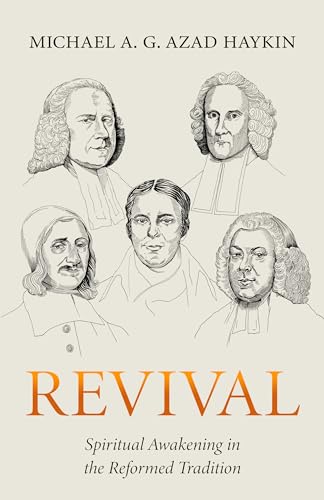

Revival: Spiritual Awakening in the Reformed Tradition
Written by Michael A. G. Azad Haykin Reviewed By Ryan RindelsFew scholars, if any, have focused as much attention on the evangelical revivals of the “long eighteenth century” as Michael Haykin. Aware that drawing lessons from spiritual renewal is irregular in academia, Haykin nevertheless sees this task as a calling. In Revival: Spiritual Awakening in the Reformed Tradition, the author affirms the late Martin Lloyd-Jones’s thesis that the history of the church “is a history of ups and downs” (p. xi) and gives his own slightly altered proposal: the history of the church is a history of revival and times of declension (p. 147). Accepting this paradigm behooves a reader to explore the Awakenings in the Anglo-American context from the 1730s to approximately 1830. Haykin hopes that the principles his book provides will “stimulate ardent prayer for God to revive his church in the midst of these trying times” (p. xiii).
Revival is divided into nine brisk chapters with a three-page conclusion listing eight theses on revival. It also contains two appendices: a 1754 letter by the Anglican William Grimshaw and a circular letter by the British Baptist John Stutterd (1750–1818). Haykin also provides a list of ten reflection questions of a practical nature, which hint at the book’s devotional scope.
Chapter 1, “When the Spirit Shall Be Poured Forth Plentifully,” considers instances of proto-revival among English Puritans in the seventeenth century. Haykin includes the conversion of the Anglican John Rogers (1570–1636), the Kirk O Shotts revival in Scotland in 1630, and the well-known reformation of Kidderminster under the ministry of Richard Baxter. Additionally, he includes several vignettes from Baptist figures during the period, namely Joseph Collett (1684–1741) and Abraham Cheare (1626–1668). These comparatively smaller revivals reveal that the eighteenth-century awakenings did have promising antecedents.
In chapter 2, “God Is Doing Marvellous Things,” Haykin provides the social and spiritual context among the churches in England during the first quarter of the eighteenth century. Citing several scholarly works showing high rates of alcoholism, poverty, sexual promiscuity, and low church attendance, Haykin positions the reader for the startling volte face that began with the first Methodists, two of whom were the Welsh Anglicans Howell Harris and Daniel Rowland. Both men experienced startling evangelical conversions in 1735. The vigor and danger of early Methodist preaching is legendary, and Haykin considers whether Howell Harris’s head injury, incurred after a mob attacked him while preaching in Bala, North Wales, contributed to the erratic and even scandalous behavior that discredited his subsequent ministry (pp. 27–28). As students of this period are aware, such violence against preachers was not uncommon, a fact that should temper any romantic notions we may have about the eighteenth century.
In chapter 3, “Come to This Life-Giving Stream,” Haykin considers the renowned evangelist George Whitefield, whose name is synonymous with revival. Whitefield was the most controversial evangelist during his lifetime and remains a subject of controversy. Haykin notes Whitefield’s introduction of slavery into Georgia and the Wesley brothers’ opposition to it, and he considers whether Whitefield would have “come to see the error of his thinking about slavery,” as the subsequent generation of Methodists in England did (p. 51). Whitefield’s popularity with African slaves and the warm elegy Phillis Wheatley (1753–84) published in memory of the evangelist militates against the patent dismissal of the evangelist (p. 49).
In chapter 4, “He Carries Fire Wherever He Goes,” Haykin recounts the life and ministry of William Grimshaw, whose conversion famously featured an “uncommon heat” emanating from a copy of the Puritan John Owen’s The Doctrine of Justification by Faith (p. 60). Grimshaw is perhaps the least known of the Anglican evangelicals, yet his inclusion in Revival is warranted. Historian Frank Baker claimed he had a “more potent influence than any other leader of his time” (p. 62).
A full thirty pages are devoted to Jonathan Edwards. Chapter 5, “The Theologian of Revival,” gives a succinct biography of Edwards, his role in the Northampton Awakening, and the interplay between westward expansion, education, and missions. Chapter 6 considers Edwards’s outstanding paradigmatic work, Religious Affections (1746), and its “twelve marks of genuine revival.” Haykin’s focus on Edwards is significant as the contemporary renaissance of Edwardsean scholarship has passed its zenith.
In chapters 7–9, Haykin shifts from Anglicans and Congregationalists to British Baptists. Like the Church of England, though for different reasons, Particular Baptists at that time experienced stagnation, largely due to their theological captivity to High Calvinism. As with Revival’s first chapter, Haykin looks to countervailing examples of spiritual vitality, including Benjamin Francis and the poet Anne Steele in chapter 7, “We Are a Garden Wall’d Around.” Andrew Fuller and his influential ministry are the focus of chapter 8, “Impress Thy Truth upon My Heart with Thine Own Seal,” particularly his book, The Gospel Worthy of All Acceptation (1785), and a circular letter exhorting Baptist congregations to seek revival. The culmination of spiritual renewal—chapter 9, “The Lord Is Doing Great Things, and Answering Prayers Everywhere”—comes with the “concert of prayer,” a monthly prayer meeting inspired by Jonathan Edwards’s A Humble Attempt at Extraordinary Prayer (1748) and promoted by John Sutcliff. Haykin notes that the Baptist Missionary Society was established in the prayer call’s wake in 1796. In terms of empirical measurement, the number of Particular Baptist churches doubled in less than fifty years (p. 142), a dramatic improvement that the participants, no less than William Carey himself, attributed to their decision to pray monthly.
In an age of diminished reading, in quantity and quality, Revival has sufficient brevity so as not to discourage the potential reader otherwise intimated by lengthy critical works such as George Marsden’s Jonathan Edwards or Henry Rack’s Reasonable Enthusiast. The book may well whet one’s appetite for deeper reading on the period. It is difficult to imagine writing, much less inspiring a reader, without believing in and longing for revival. The crisp, succinct book provides light as well as heat, as its author has written as a lover, not a bystander.
Ryan Rindels
Ryan Rindels
Golden Gate Baptist Theological Seminary
Mill Valley, California
Other Articles in this Issue
This essay is the second of a two-part analysis of John’s use of the articular substantival participle...
Empathy and Its Counterfeits: Navigating The Sin of Empathy and a Way Forward
by Jonathan D. WorthingtonIn our families, churches, or neighborhoods; in political discussions, situations of accused abuse, or racially charged conversations; in polarizing times, compassion must be wed with relational exegesis, the well-established name for which is empathy...
Philosophical Foundations of a Transgender Worldview: Nominalism, Utilitarianism, and Pragmatism
by Anthony V. CostelloEvery social and political phenomenon has some prior, underlying philosophical basis...
This article explores the relationship between Tolkien’s angelology, as reflected in his fictional writings, and classical angelology, particularly as represented by Augustine and Thomas Aquinas...
The Role of the Regula Fidei in the Twenty-First-Century Religious Landscape: How the “Rule of Faith” Can Help Address the Existential Issues of the Postmodern Christian Community
by Roland WeisbrotThis article offers a historical-systematic analysis of the role of the rule of faith in establishing and maintaining the Christian metanarrative and orthodox scriptural interpretation...
Other Reviews in this Issue