
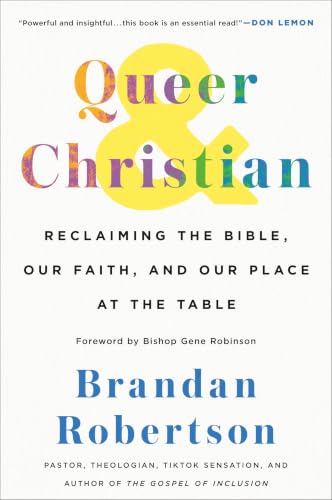
Queer and Christian: Reclaiming the Bible, Our Faith, and Our Place at The Table
Written by Brandan Robertson Reviewed By Andrew SlayIn Queer and Christian: Reclaiming the Bible, Our Faith, and Our Place at the Table, Brandan Robertson aims to provide an accessible guide for those who identify as queer to understand what the Bible truly says about queer sexuality and gender. He also offers a path toward reclaiming the Bible as a source of empowerment and inspiration for queer people. In essence, Robertson argues that God is queer and that queer inclusion is woven throughout the Bible. Therefore, he seeks to help “queer Christians” reclaim the Bible as a tool for love instead of fear, promoting full inclusion for LGBTQ individuals in the church.
Robertson makes his argument for queer inclusion in three ways: (1) from personal experience; (2) by denying that queerness is condemned in Scripture; and (3) by pointing to affirmations of queerness in Scripture.
Robertson begins by sharing his experience of finding Jesus as a teenager and wrestling with his queer “identity.” He became a Christian in a fundamentalist Baptist church and, initially, viewed the Bible as God’s inerrant word and believed that a queer lifestyle was wrong. However, when he continued to have strong desires for romantic relationships with other men, even after years of conversion therapy and pleading with God to change his desires, Robertson started to question what the Bible taught about sexual ethics in general and homosexuality in particular.
If his desires were sinful, Robertson wondered why God would allow him to continue struggling with unchosen and unwanted feelings. This led him to explore interpretations of Scripture from scholars and pastors who “loved Jesus and were deeply committed to the Bible while also concluding that being gay was not a sin” (p. 27). It was this discovery of LGBTQ-affirming interpretations that enabled him to “stumble out of the closet” and fully embrace his queer identity (p. 32).
Despite this apparent affirmation of scriptural authority, Robertson insists that the Bible is not God’s inerrant and authoritative word; rather, it is a book of wisdom written by fallible men. Not surprisingly, it is self-contradictory. Consequently, the Bible does not “have a clear position on anything [including sexual ethics] because it does not speak with one voice” (p. 47). Therefore, while Robertson refers to the Bible as “inspired by God,” all he means is that the writers of Scripture were motivated by their relationship with God, just as we can be inspired to exercise by the encouragement of a friend. In fact, Robertson goes so far as to say that the Bible contains many inaccurate stories and even things we should “rightfully condemn as unethical and wrong.” Its authority, then, is not found within it, but “within the communities that hold it as sacred and interpret it” (p. 47).
This view of biblical authority allows Robertson flexibility and freedom for fresh interpretations of the biblical text, based on the (supposed) historical and cultural contexts in which Scripture was written, and that he believes go back to the early church. Robertson walks through the typical passages that speak against homosexuality, which he refers to as “clobber passages,” and presents three main arguments against their contemporary relevance. First, the prohibitions against homosexuality in the Old Testament are explicitly tied to pagan worship and were given to Jewish people living under the Old Covenant, not to Christians living under the New Covenant (pp. 58, 66, 71–76). Second, any condemnation of homosexuality in the New Testament refers to idolatry, pederasty, prostitution, or sexual abuse, not to consensual and loving same-sex relationships (pp. 101–13). Third, the biblical authors had no concept of same-sex orientation and queerness as an identity. Therefore, any condemnation of homosexuality was directed against the practice (but only in cases related to idolatry, abuse, or prostitution), not against true homosexuality or a person’s gay identity (pp. 53–55). To this, Robertson adds that through its teaching on the inclusion of the Gentiles (e.g., Acts 10–11), the Bible anticipates the full inclusion of all types of people, including queer people.
Contending that neither the Bible nor Jesus ever “spoke a single word in condemnation of queer people” (p. 91), Robertson concludes his argument by highlighting many positive affirmations of queer saints throughout biblical history. He suggests that Ruth and Naomi, David and Jonathan, Joseph, Jesus and Lazarus, and the Ethiopian Eunuch were all queer and engaged in queer relationships. He bases this upon the love expressed between these characters, assuming it was romantic and erotic love. He also classifies these saints as queer by claiming that the term can describe anyone who “defied sexual and gender assumptions in their culture and era,” or anyone who was simply different or misunderstood. Since Jesus defied cultural and religious expectations for women, refused to marry, and loved many men, he too was queer (pp. 159–61).
Robertson’s case is passionately argued and stems from his experience as a person who identifies as queer and has faced significant abuse and rejection for embracing this identity. As such, his book serves as a warning to the church to do better in addressing vulnerable youth who are grappling with same-sex sexual desires. Perhaps if Robertson had received better guidance on the process of sanctification and the lifelong struggle faced by every Christian with sinful desires of various kinds (including same-sex sexual desires), he might have come to very different conclusions.
Nevertheless, as it stands, Robertson’s argument contains three fundamental flaws. First, as numerous affirming scholars concede (e.g., William Loader and Luke Timothy Johnson), his assertion that the prohibitions against homosexual practice pertain only to pagan worship or sexual abuse is untenable. Scripture is clear: same-sex sexual acts not only contradict God’s will but are contrary to created nature (Lev 18:22, 20:13; Rom 1:26–27). Therefore, while it is true that God issued these commands so that his people might stand apart from those who worship other gods, their purpose is so that we might imitate his holiness and maintain a sexual ethic that aligns with creation order. That means confining sexual expression to the one-flesh covenant union between a husband and wife. All sexual activity outside of this context stands condemned and is a potential ground for exclusion from the kingdom of God (1 Cor 6:9–10).
Second, as already noted, Robertson advocates contradictory views of the Bible’s authority. Many times, he claims that Scripture has no authority over our lives and that we can eat the meat and spit out the bones of whatever we like or dislike. But this begs the question: if the Bible is not verbally inspired, then why is his interpretation of it any more authoritative than any other? Yet, when making his case for God’s acceptance of queer people, he not only claims biblical authority but, on that basis, concludes that “we don’t need to defend our right to be a follower of Jesus or to be a part of the church-God has welcomed us in, and that’s the final word” (p. 227). This, however, not only ignores the role of repentance in entering God’s kingdom but as argued in the previous paragraph, badly misunderstands both the nature of and reasons for the Bible’s prohibitions against homosexual practice.
Third, while Robertson makes room for LGBTQ people at the table, it is not the table of historic Christianity. Despite repeatedly claiming that the early church had no consensus on sexual ethics and that it was never an essential part of the Christian faith (p. 35), he provides little evidence to support this contention. To the contrary, and on the basis of Genesis 1 and 2 (cf. Matt 19:4–5), the historic church has been in agreement that God created humanity male and female, and that marriage is only between one man and one woman. Indeed, this remains the predominant view today. So, while Robertson is right that queer people who believe their way of life is holy and honoring to God have “created a table of their own” (p. 243), the problem is that this table is not in the biblical and historic Christian church but in the church of “queer Christianity,” a church which stands opposed the good word of the Triune God in Scripture.
Andrew Slay
New Orleans Baptist Theological Seminary
New Orleans, Louisiana, USA
Other Articles in this Issue
This essay is the second of a two-part analysis of John’s use of the articular substantival participle...
Empathy and Its Counterfeits: Navigating The Sin of Empathy and a Way Forward
by Jonathan D. WorthingtonIn our families, churches, or neighborhoods; in political discussions, situations of accused abuse, or racially charged conversations; in polarizing times, compassion must be wed with relational exegesis, the well-established name for which is empathy...
Philosophical Foundations of a Transgender Worldview: Nominalism, Utilitarianism, and Pragmatism
by Anthony V. CostelloEvery social and political phenomenon has some prior, underlying philosophical basis...
This article explores the relationship between Tolkien’s angelology, as reflected in his fictional writings, and classical angelology, particularly as represented by Augustine and Thomas Aquinas...
The Role of the Regula Fidei in the Twenty-First-Century Religious Landscape: How the “Rule of Faith” Can Help Address the Existential Issues of the Postmodern Christian Community
by Roland WeisbrotThis article offers a historical-systematic analysis of the role of the rule of faith in establishing and maintaining the Christian metanarrative and orthodox scriptural interpretation...
Other Reviews in this Issue