
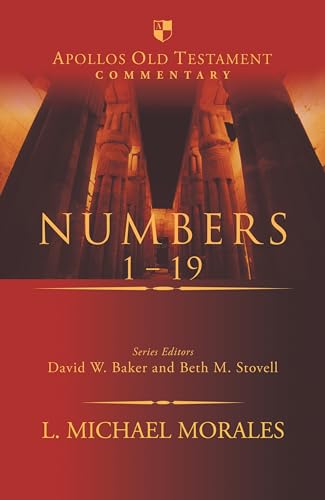
Martin Noth is well known for concluding that the book of Numbers displays “confusion and lack of order” (Numbers: A Commentary [London: SCM, 1968], 4). That sentiment, frequently reiterated since, is persuasively challenged by L. Michael Morales in this latest addition to the Apollos Old Testament Commentary series. Morales, longstanding professor of biblical studies at Greenville Presbyterian Theological Seminary, spent the best part of a decade producing this volume. The fruits of that long labor are everywhere present. Where others find disorder, Morales carefully extricates plan and purpose. This, in turn, proffers exciting new possibilities for discerning theological and rhetorical significance. Indeed, as one works through the commentary, it becomes increasingly clear why the New Testament writers so often evoke the themes and ideas of Numbers. Hence, the volume admirably achieves the series’ twin aims of producing “tools of excellence for the academy” and “tools of function for the pulpit” (p. xi).
A substantial introduction orients readers to the book of Numbers (pp. 1–74). While typical matters like authorship and structure are addressed (pp. 61–73), these are preceded by a penetrating theological and literary evaluation of the book. Fundamentally, Morales claims that Numbers is about the covenant community, brought into relationship and life with YHWH, and arranged as a camp (p. 12). Within the Sinai material, therefore, Numbers 1–10 functions as the telos to a wider literary movement. That progression, outlined on pp. 14–17, charts how YHWH enters a covenant relationship with Israel (Exod 19–24), descends to dwell within the tabernacle (Exod 25–40), and makes that dwelling place a functional tent of meeting (Leviticus). Israel’s encampment in Numbers, therefore, constitutes “the flowering of YHWH’s engagement with Israel at Sinai” as the tribes gather around the divine presence for the first time (pp. 13, 18). The camp thus functions as an organizing principle for Numbers and becomes the paradigm for the ideal covenant community (pp. 19–21). With all its cosmological symbolism, it also becomes the earthly correlate to YHWH’s heavenly host (pp. 22–27) and a means of conveyance for YHWH’s glory (pp. 27–34). In turn, the structural and purity boundaries of the camp set theological lines that explain the arrangement of subsequent material: the nature of testing during the wilderness sojourn (Num 11–25) and anticipation of the nation’s life in the land (Num 26–36; p. 42). Therefore, while users of commentaries sometimes gravitate towards consulting only a select portion of the work, Morales’s introduction provides an essential theological prolegomenon that makes sense of later interpretative decisions.
The commentary proper follows the layout of the Apollos series. Morales provides his own translation (with notes) for each textual unit. Although readers may find this to be a little clunky at times, it does give non-specialists a good sense of the contours, emphases, and repetitions of the underlying Hebrew. Translation forms the basis for discussion of the passage’s form and structure as well as detailed comment on its content. A final Explanation section acts as a summary and considers the purpose of the unit within the flow of the book. The volume is supplemented throughout with helpful diagrams, and several excurses explore important tangential issues (e.g., how to interpret the census figures, pp. 100–108).
Throughout, Numbers 1–19 evinces the careful scholarship and theological acumen that have become a hallmark of Morales’s work on the Pentateuch. Astute observations abound. So, too, do intriguing possibilities, including the combined function of the “strayed woman” (Num 5) and Nazarite (Num 6) pericopes to portray alternate pathways for the YHWH-Israel relationship (p. 149), and the literary placement of Numbers 19 to mark the cleansing of the second generation from the corpse-impurity of the first that died in the wilderness (p. 499). As one might expect in a commentary of this size, Morales interacts with a wide range of contemporary secondary literature. Crucially, however, he also listens to a plethora of older voices. This not only grants readers insight into rabbinic and medieval Jewish exegesis of Numbers but demonstrably adds depth and nuance to Morales’s own interpretation. The result is a culturally rich exegesis of Numbers that manages to avoid some of the excesses and oversights of modern approaches and Western predilections. This extends to Morales’s willingness to read Numbers as a constituent component of a final-form Torah. Tacit acknowledgement of this literary complex enables a more contextually aware reading of details within Numbers, including the evident intertextuality that shapes meaning at crucial junctures (e.g., parallels between Num 16–18 and the story of Cain [Gen 4], pp. 432–33).
In this, the first of a two-volume set, Morales has produced an exceptional resource for studying the book of Numbers. Readers can be confident of being expertly led through a fascinating landscape by a commentary that deserves to appear on the shelves of preachers and academics alike.
G. Geoffrey Harper
Sydney Missionary & Bible College
Croydon, New South Wales, Australia
Other Articles in this Issue
This essay is the second of a two-part analysis of John’s use of the articular substantival participle...
Empathy and Its Counterfeits: Navigating The Sin of Empathy and a Way Forward
by Jonathan D. WorthingtonIn our families, churches, or neighborhoods; in political discussions, situations of accused abuse, or racially charged conversations; in polarizing times, compassion must be wed with relational exegesis, the well-established name for which is empathy...
Philosophical Foundations of a Transgender Worldview: Nominalism, Utilitarianism, and Pragmatism
by Anthony V. CostelloEvery social and political phenomenon has some prior, underlying philosophical basis...
This article explores the relationship between Tolkien’s angelology, as reflected in his fictional writings, and classical angelology, particularly as represented by Augustine and Thomas Aquinas...
The Role of the Regula Fidei in the Twenty-First-Century Religious Landscape: How the “Rule of Faith” Can Help Address the Existential Issues of the Postmodern Christian Community
by Roland WeisbrotThis article offers a historical-systematic analysis of the role of the rule of faith in establishing and maintaining the Christian metanarrative and orthodox scriptural interpretation...
Other Reviews in this Issue