
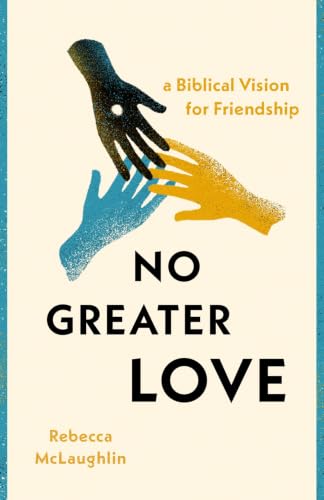
No Greater Love: A Biblical Vision of Friendship
Written by Rebecca McLaughlin Reviewed By Robert S. SmithWhile not her most recent book, and oddly one that seems to have flown under the radar, Rebecca McLaughlin’s No Greater Love: A Biblical Vision of Friendship is much needed today. It is both important enough and accessible enough that it belongs in that class of books that should be read by as many Christians as possible. This is not because the biblical theme of friendship has been entirely neglected—see, e.g., Drew Hunter, Made for Friendship: The Relationship That Halves Our Sorrows and Doubles Our Joys (Wheaton: Crossway, 2018) and Michael A. G. Haykin, Iron Sharpens Iron: Friendship and the Grace of God (Bridgend, UK: Union, 2022). But there is a need for both further work and fresh work, which No Greater Love helps to meet.
As McLaughlin points out in the introduction, many studies of friendship begin by drawing on C. S. Lewis’s chapter on philia in The Four Loves (1960). Yet while Lewis’s analysis is thoroughly Christian, its mode is more philosophical and experiential than biblical or theological. Furthermore, those treatments that do engage with Scripture more overtly, often focus on Old Testament examples of friendship (notably, David and Jonathan) to see what can be learned from them. Without discounting the value of these approaches, McLaughlin’s method is stronger still: “to anchor our understanding of friendship on Jesus Himself, and the examples of deep Christian friendship we find in the New Testament” (p. 13).
Accordingly, the starting point in chapter 1 is Jesus’s (new) commandment to “love another as I have loved you,” which in John 15 is immediately followed by the statement, “Greater love has no one than this, that someone lay down his life for his friends” (John 15:12–13). The fact that Jesus then says to his disciples, “You are my friends” (v. 14), completes the picture. Out of love for his “friends,” Jesus will lay down his life for them, and because “their love for one another [is] to be just like His love for them” (p. 22, emphasis original), his disciples ought to be true friends to each other, willing to die for one another.
The other paradigmatic element of Jesus’s friendship love that chapter 1 highlights is the fact that its ultimate display is in a context of weakness (the disciples in Gethsemane), betrayal (Judas in Gethsemane), and denial (Peter in Caiaphas’s courtyard). Thus, the love Jesus commands is
a love that is prepared to die for one’s friends, despite their failure. It’s a love that lives vulnerably even toward those false friends who may be finally exposed as only wanting to be with us for what they can get. It’s a love that does not easily give up on friends who let us down, because the greatest friend of sinners has not given up on us. (p. 29)
Chapter 2 (“Nontraditional Family”) looks at “church as family” and argues that “healthy Christian friendship grows on the trellis of Christian family love” (p. 32). Behind this lies the fact that “the church is not just like a family. It is a family. Our first identity as followers of Jesus is not biological. It’s theological” (p. 35, emphasis original). This has implications for Christian hospitality, how families relate to those who are unmarried, and even where (and with whom) we sit in church!
Chapter 3 (“My Very Heart”) demonstrates that there is “ample precedent for full-blooded, nonromantic, deeply rooted friendship love in the New Testament.” In this context, McLaughlin also makes a compelling biblical case for reclaiming both “the language and the physical expression of deep friendship love” (p. 48). Chapter 4 (“Comrades in Arms”) then investigates why “mission is the throbbing heart of Christian friendship, and how we get close to one another not by running after friendship but by marching into battle together” (p. 60).
In chapter 5 (“The Inner Ring”), McLaughlin proposes that the antidote to exclusion is to stop asking “Who will love me?” and instead to turn “toward those who are left out” (p. 76). Chapter 6 (“Bodybuilding”) examines how the biblical metaphor of the church as Christ’s body impacts Christian friendship, helping us to “recognize our need for one another, what our role in one another’s lives should be, and how we should respond when we are envious of someone else’s gifts” (p. 90).
Chapter 7 (“Your Unexplored Self”) turns to “the inbuilt differences between” friendship and marriage, arguing that these “are vital for both relationships” (p. 104). It also contains a particularly valuable section on codependency, noting the way in which friendship “can lean toward idolatry when we seek one friend to meet all our emotional needs” (p. 111). This highlights that while marriage is “locked in and exclusive,” friendship isn’t (p. 112). Nevertheless, if the two are allowed to complement rather than compete with each other, “our closest friendships can be just as close as spousal relationships.” Indeed, “healthy friendships can save marriages” (p. 113).
Chapter 8 (“Brothers and Sisters”) explores the possibilities of “meaningful male-and-female friendship” and the parallel set of opportunities and challenges faced by “Christians who experience same-sex attraction” (p. 118). Here Paul’s exhortation in 1 Timothy 5:1–2 is vital. For while the fictive familial relationships he encourages are “not sexual,” they are “deeply loving” (p. 119). This, of course, is no guarantee of immunity from temptation. But “while we must flee from sexual immorality, we must be careful not to run away from gospel-centered friendship based on fear” (p. 124). McLaughlin is surely right: “the antidote to sexual sin is not relational starvation. It is love” (p. 127).
Chapter 9 (“Loving Neighbors”) develops the theme of friendship between Christians and non-Christians and “the importance of extending hospitality to those with whom we disagree” (p. 132). McLaughlin’s rationale is clear: if we truly believe that salvation is found in Christ alone, “we cannot say we love our friends and not want them to come to Him” (p. 135). The final chapter (“Life Together”) addresses the reality of sin in our friendships and “how we might live together in a world of shattered dreams.” Consequently, it deals with “what role forgiveness plays in Christian friendship, whether it is ever right to end a friendship, and how we can move forward when we’ve lost trust in each other or—perhaps yet more distressingly—in ourselves” (p. 148).
No Greater Love is marked throughout by a refreshing and disarming honesty, with McLaughlin sharing openly about her own sins, weaknesses, and sometimes profoundly painful friendship failures. Each chapter also includes helpful personal anecdotes and practical real-life applications. Moreover, aware of the dangers lurking on either side of the truth, her discussions are always appropriately nuanced, while never shying away from speaking plainly and biblically about difficult matters such as betrayal, abuse, and church disciple. Nevertheless, for all the mess we can make of our friendships, her central conviction remains undisturbed: when patterned after Jesus’s example, “all the different kinds of human love are precious pointers to the love God has for us—refracting its blinding light in different ways” (p. 164).
For all these reasons, No Greater Love is a book for every believer. But it will have a particular salience for anyone who has ever asked, “Would we be better off withdrawing from the field of friendship, bandaging our wounds, and saying to ourselves, ‘I’ve learned my lesson and I’ll never risk my heart with friends again?’” (pp. 10–11). To this question, McLaughlin’s answer is a resounding “No!” In fact, she believes that, as followers of Jesus, we are called to step back into the arena and, guided by Scripture, to continue learning “to better navigate the contours of this glorious and hazardous gift called friendship” (p. 11).
I am personally grateful for this book and believe it will prove to be a precious gift to Christ’s church. Take and read!
Robert S. Smith
Rob Smith is lecturer in theology, ethics & music ministry at Sydney Missionary Bible College in Sydney, Australia, and serves as Ethics and Pastoralia book reviews editor for Themelios.
Other Articles in this Issue
This essay is the second of a two-part analysis of John’s use of the articular substantival participle...
Empathy and Its Counterfeits: Navigating The Sin of Empathy and a Way Forward
by Jonathan D. WorthingtonIn our families, churches, or neighborhoods; in political discussions, situations of accused abuse, or racially charged conversations; in polarizing times, compassion must be wed with relational exegesis, the well-established name for which is empathy...
Philosophical Foundations of a Transgender Worldview: Nominalism, Utilitarianism, and Pragmatism
by Anthony V. CostelloEvery social and political phenomenon has some prior, underlying philosophical basis...
This article explores the relationship between Tolkien’s angelology, as reflected in his fictional writings, and classical angelology, particularly as represented by Augustine and Thomas Aquinas...
The Role of the Regula Fidei in the Twenty-First-Century Religious Landscape: How the “Rule of Faith” Can Help Address the Existential Issues of the Postmodern Christian Community
by Roland WeisbrotThis article offers a historical-systematic analysis of the role of the rule of faith in establishing and maintaining the Christian metanarrative and orthodox scriptural interpretation...
Other Reviews in this Issue