
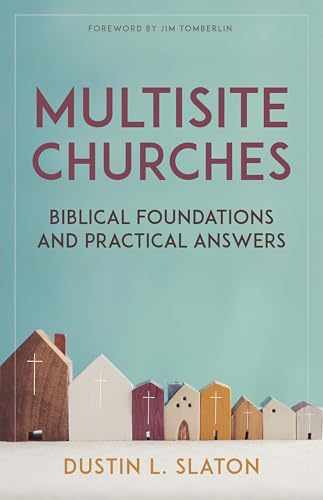
Multisite Churches: Biblical Foundations and Practical Answers
Written by Dustin Slaton Reviewed By Ian J. MaddockFew aspects of contemporary evangelical ecclesiology have generated as much polarized reaction in recent times as the multisite model of church, a phenomenon that emerged in the 1990s and has experienced significant growth throughout the past three decades. Proponents of this model (or perhaps, better, models—given the diversity of practice expressed under the banner of multisite) often highlight its perceived success as a missional strategy. Critics typically point to the paucity of exegetical and theological arguments for it; indeed, the notion of a multisite church (singular) is typically considered by those opposed to the multisite strategy to be an ecclesiological misnomer.
Addressing this lacuna, and in the process aiming to “provide a simple theological foundation that gives credibility to multisite churches as a legitimate, biblical church model, not simply another fad of a consumeristic church” (p. 33), stands as the worthy motivation behind Dustin Slaton’s Multisite Churches: Biblical Foundations and Practical Answers. No armchair advocate, Slaton’s interest in this model came through direct exposure while serving as a campus pastor at a multisite church in Texas. Nor does he present himself as an uncritical proponent: from experience, he describes having observed numerous “positive and negative aspects of multisite ministry” (p. 23), not to mention definitions of multisite church that fail to conform to congregational principles.
Despite his immersion in the world of multisite churches, and having been challenged by the critiques offered by, most notably, Jonathan Leeman in One Assembly: Rethinking the Multisite and Multiservice Church Models (Wheaton, IL: Crossway, 2020), Slaton’s search for sources that attempt to biblically substantiate this model of church governance uncovered what he styles a “disheartening” absence of “in-depth theological consideration” (p. 24). While acknowledging his indebtedness to the efforts of Greg Allison and John Hammett to provide a principled theological rationale for multisite churches—both notable exceptions to the pragmatic rule—Slaton nonetheless asserts that even these “have not yet provided a holistic defense of the multisite model, nor have they provided a fully formed ecclesiology for multisite churches” (p. 32).
In part 1, after surveying the (limited and largely pragmatically oriented) existing scholarship on multisite churches, Slaton’s effort to fill this gap begins by observing echoes of multisite church practice throughout history, especially aspects of Wesley’s Methodist Societies in the eighteenth century and the Sunday School movement that began in the nineteenth century. He nonetheless affirms the undeniable: that “the modern multisite movement in the United States is very young” (p. 65). This relative lack of historical precedent notwithstanding, Slaton proceeds to affirm the multisite model on the basis of a number of recommending qualities: it “fulfills a great commission purpose”; it “is a biblical model” (in particular, conjecturing that “the multisite model can be seen in an undeveloped form in the early church gathering in both large groups and small groups”); it “practices good stewardship”; and it “is the most effective model for multiplication and evangelism”—though not a “replacement for other multiplication methods” (for example, church planting; pp. 89–95).
The core of the multisite model’s appeal for Slaton is his belief that it best enables and encourages the growth of healthy churches: “structured rightly,” he argues, it is “a valid [congregational] church structure and can be used effectively to reach more people with the saving knowledge of Jesus Christ” (p. 25). In fact, the task of “Building Healthy Multisite Churches” occupies the entirety of part 2 (and the bulk of the remainder of the book), as Slaton explores how expository preaching, the administration of the ordinances, church membership, church discipline, corporate worship, discipleship, prayer, evangelism, missions, stewardship, and community might fruitfully be enacted in a multisite setting. Writing unabashedly from the vantage point of convictional Baptistic-flavored congregationalism—an excursus on “The Southern Baptist Convention and multisite churches” betrays his predominant, though not exclusive, ecclesiological target audience—his chosen categories reflect an assumed familiarity with, and endorsement of, Mark Dever’s Nine Marks of a Healthy Church (Wheaton, IL: Crossway, 2013).
Clearly conscious that the bulk of the most strident criticisms of multisite churches have emerged from the 9Marks stable—criticisms less “about the purity of multisite churches’ missional intentions” and more “about the wisdom of their processes” (p. 92)—Slaton turns to addressing these challenges head on. In response to the charge that gathering (in its entirety) is intrinsic to a local church’s identity and essence, Slaton’s definition of a multisite church as “one church whose members ordinarily gather at multiple campuses and ideally gather together as a whole church occasionally” (p. 279) is a creative attempt to temper what he sees as the non-negotiability of whole-membership gathering in Scripture with the caveat that this need only occur periodically. Multiple campuses and church unity are not mutually exclusive categories in Slaton’s thinking; instead, he argues that the gatherings of disparate campuses, “united by covenant to carry out the biblical responsibilities, functions, and ministries of a church,” are a legitimate way of expressing the biblical injunction to enact togetherness.
Critics of multisite churches might well applaud Slaton’s effort to preserve the importance of the gathering of a whole church as crucial to its existence but nonetheless query his decision to limit this to periodic occasions. Indeed, over and above the exegetical tussling in this final section, Slaton’s commitment to the normative principle—and with it a belief that “Scripture does not present clear direction” when it comes to church governance, instead allowing “Christians to incorporate in their worship forms and practices not forbidden by Scripture, provided they promote order in worship and do not contradict scriptural principles” (p. 25, citing Daniel Block, For the Glory of God: Recovering a Biblical Theology of Worship [Grand Rapids: Baker, 2014], pp. 2–3)—stands in irreconcilable tension with the regulative principle embraced by critics like Leeman, Dever, Jamieson, and company.
Overall, readers will find much to appreciate about Slaton’s nuanced commendation of multisite churches, regardless of their ecclesiological precommitments. His efforts to assuage the suspicion that this model is inevitably driven by an impoverished approach to church polity—one that privileges pragmatics over biblical principle—is broadly successful, even if one is not ultimately persuaded by the conclusions he reaches. Multisite churches have long lacked an extended biblical and theological justification for their existence, and Slaton’s book is a worthy contribution to this developing discussion.
Ian J. Maddock
Ian J. Maddock
Sydney Missionary & Bible College
Croydon, New South Wales, Australia
Other Articles in this Issue
This essay is the second of a two-part analysis of John’s use of the articular substantival participle...
Empathy and Its Counterfeits: Navigating The Sin of Empathy and a Way Forward
by Jonathan D. WorthingtonIn our families, churches, or neighborhoods; in political discussions, situations of accused abuse, or racially charged conversations; in polarizing times, compassion must be wed with relational exegesis, the well-established name for which is empathy...
Philosophical Foundations of a Transgender Worldview: Nominalism, Utilitarianism, and Pragmatism
by Anthony V. CostelloEvery social and political phenomenon has some prior, underlying philosophical basis...
This article explores the relationship between Tolkien’s angelology, as reflected in his fictional writings, and classical angelology, particularly as represented by Augustine and Thomas Aquinas...
The Role of the Regula Fidei in the Twenty-First-Century Religious Landscape: How the “Rule of Faith” Can Help Address the Existential Issues of the Postmodern Christian Community
by Roland WeisbrotThis article offers a historical-systematic analysis of the role of the rule of faith in establishing and maintaining the Christian metanarrative and orthodox scriptural interpretation...
Other Reviews in this Issue