
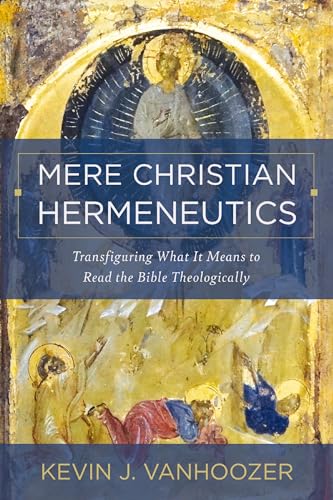
Mere Christian Hermeneutics: Transfiguring What It Means to Read the Bible Theologically
Written by Kevin Vanhoozer Reviewed By Oliver van RuthKevin Vanhoozer’s Mere Christian Hermeneutics is a creative undertaking to reconcile and integrate biblical studies and systematic theology with a renewed vision of faithful biblical interpretation. Vanhoozer imaginatively invites his readers to ascend a holy mountain, coopting the word, “transfigure,” to describe both the method and the telos of reading. Mere Christian Hermeneutics is thorough, expansive, and provocative. It is destined to bristle both the exegete and the theologian, yet its comprehensiveness and bold integration will likely make it a standard text for the study of hermeneutics.
Vanhoozer attempts to give a theologically adequate definition of the so-called literal reading of Scripture, a notorious hermeneutical hot potato. Some wield a literal reading of Scripture as a badge of authenticity. Others see the text as only words, up for critical dissection. The difference, Vanhoozer argues, arises in our reading cultures, the social spaces that frame and shape one’s interpretation. Contra the immanent and disenchanted frame of modernity, a Christian social imaginary reads the Bible from a peculiar eschatological space, a reading culture that is created and sustained by the Word. Beyond analyzing the text, readers must situate themselves in the enchanted world of the text. Both the reading cultures of biblical studies and theology thus need to be formed by the church “with a distinctly theological interest: to know and love God” (p. 102).
Divergence over the literal interpretation is, therefore, the result of different frames of reference. Vanhoozer defines a necessary eschatological frame of reference that maintains the form and content of Scripture as divine address and pertains to God’s real presence in the midst of history. To do justice to the letter of the text is to allow the “scriptural imaginary” to rule. This is the eschatological frame of reference that ultimately discovers a “Christ-bound literal sense” (p. 142) as its supreme norm and eschatological fulfillment. Indeed, the Bible itself demands a theological reading. Playing on the parts of the word “trans” and “figure,” Vanhoozer describes a reading that is “trans-figural” (pp. 167–80). Rejecting both the immanent frame of early and late moderns, Vanhoozer proposes a figural interpretation that corresponds to the scriptural story and imaginary itself, informed by a theological vision.
Mere Christian Hermeneutics is a figural reading of the Bible that thickens the literal sense. In other words, it is no less than literal, but with a frame of reference that is historical-eschatological, in which the reader looks at “the way in which biblical figures connect ‘across’ times and testaments so as to make up a coherent unified narrative centered on Jesus Christ” (p. 167). Vanhoozer explains: “Trans-figural interpretation takes its bearing from the letter of the text, following the divine authorial intent in its canonical context, on its redemptive-historical trajectory to its Christological destination.” (p. 177). Indeed, a literal reading necessitates a theological interpretation.
Vanhoozer pivots in part 3 on a hyphen. Adding to a “trans-figuring” sense, readers must read “transfigurally” in the economy of light and pattern of Christ’s transfiguration. The transfiguration, which overshadows the entire project and metaphorical mountain climb, comes to full light in chapter 7. Vanhoozer contends that the change in Jesus’s figure “is emblematic of the changes required in our reading, and in us as readers, when we read the Bible theologically” (p. 226). There is a stark analogy between Jesus’s body transfigured and the letter of the biblical text read theologically. Just as Jesus’s humanity is not diminished in his glorification, so, too, the letter of the biblical text is not diminished by a mere Christian hermeneutic.
The author shows that reading transfigurally not only shines light on the text but transforms the reader. Because theological interpretations engage the Scripture as dialogue with its living divine author, transfiguring interpretation will culminate “in the transformation of the reader effected by beholding the glory of God in the face of Christ” (p. 351). A faithful reading requires a willingness to “expose oneself to the white-hot light” (p. 332) of Scripture and thus be changed.
In his conclusion, Vanhoozer calls for biblical exegesis and systematic theology to work in tandem, beholding the radiant face of Christ in the text, “reading for the glory of the literal sense with both historical and eschatological frame of reference” (p. 368). With a plea for reformation of reading cultures, Vanhoozer asks, “Into what kind of reading community are we socializing seminary students and churchgoers, and with which frames of reference?” (p. 368). It is the vision of “mere Christian hermeneutics,” Vanhoozer believes, that will produce the readers who can bear a faithful and bright witness to the light of Christ.
Vanhoozer’s argumentation might be criticized for an overstretched wordplay and convoluted argument. Further, the problem of the accused immanent frame is a problem most pertinent to the secular West. Yet Mere Christian Hermeneutics remains a compelling vision, and Vanhoozer’s comprehensive survey of the history of interpretation and extensive research, coupled with bold and innovative ideas and novel terms, has provided an essential and timely resource for the church. He rightly calls attention to unhealthy chasms in biblical and theological disciplines and charts a compelling vision forward of transfigured reading communities, handling the Scriptures as what they truly are—divine discourse. Further work might address what such a reading means for preaching and teaching. How does a “transfigural” reading pertain to discipleship or Bible study in the church? Without offering answers, Vanhoozer’s questions are profoundly helpful and will serve the church and the training of exegetes and theologians for many years to come.
Oliver van Ruth
Gordon-Conwell Theological Seminary
Other Articles in this Issue
This essay is the second of a two-part analysis of John’s use of the articular substantival participle...
Empathy and Its Counterfeits: Navigating The Sin of Empathy and a Way Forward
by Jonathan D. WorthingtonIn our families, churches, or neighborhoods; in political discussions, situations of accused abuse, or racially charged conversations; in polarizing times, compassion must be wed with relational exegesis, the well-established name for which is empathy...
Philosophical Foundations of a Transgender Worldview: Nominalism, Utilitarianism, and Pragmatism
by Anthony V. CostelloEvery social and political phenomenon has some prior, underlying philosophical basis...
This article explores the relationship between Tolkien’s angelology, as reflected in his fictional writings, and classical angelology, particularly as represented by Augustine and Thomas Aquinas...
The Role of the Regula Fidei in the Twenty-First-Century Religious Landscape: How the “Rule of Faith” Can Help Address the Existential Issues of the Postmodern Christian Community
by Roland WeisbrotThis article offers a historical-systematic analysis of the role of the rule of faith in establishing and maintaining the Christian metanarrative and orthodox scriptural interpretation...
Other Reviews in this Issue