
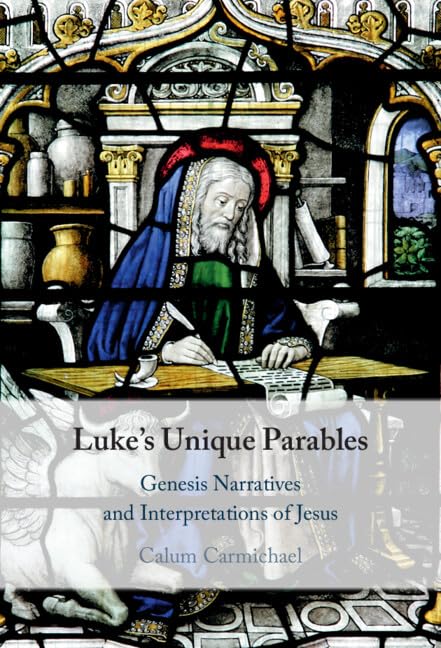
Luke’s Unique Parables: Genesis Narratives and Interpretations of Jesus
Written by Calum Carmichael Reviewed By Thomas Haviland-PabstCarmichael is emeritus professor of Comparative Literature at Cornell University and author of numerous books such as The Book of Numbers: A Critique of Genesis (New Haven: Yale University Press, 2012). With this monograph, the author seeks to offer an exploration of Luke’s parables (all but one unique to Luke) that connects them to narrative episodes in Genesis.
The book is divided into fifteen chapters. Aside from the introductory and concluding chapters (chapters 1 and 15, respectively), the chapters cover thirteen Lukan parables as they appear in Luke. Thus, chapter 2 discusses the parable of the two debtors in Luke 7:36–42, and the penultimate chapter (chapter 14) explores Luke 20:9–18.
Each chapter has the same basic structure: the passage of the parable in view in its context, followed by a running commentary of the parable in conversation with narratives in Genesis. We will highlight one parable discussed in the book to give the reader a sense of the author’s argumentation and exegesis.
In his discussion of the Good Samaritan parable, Carmichael follows the lead of an article written by Preston Sprinkle to argue that the primary OT text lying behind the parable is not Leviticus 19:18 but rather Genesis 42 and its context. He makes the compelling case that the Levitical commandment—“Do not seek revenge or bear a grudge against anyone among your people but love your neighbor as yourself” (Lev 19:18)—draws from the earlier story of Joseph forgiving his brothers rather than seeking revenge.
In addition, by connecting this parable to Genesis 42 and its context, he makes the case that the contrast between the Samaritan and the Levitical figures in the parable (the priest and the Levite) alludes to the division between Joseph and his brothers, with the former as the ancestor of the Samaritans and the latter, personified by Levi’s descendants, as the ancestor of the Jewish people who sought to distance themselves from the Samaritans on the basis of cultic purity. In other words, this connection provides another layer of support for those who see the division between the Samaritans and the Jewish people lying behind the parable. Along these same lines, Joseph is both able to identify with the victim in the parable as well as the rescuer since he was both victim and rescuer.
Carmichael’s treatment of the Good Samaritan parable is a positive example of his overall discussion, as it supports his thesis that the Lukan parables are created from the Genesis narratives. This especially reflects the author’s conviction, discussed in the introduction, that earlier interpreters (citing Joseph and Philo, among others) derived law from narrative. The parable of the rich man and Lazarus (Luke 16:19–31) is another positive example of his thesis. Here, the author argues that this reflects the antagonism between Esau and Jacob, with the appearance of Abraham in the parable (16:29) explicitly connecting this parable to Genesis. However, despite these positive test cases for this thesis, there are several problems with the author’s overall treatment.
In the introduction, the author provides numerous reasons for connecting Luke’s parables to the Genesis narratives. First, he argues that just as later parts of the OT connect to earlier parts (e.g., the reference in Amos 5:15 to “the remnant of Joseph”; the connection of the book of Daniel to the Joseph story), so also are Luke’s parables connected to Genesis narratives. Luke’s use of Genesis, it is argued, is corroborated by, for example, the retelling of Genesis and Exodus in the book of Jubilees. Second, it is plausible for Luke to make such connections because Luke’s “original audience,” including “knowledgeable Pharisees” (p. 8), would have been very familiar with the Genesis stories. Third, not only would Luke’s audience have been familiar with Genesis narratives but also, given Luke 16:29 among other passages, “Jesus requires the listener to understand his existence and mission in terms of the Old Testament” (p. 8). Fourth, he writes that “the Greek word parabolē refers to how one story is thrown … alongside another to capture some aspect of it” (p. 13).
While some of this is well and good, especially since the first three points are often argued by scholars working in the NT’s use of the OT, “precise” (p. 13) connection between the thirteen parables explored and the Genesis narratives has not been sufficiently demonstrated. To begin with, Carmichael shows no awareness of the taxonomy pioneered by Richard B. Hays regarding the NT’s use of the OT, which places such connections on a spectrum, with echoes on one end and direct quotations on the other. Had he integrated the insight of Hays and others, such as G. K. Beale, into this book, he would have discovered that, in the main, most of the connections he makes are echoes, at best, even faint echoes at times. Echoes, we would argue, do not qualify as “quite precise” (p. 13) connections.
Further, it appears that the author’s insistence that law always derives from narrative and that parable always means one story is compared with another (i.e., the Genesis narratives) forces him to see connections that are not necessarily there. In summary, the rigor of the author’s argument is lacking. Though there are some insights found in this book, we would recommend the reader consult more solid forays into the OT connections found in Luke’s parables, such as Kenneth E. Bailey’s Jacob and the Prodigal: How Jesus Retold Israel’s Story (Downers Grove, IL: InterVarsity Press, 2003).
Thomas Haviland-Pabst
Montreat College
Asheville, North Carolina, USA
Other Articles in this Issue
This essay is the second of a two-part analysis of John’s use of the articular substantival participle...
Empathy and Its Counterfeits: Navigating The Sin of Empathy and a Way Forward
by Jonathan D. WorthingtonIn our families, churches, or neighborhoods; in political discussions, situations of accused abuse, or racially charged conversations; in polarizing times, compassion must be wed with relational exegesis, the well-established name for which is empathy...
Philosophical Foundations of a Transgender Worldview: Nominalism, Utilitarianism, and Pragmatism
by Anthony V. CostelloEvery social and political phenomenon has some prior, underlying philosophical basis...
This article explores the relationship between Tolkien’s angelology, as reflected in his fictional writings, and classical angelology, particularly as represented by Augustine and Thomas Aquinas...
The Role of the Regula Fidei in the Twenty-First-Century Religious Landscape: How the “Rule of Faith” Can Help Address the Existential Issues of the Postmodern Christian Community
by Roland WeisbrotThis article offers a historical-systematic analysis of the role of the rule of faith in establishing and maintaining the Christian metanarrative and orthodox scriptural interpretation...
Other Reviews in this Issue