
Interpreting Israel’s Scriptures: A Practical Guide to the Exegesis of the Hebrew Bible / Old Testament
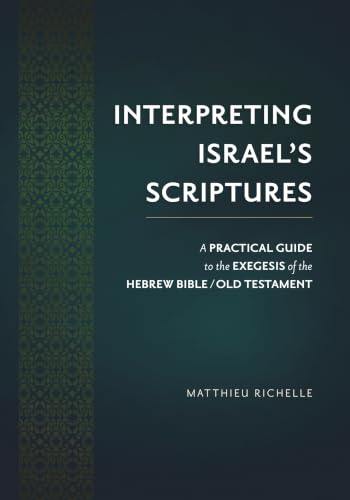
Written by Matthieu Richelle Reviewed By G. Kyle EssaryMatthieu Richelle’s Interpreting Israel’s Scriptures provides readers with a comprehensive, clear, and practical introduction to methods for Old Testament exegesis. Originally published in French in 2012, this edition has been translated into English and updated significantly. The book is divided into three parts: chapters focused on the making of the text, chapters focused on facets of the text, and chapters focused on readers of the text.
The first part covers translation, textual criticism, and compositional strategies behind the text. In the first chapter, the reader finds an overview followed by a method for dealing with challenges in the text, followed by numerous examples and finally a series of exercises to reinforce the topics of the chapters. This format continues throughout each chapter of the book. Interspersed throughout are additional bibliographies, definitions, and help for related topics that may arise in the examples. The two chapters on compositional criticism introduce students to “scribal activity” through discussions of source and redaction criticism, as well as issues like linguistic dating. Although Richelle will challenge students with statements such as, “traditional ideas about authorship are just that: traditional, not biblical” (p. 76), he will also point readers to works by conservative Old Testament scholars like Kenneth Kitchen alongside those by Konrad Schmid, Thomas Römer, and others (p. 109). Although conservative, evangelical views may be challenged at points, Richelle takes an ecumenical posture that values each reader’s perspective. This posture allows him to introduce a variety of methods in a charitable manner.
Having addressed matters behind the text in the first part, the second part focuses on facets of the text and includes chapters on literary genre, literary context, historical geography and background, structure, poetry, narrative, and intertextuality. Readers will find that Richelle strives both for clarity and practicality in his examples. The examples in each chapter helpfully explain the methods introduced and prepare the reader well for the exercises at the end of the chapters. A few psalms, portions of Isaiah, as well as portions of Genesis 1–11 appear at different sections of the book as examples. This allows readers to see how viewing a single text using different methods can deepen their understanding of it. Richelle will often use scholarly terms but will also explain what the terms mean. The chapter on poetry stands out in this regard. He explains the various terminology needed to assess biblical poetry and does so through practical examples.
The final part moves from a focus on the text to a focus on the reader. It includes chapters on reception history, feminine and gender studies, and postcolonial criticism. The chapter on reception history gave several helpful examples of how Old Testament texts were interpreted and reinterpreted in the Second Temple period, by the church fathers, and in medieval rabbinic exegesis. The chapter stood out in its bibliographic references that point readers to further studies in this broad topic. The chapter on feminine and gender studies unpacks the complexities of its diverse and often conflicting methodologies. As a lecturer in a postcolonial context, I found his measured acceptance and critiques of postcolonial interpretations in his final chapter helpful. These reader-oriented methods, which remain common in academic discussions, are presented fairly. However, conservative evangelical scholars may not find them as helpful due to presuppositions that seek to reconstruct or rehabilitate the text (p. 322), with some rejecting or revising biblical authority altogether (p. 326).
In the introduction, Richelle suggests that the book will present an “irenic, ecumenical, and interreligious spirit” (p. 5). The book succeeds in this goal. The bibliographies include not only critical scholars, but also Jewish, Catholic, and evangelical scholars. When Richelle notes the majority position on a topic, he respectfully acknowledges dissenting views and allows readers to assess the data on their own within their own perspective.
However, this ecumenical spirit also limits the book. Unlike standard evangelical handbooks, which typically address biblical and canonical theology, typology, and theological interpretation, this book stays within the boundaries of an interreligious approach. This limitation could make the handbook less useful in an evangelical classroom.
Richelle also notes in the introduction that part 1 assumes a basic knowledge of Hebrew (p. 3). While true at points, I would suggest that readers without any knowledge of Hebrew would still find quite a few helpful notes in these chapters and should still read them.
I would heartily recommend this work to pastors who have a seminary education and would like to study academic exegetical methods more deeply. Students of biblical studies, particularly those focused on the Old Testament, should own a copy. The clarity and practicality will reinforce their education in exegetical methods. The ecumenical nature of the volume will challenge them and may help to understand better those with whom they disagree. But I conclude with a dilemma. Despite my endorsement, I am unsure where this book fits within a standard evangelical seminary curriculum. It may not be ideal for general biblical interpretation courses due to its exclusive Old Testament focus and lack of discussion on matters of theological interpretation. It could serve, however, as a valuable supplement in advanced Hebrew and Old Testament exegesis courses.
G. Kyle Essary
G. Kyle Essary
Malaysia Baptist Theological Seminary
Kuala Lumpur, Selangor, Malaysia
Other Articles in this Issue
This essay is the second of a two-part analysis of John’s use of the articular substantival participle...
Empathy and Its Counterfeits: Navigating The Sin of Empathy and a Way Forward
by Jonathan D. WorthingtonIn our families, churches, or neighborhoods; in political discussions, situations of accused abuse, or racially charged conversations; in polarizing times, compassion must be wed with relational exegesis, the well-established name for which is empathy...
Philosophical Foundations of a Transgender Worldview: Nominalism, Utilitarianism, and Pragmatism
by Anthony V. CostelloEvery social and political phenomenon has some prior, underlying philosophical basis...
This article explores the relationship between Tolkien’s angelology, as reflected in his fictional writings, and classical angelology, particularly as represented by Augustine and Thomas Aquinas...
The Role of the Regula Fidei in the Twenty-First-Century Religious Landscape: How the “Rule of Faith” Can Help Address the Existential Issues of the Postmodern Christian Community
by Roland WeisbrotThis article offers a historical-systematic analysis of the role of the rule of faith in establishing and maintaining the Christian metanarrative and orthodox scriptural interpretation...
Other Reviews in this Issue