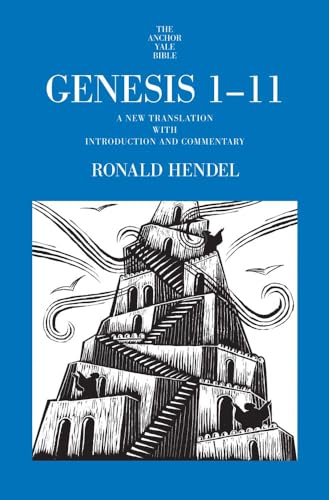

Genesis 1–11: A New Translation with Introduction and Commentary
Written by Ronald Hendel Reviewed By Dustin BurletThe first eleven chapters of Genesis offer a richly textured guide to understanding the world as a meaningful cosmos designed by an all-powerful, omniscient God who deeply cares about his creation. These chapters establish foundational theological concepts—such as sin and judgment—while also laying the groundwork for Scripture’s narrative of redemption/salvation via covenant. Yet, these chapters remain a focal point of acrimony, dispute, and debate(s). Enter Ronald Hendel’s Genesis 1–11, a new addition to the esteemed Anchor Yale Bible commentary series.
The book begins with an in-depth introduction covering the “standard” topics (pp. 3–58). These include areas such as “Text,” a recognized and notable specialty of Hendel, the “Ancient Near East,” “Sources,” and “Contextualization.” An extensive bibliography (pp. 61–90) and three thorough indices (“Subject,” “Author,” and “Ancient Sources”) round things off.
Hendel divides Genesis into eleven sections: “Creation” (1:1–2:3), “The Garden of Eden” (2:4–3:24), “Cain and Abel” (4:1–26), “Generations from Adam to Noah” (5:1–32), “The Sons of God and the Daughters of Humans” (6:1–4), “The Flood According to J” (6:5–8:22), “The Flood According to P” (6:9–9:29), “The Curse of Canaan” (9:18–27), “The Table of Nations” (10:1–32), “The Tower of Babel” (11:1–9), and “Generations from Shem to Abram” (11:10–32). The commentary proper includes four main sections: “Translation,” “Textual Notes,” “Notes,” and “Comments.”
Concerning Hendel’s translation, different typefaces signify different sources: boldface = “P” (Priestly source), roman type = “J” (Yahwist source), and italics = “R” (the “redactor[s]”). Herein, Hendel highlights the “supplementary hypothesis” by claiming this approach is justified by “the principle that apart from the main sources there have been all kinds of growths” (p. 13, cf. p. 6).
The translations themselves are often quite “bold” and dynamic. For instance, Hendel translates Genesis 6:3 as follows: “Yahweh said, ‘My breath will not be strong in humans forever, inasmuch as they are also flesh.’” A more extended example is offered below:
In the beginning, when God created heaven and earth—the earth was desolate chaos, and darkness was over the face of the ocean, and a wind of God was soaring over the face of the water—God said, “Let there be light,” and there was light. And God saw that the light was good, and God separated the light from the darkness. And God called the light “day,” and the darkness he called “night.” There was evening and there was morning, one day. (Genesis 1:1–5)
As expected, the “Textual Notes” are exceptionally robust. In fact, when combined with the insightful comments about “Text” within the introduction, I would be hard-pressed to find another commentator who provides more clarity. However, without access to BHQ and Hendel’s The Text of Genesis 1—11: Textual Studies Critical Edition (New York: Oxford University Press, 1998), most students (and possibly even some scholars) will struggle to unlock this section’s full value.
Hendel’s “Notes” demonstrate a thoughtful and measured engagement with GKC, IBHS, and Joüon-Muraoka on grammatical matters. Hendel also draws from various lexicons, including BDB, HALOT, TDOT, and TLOT—although (regrettably) he does not leverage DCH or DCHR.
With respect to the verbal system, each stem is handled on its own terms (free from exegetical fallacies). It is, however, Hendel’s engagement with the subtle differences between the various phases (or chronolects) of Biblical Hebrew (see p. 15) that makes the “Notes” shine.
To be clear, Hendel identifies four phases: (1) Archaic Biblical Hebrew; (2) Classical Biblical Hebrew, which (according to Hendel) characterizes the “J” and “E” (Elohist) sources; (3) Transitional Biblical Hebrew, characteristic of the “P” source and a few other texts in Genesis; and (4) Late Biblical Hebrew—which does not appear in the text of Genesis explicitly but does often occur in the linguistic updating of certain forms in the Samaritan Pentateuch and some MT vocalizations.
For example, consider the following note by Hendel on Genesis 6:3:
The relative particle ša is an old form, found in Akkadian, Ugaritic, and elsewhere. In Classical Hebrew the equivalent form (although etymologically related) is ’ǎšer. In Late Biblical Hebrew the dominant form is še, which may be a clipped form of ’ǎšer…. The old relative ša occurs in archaic Hebrew poetry (Judg 5:7, and probably Num 24:3, 15) and in frozen form in names (mətǔšā’ēl, “man of God,” Gen 4:18; and mîšā’ēl, “who is of God?,” Exod 6:22), and probably persisted in the northern dialect of Hebrew…. The compound form ba’ǎšer (Gen 39:9, 23) is equivalent to bəša-here. The corresponding Late Biblical Hebrew form is bəše (Eccl 2:16). The effect of this archaic-sounding compound preposition, in conjunction with the unique verb yādôn, is to color Yahweh’s speech as lofty and archaic. Yahweh speaks in a high register here, befitting his divinity and antiquity, but with an aura of obscurity. (p. 269)
In his “Comments” sections, while Hendel treads on familiar ground, I appreciate his careful study of some controversial topics. For instance, with respect to cosmology, Hendel states:
The often elusive intricacy of Genesis 1 makes it difficult to specify in detail the picture of the cosmos…. Some commentators infer that the cosmos implicit in Genesis 1 is not a physical picture at all, but a symbolic expression of cosmic and theological principles…. These reservations may be valid if one tries to synthesize or harmonize descriptions of the cosmos from a variety of sources or eras, or when dealing with symbolic religious iconography in seals or reliefs. But Genesis 1 describes a cosmos that seems in every respect a physical, material structure. (p. 144)
There are also not a few well-crafted, clear tables and charts. Special mention, though, should be made of the exquisite drawings by William H. C. Propp, including (among others) depictions of Leviathan, Marduk’s Dragon, the Cosmic Imagery of Egypt, the sun god Šamaš, the Tower of Babel stele, and the world according to the Table of Nations.
Lastly, it should be noted that Hendel uses SBL’s “academic” (and not “general-purpose”) style of transliteration, but that the actual rubric is not provided within the AB volume itself, which is (at times) quite bothersome and a nuisance.
To conclude, Ronald Hendel’s Genesis 1–11 in the Anchor Yale Bible commentary series was worth the wait. With over thirty years of research, his analysis deepened my understanding of Biblical Hebrew and offers fresh perspectives on much “established” scholarship. It is a valuable resource for anyone engaging Genesis on a serious level. Highly recommended!
Dustin Burlet
Millar College of the Bible
Winnipeg, Manitoba, Canada
Other Articles in this Issue
This essay is the second of a two-part analysis of John’s use of the articular substantival participle...
Empathy and Its Counterfeits: Navigating The Sin of Empathy and a Way Forward
by Jonathan D. WorthingtonIn our families, churches, or neighborhoods; in political discussions, situations of accused abuse, or racially charged conversations; in polarizing times, compassion must be wed with relational exegesis, the well-established name for which is empathy...
Philosophical Foundations of a Transgender Worldview: Nominalism, Utilitarianism, and Pragmatism
by Anthony V. CostelloEvery social and political phenomenon has some prior, underlying philosophical basis...
This article explores the relationship between Tolkien’s angelology, as reflected in his fictional writings, and classical angelology, particularly as represented by Augustine and Thomas Aquinas...
The Role of the Regula Fidei in the Twenty-First-Century Religious Landscape: How the “Rule of Faith” Can Help Address the Existential Issues of the Postmodern Christian Community
by Roland WeisbrotThis article offers a historical-systematic analysis of the role of the rule of faith in establishing and maintaining the Christian metanarrative and orthodox scriptural interpretation...
Other Reviews in this Issue