
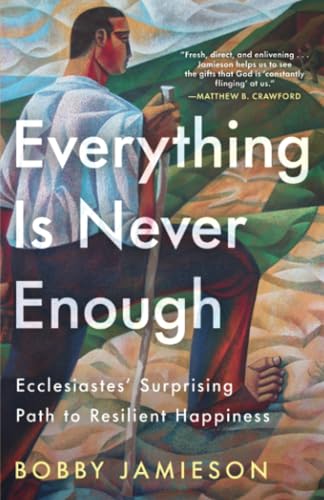
Everything Is Never Enough: Ecclesiastes’ Surprising Path to Resilient Happiness
Written by Bobby Jamieson Reviewed By S. D. EllisonIn my final year of seminary, I decided to preach through Ecclesiastes as I provided pulpit supply for various churches. One day I shared my decision with a seasoned pastor and confessed how difficult I was finding it. The puffing of his cheeks and commiserations confirmed the challenge that I faced in attempting to preach through the remainder of the book. My youth made me ambitious enough to tackle Ecclesiastes, my friend’s maturity confirmed the mammoth task that lay ahead of me. Bobby Jamieson is older than I was then and yet younger than my friend the seasoned pastor, perhaps just young enough to have the ambition to take on Ecclesiastes and yet wise enough to manage the nuances of the book. At least, what he has produced suggests this is the case Everything Is Never Enough is an astonishingly good book.
Jamieson holds degrees from the Southern Baptist Theological Seminary (MDiv, ThM) and University of Cambridge (PhD), and he served as Associate Pastor in Washington, DC, before recently moving to plant Trinity Baptist Church in Chapel Hill, North Carolina. He is therefore well placed to tackle Ecclesiastes with pastoral sensitivity.
Initially, I was a little confused with both the publisher and the structure of the book. It seemed to me that a logical exposition of Ecclesiastes published with a more recognized Christian publisher such as Crossway or IVP may have been a more obvious choice. But on reading, I quickly discovered that I was wrong. Rather, Waterbrook (as an imprint of Penguin) provides a breadth of readership that the more recognized publishers might not enjoy, and the intriguing structure invites the reader to explore its world.
The book is structured in three unequal parts, which matches Jamieson’s suggestion that Ecclesiastes should be viewed as a house with three floors. Part 1 is the longest. This is the ground floor of the house—how Qohelet views things “under the sun.” This section serves as smelling salts, triggering a reaction that awakens the reader to the absurdity of this world because of humanity’s inability to control it. The section is bracketed by two chapters that define and elaborate on the crucial term הֶבֶל which sandwich several thematic chapters (“Gain,” “Work,” “Knowledge,” “Pleasure,” “Money,” “Time,” “Enough,” “Power,” and “Death”). Jamieson’s sane and temperate—almost dispassionate—treatment of these themes in Ecclesiastes has an accumulatively forceful impact. There is no denying that all that the world pursues under the sun fails to truly satisfy. In part 1 Jamieson offers a devastatingly accurate diagnosis for the lack of satisfaction endemic in our world.
Part 2 is slightly shorter; it is the middle floor, noting the seven passages in which Qohelet declares certain things good. This section is like a map and information leaflet picked up at the entrance to a zoo or theme park. It offers direction and instruction on how to make the most of your visit; it lists times and events that you do not want to miss. Jamieson outlines how Qohelet instructs his readers to recognise the limitations of God’s good gifts, and in doing so to find enjoyment in them (chapter titles are: “Gift,” “Enjoy,” “Lot,” “Eat and Drink,” “Toil,” “Wealth,” “Marriage,” and “Resonance”). This section reflects the more positive declarations threaded throughout Ecclesiastes. In the end, enjoyment is only possible when we embrace limitations, remain present in the moment, and accept gifts as signposts to God, the giver of gifts. In part 2 Jamieson promises that there is a glimmer of hope.
Part 3 consists of only two chapters and is the top floor. From here things look very different. This section is like a debrief after an event or trip—having been there and done it, we can see things more clearly. While the chapter titles—“Fear” and “Judgement”—do not immediately suggest hope, these final chapters do offer hope, hope that there is a God who is bigger, grander, and kinder than we can imagine, and that judgement is related in some way to God’s gifts to humanity. It helps make sense of the apparent conflict between Parts 1 and 2—divine gifts in a depraved world will always create tension. In part 3 Jamieson pierces the sky to let the light in, concluding, “Everything is never enough, but Jesus is. Jesus is enough to satisfy God’s judgment on your behalf. And Jesus is enough to satisfy your soul forever. Jesus alone is God’s answer to your life’s absurdity” (p. 211).
Everything Is Never Enough is a remarkable achievement. In my estimation, the best use for this book is as an evangelistic tool, especially for seekers who are readers and thinkers. It accurately diagnoses symptoms and clearly explains the frustrations of this world as it is and, after a long a tortuous journey with Qohelet, proposes that resolution to all of it can be found only in Jesus. In this way, Jamieson (alongside Qohelet) confronts the reader with the reality that this world is never enough. For this reason, I think it could also be used profitably in student and young adult ministries as fodder for discussion. So many young Christians get caught up in rat races dictated by the world—this exposition of Ecclesiastes, if heeded, would help many avoid common pitfalls.
It was a pleasure to read. Indeed, I think it is reminiscent of Lewis or Chesterton—the book feels timeless. While this is bound in some way to the timelessness of Scripture, and Ecclesiastes in particular, it is in no small part due to Jamieson’s continued perfecting of the writing craft. And in this, I think it stands alone as a contemporary popular-level exposition of Ecclesiastes. If one wants a logical exposition published with a more recognized Christian publisher, David Gibson’s Living Life Backward: How Ecclesiastes Teaches Us to Live in Light of the End (Wheaton, IL: Crossway, 2017) or Philip Ryken’s Ecclesiastes: Why Everything Matters (Wheaton, IL: Crossway, 2010) would be most suitable. Jamieson, however, offers an original treatment that deserves to be read widely.
S. D. Ellison
Davy Ellison holds a PhD in OT biblical studies from Queen’s University, Belfast and serves as the director of training at the Irish Baptist College, Moira, Northern Ireland.
Other Articles in this Issue
This essay is the second of a two-part analysis of John’s use of the articular substantival participle...
Empathy and Its Counterfeits: Navigating The Sin of Empathy and a Way Forward
by Jonathan D. WorthingtonIn our families, churches, or neighborhoods; in political discussions, situations of accused abuse, or racially charged conversations; in polarizing times, compassion must be wed with relational exegesis, the well-established name for which is empathy...
Philosophical Foundations of a Transgender Worldview: Nominalism, Utilitarianism, and Pragmatism
by Anthony V. CostelloEvery social and political phenomenon has some prior, underlying philosophical basis...
This article explores the relationship between Tolkien’s angelology, as reflected in his fictional writings, and classical angelology, particularly as represented by Augustine and Thomas Aquinas...
The Role of the Regula Fidei in the Twenty-First-Century Religious Landscape: How the “Rule of Faith” Can Help Address the Existential Issues of the Postmodern Christian Community
by Roland WeisbrotThis article offers a historical-systematic analysis of the role of the rule of faith in establishing and maintaining the Christian metanarrative and orthodox scriptural interpretation...
Other Reviews in this Issue