
Biblical Theology in the Life of the Early Church: Recovering an Ancient Vision
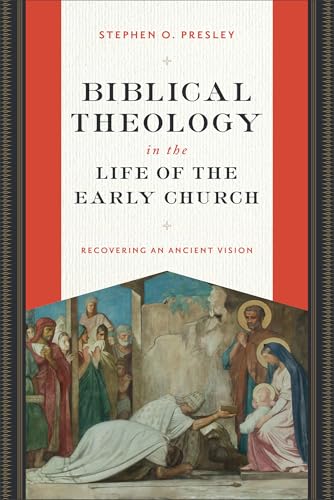
Written by Stephen O. Presley Reviewed By Zachary T. HedgesIn this volume, church historian Stephen O. Presley offers a sequel—or better, a prequel—to his proposal in last year’s Cultural Sanctification: Engaging the World like the Early Church (Grand Rapids: Eerdmans, 2024). Where that work called us to retrieve the early church’s approach to bearing witness in a hostile pagan world, this year’s follow-up digs deeper into what such a recovery entails: “an entirely different view of reality” (p. ix).
The early Christian “view of reality” was, of course, derived from Holy Scripture. Yet to make sense of the approach to Scripture found in Irenaeus, Origen, Augustine, and others, Presley contends, we must advance the conversation beyond hermeneutical “methods” to “fundamental assumptions” (p. ix). Only by examining early Christian convictions about the nature of Scripture itself, the God who speaks through it, and the Christian life that it guides, can we be delivered from the sterilized, critical dissection of the text which has infiltrated modern (post-Enlightenment) biblical studies (p. 4).
To be clear, Presley is appreciative of the still-flourishing, modern, “biblical theology” movement, which reacted against these trends through a renewed emphasis on the unity of the canon. Yet even these presentations rarely engage with what the fathers regarded as primary—“the realm of metaphysics,” or ultimate reality (p. 6). For early Christians, Scripture was not an object for intellectual scrutiny but the all-encompassing self-revelation of God, laying metaphysical foundations and giving rise, in turn, to distinctive modes of thinking (epistemology) and living (ethics). For them, “biblical theology is not a discipline but a way of life that reads the Bible as a culture-shaping text” (p. 6).
The “culture” that it shapes is, of course, the believing community of the church. In chapter 1, Presley calls for an “ecclesial biblical theology” (p. 7), one which embraces the “synergy” between three essential elements: Scripture, the rule of faith, and the church’s liturgy (or spiritual life, p. 17). The rule, as the apostolic proclamation of the triune God and his economic activity in creation and redemption, arises from Scripture as a summary of its teaching and also establishes boundaries for its proper interpretation, in a “cyclical relationship” (pp. 21–27). Meanwhile, the church’s liturgy cultivates the habits and virtues necessary for spiritual participation in this ultimate story: baptism, eucharist, prayer, and devotional life (pp. 28–32).
Chapters 2–6 illuminate various facets of this ecclesial biblical theology. Presley begins in chapter 2 where modern hermeneutics refuses to go—the spiritual sense, which is indeed “the primary sense and purpose of reading Scripture” (p. 37). The church fathers universally assumed that the ultimate “referent” for Scripture’s many “signs” is the God confessed in the rule of faith (p. 39). This truth demands certain interpretive postures from the reader, such as deriving meanings consistent with the confession of faith, assuming the Scriptures’ internal harmony, relying on the Spirit’s illumination, and submitting to Scripture’s divine authority (p. 50).
Yet the primacy of the spiritual sense does not displace the literal sense for early Christians, as is often thought. On the contrary, Presley insists in chapter 3 that tracing the overarching narrative of the literal sense, where modern biblical theology has “shined,” is indispensable to the spiritual sense. It is the only framework for contemplating the redemptive activity of God centered around Christ and its implications for the spiritual life (p. 68).
This leads to chapter 4’s argument that the fathers regarded Christ himself as Scripture’s interpretive locus. While modern discussions have bogged down in debates over terms (typology, allegory, etc.), early Christian exegetes discern Christ in all of Scripture from three broader perspectives: the personal (reading through a Trinitarian lens to identify the divine person of the Son), the prophetic (recognizing his fulfillment of prophecy across his two advents), and the partitive (distinguishing descriptions of his divine and human natures without losing sight of their unity). Together, these perspectives “reveal what has existed all along”—Scripture’s unified witness to Christ (p. 117).
Presley turns in chapter 5 from the text to the interpreter, reflecting on the role of the virtues in biblical exegesis. For premodern Christians, the moral character of the reader is both a prerequisite and a goal of the study of Scripture as guided by the Spirit (p. 123). Moreover, the ethic which constitutes “the good life” arises out of the metaphysical vision which Scripture casts and, in a sort of “feedback loop” (p. 131), further shapes the interpreter as an “active participant” in its ongoing story (p. 145).
Presley’s closing chapter returns to the church as “the primary locus for reading Scripture” (p. 149). Through its catechesis (or instruction), its liturgy (or public worship), and its proclamation (or preaching), the church alone can instill the fundamental assumptions that were vital, as Presley has shown, to early Christian efforts to interpret Scripture in a manner appropriate to the God who speaks through them.
Presley makes a bold case in suggesting that the hermeneutical “methods” revered by moderns are, at best, in serious need of supplement and that “the proper context for biblical theology … is not canon or historical context or even salvation history; it is the Christian community formed through the intertwining threads of confession and liturgy” (p. 172). This extensively documented historical survey is formidable, and its lively and accessible presentation warmly invites biblical interpreters of all stripes to reflect thoughtfully on these disparities between ancient and modern assumptions. Of course, by Presley’s own argument, there is no setting more appropriate for doing so than the community of the local church itself!
Zachary T. Hedges
Trinity College of Florida
Other Articles in this Issue
This essay is the second of a two-part analysis of John’s use of the articular substantival participle...
Empathy and Its Counterfeits: Navigating The Sin of Empathy and a Way Forward
by Jonathan D. WorthingtonIn our families, churches, or neighborhoods; in political discussions, situations of accused abuse, or racially charged conversations; in polarizing times, compassion must be wed with relational exegesis, the well-established name for which is empathy...
Philosophical Foundations of a Transgender Worldview: Nominalism, Utilitarianism, and Pragmatism
by Anthony V. CostelloEvery social and political phenomenon has some prior, underlying philosophical basis...
This article explores the relationship between Tolkien’s angelology, as reflected in his fictional writings, and classical angelology, particularly as represented by Augustine and Thomas Aquinas...
The Role of the Regula Fidei in the Twenty-First-Century Religious Landscape: How the “Rule of Faith” Can Help Address the Existential Issues of the Postmodern Christian Community
by Roland WeisbrotThis article offers a historical-systematic analysis of the role of the rule of faith in establishing and maintaining the Christian metanarrative and orthodox scriptural interpretation...
Other Reviews in this Issue