
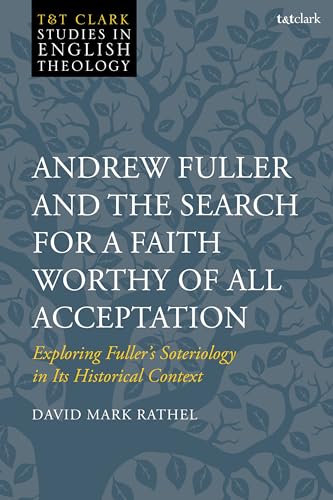
Andrew Fuller and the Search for a Faith Worthy of All Acceptation: Exploring Fuller’s Soteriology in Its Historical Context
Written by David Mark Rathel Reviewed By Matthew StewartWhat does an obscure eighteenth-century Baptist theological debate have to do with the spread of the gospel? Far more than one might assume. As David Mark Rathel of Gateway Seminary skillfully argues in Andrew Fuller and the Search for a Faith Worthy of All Acceptation, a theological shift in one small-town pastor’s thought would have massive ramifications for the spread of the gospel among the nations. Indeed, the debates swirling among English Calvinistic Baptists during the long eighteenth century (1680s–1830s) concerning the duty of unbelievers to receive the gospel (also known in that time as the Modern Question) had a profound impact on their spiritual health and gospel witness.
Yet, Rathel contends that researchers have not given adequate attention to the historical background of the debate. At the center of the argument was Andrew Fuller (1754–1815), who served as the pastor of Kettering Baptist Church from 1783 to 1815. In addition to his pastoral labors and secretarial duties for the Baptist Missionary Society, Fuller published several works. The Gospel Worthy of All Acceptation (1785) was Fuller’s most contentious and consequential. By surveying “the historical development of eighteenth-century hyper-Calvinism in Northamptonshire,” Rathel seeks to “demonstrate how such a survey contextualizes Andrew Fuller’s theology and illuminates his proposals about the human response to the gospel” (p. 11). Rathel does not stop there, however. He proposes “that existing accounts of hyper-Calvinism are deficient because they do not adequately document the diversity found in the movement.” In response, Rathel offers “a new interpretation of hyper-Calvinism that accounts for its complexity” (p. 11).
Rathel sets out to orient readers to the debate’s major contours and contributors. At the heart of what Fuller (a Calvinist himself) labeled “false Calvinism” was a concern to preserve God’s sovereign grace in salvation. Sometimes referred to as “high Calvinism” or “hyper-Calvinism,” false Calvinism rejected the idea of gospel-offers to unbelievers. The question is, What doctrinal commitment led to this conclusion? Covenant theology, the pactum salutis, and eternal justification are some of the more popular suggestions. Yet, Rathel proposes that scholars have misread the debate. Focusing on more prominent figures such as John Gill (1697–1771) and Joseph Hussey (1660–1728), researchers have largely neglected men such as Lewis Wayman (d. 1764), John Brine (1703–1765), and John Johnson (1706–1791), even though, as Rathel contends, they had a greater impact on the Modern Question debate (p. 5).
In chapters 1–2, Rathel explores Hussey’s and Gill’s theology. He concludes that Gill modified “traditional accounts of soteriology” through the “Hussey-inspired theology of his youth.” “This theology,” argues Rathel, “diminished human agency to the point that it denied universal offers of the gospel and the obligation of all people to respond positively to the gospel” (p. 87). At the core of both men’s Calvinism was the doctrine of eternal justification (p. 80).
Fuller, however, did not aim at eternal justification. As Rathel explains in chapter 3, with a survey of the historical background to the Modern Question debate, Fuller drew upon the arguments of men like Matthias Maurice (1634–1738) and Abraham Taylor (d. 1740) to address the issue of Adamic inability. “To address objections raised during the modern question debate,” argues Rathel, “hyper-Calvinist theologians [like Wayman, Brine, and Johnson] broadened their tradition by arguing that prelapsarian Adam had no ability or obligation to accept the gospel. From this point, they asserted that contemporary audiences likewise have no capacity or duty to accept the gospel” (p. 91).
Rathel unpacks this point in chapter 4 by comparing a recently discovered Fuller manuscript entitled Thoughts on the Power of Men to Do the Will of God (1777 or 1778) and The Gospel Worthy (the former appears to be the inspiration for the latter). As Rathel contends, Fuller even used Gill against his fellow hyper-Calvinists, since he did not (consistently) hold to Adamic inability (p. 140). To this end, he focused on distinguishing between natural ability and moral ability, a distinction that most researchers conclude he borrowed from Jonathan Edwards (1703–1758). Rathel, however, gives evidence of indebtedness to Gill (p. 138). Finally, Rathel helpfully concludes his work with a summary of findings and suggestions for further research (pp. 159–162).
Rathel’s work deserves high praise. By surveying the primary sources behind the Modern Question, Rathel lays a solid foundation to provide a more precise construction of Fuller’s response to hyper-Calvinism. Researchers will greatly benefit from Rathel’s labors to bring clarity to what has been a theological conundrum in Baptist studies. The bibliography alone is well worth the reader’s investment. While Rathel boldly criticizes previous research, he nevertheless supports his claims with careful theological, historical, and literary analysis. Especially fascinating is his examination of Fuller’s reading and use of Gill (see pp. 136–42).
There are a few minor typographical mistakes along the way, such as a missing word on page 140, footnote 40. There also seems to be an oversight in the fact that Joseph Hussey, who published his work, The Glory of Christ Unveiled, in 1706, could not have depended on Isaac Watts’s 1722 work, The Christian Doctrine of the Trinity, as Rathel suggests (see p. 35). None of these issues, however, significantly detracts from the author’s thesis.
Overall, Andrew Fuller and the Search for a Faith Worthy of All Acceptation provides scholars and pastors with the theological and historical background necessary for rightly understanding Fuller’s unique contributions to a debate that would have far-reaching implications. Indeed, one might argue that Fuller’s shot at hyper-Calvinism was heard, not only in England but, more importantly, around the world.
Matthew Stewart
Cross Theological Seminary
Other Articles in this Issue
This essay is the second of a two-part analysis of John’s use of the articular substantival participle...
Empathy and Its Counterfeits: Navigating The Sin of Empathy and a Way Forward
by Jonathan D. WorthingtonIn our families, churches, or neighborhoods; in political discussions, situations of accused abuse, or racially charged conversations; in polarizing times, compassion must be wed with relational exegesis, the well-established name for which is empathy...
Philosophical Foundations of a Transgender Worldview: Nominalism, Utilitarianism, and Pragmatism
by Anthony V. CostelloEvery social and political phenomenon has some prior, underlying philosophical basis...
This article explores the relationship between Tolkien’s angelology, as reflected in his fictional writings, and classical angelology, particularly as represented by Augustine and Thomas Aquinas...
The Role of the Regula Fidei in the Twenty-First-Century Religious Landscape: How the “Rule of Faith” Can Help Address the Existential Issues of the Postmodern Christian Community
by Roland WeisbrotThis article offers a historical-systematic analysis of the role of the rule of faith in establishing and maintaining the Christian metanarrative and orthodox scriptural interpretation...
Other Reviews in this Issue