
Turning Points: Decisive Moments in the History of Christianity
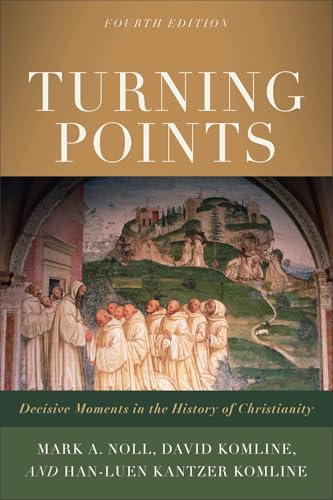
Written by Mark Noll, David Komline, and Han-Luen Kantzer Komline Reviewed By Kenneth StewartAny text which reaches a fourth edition twenty-five years after its initial release must have done something well, right from the start. In 1997 (the year of the first edition’s release), Mark Noll was still a faculty member at Wheaton College. Teaching inside and outside the classroom had convinced him that there was an unmet need for a broad-brush (but still well-informed) survey of the history of the church: something which could function both as an introductory textbook and/or a resource for group discussion. Evidently, his perception of that unmet need has been proven right over time. Steady demand—extending through his decade spent at Notre Dame University (2006–2016) and beyond—has warranted three further editions. Now, in its fourth iteration, Noll has been extensively assisted in the work of updating by David Komline and spouse Han-Luen Kantzer Komline, both historians at Western Seminary in Holland, Michigan.
The challenge to be faced, whether one intends to offer a compressed history of the church in one semester of classes or in discussion groups spread across a lengthier span of time, is essentially the same: what to include? Since its initial release in 1997, the book’s consistent strategy for addressing that question has been to select thirteen events or crises in the unfolding life of the church and to use these as doorways into eras of importance. In this fourth edition, while some chapter titles have been tweaked (ch. 8 was formerly “A New Europe: The English Act of Supremacy (1534)”; presently it is “Church and Nation: The English Act of Supremacy (1534)”—almost certainly a change for the better), the actual text of the book is modified only sparingly. To be fair, these textual changes are customarily improvements and refinements. As well, a comparison will show that great pains have been taken to ensure that the chapter-end bibliographies are kept current (and they are!). And this latest edition is also more user-friendly in that an appendix of Study Questions (pp. 313–28) will help both instructors and discussion leaders to spark conversations. This is all for the good.
A more striking change appears in the final chapter (13). Originally entitled simply “Further Turning Points of the Twentieth Century,” it surveyed the global growth of Pentecostalism, the impact of the Second Vatican Council, and the expanded role played by women in the global church. This chapter has been extensively reworked. And why not? Things do not stand just where they did in 1997. Now re-titled “Mobilizing for the Future,” the new final chapter is devoted to two major developments. The new chapter focuses on the world of modern Roman Catholicism (the Second Vatican Council: 1962–1965) and on the world of evangelical Protestantism (represented by the Lausanne Congress on World Evangelization: 1974). This is, at best, only a qualified good.
The reviewer does not question the selection of these themes (the first is carried forward from the old concluding chapter); they were and are of deep significance. Yet he would point out that even the second and more recent of these gatherings, taking place almost a half-century ago, will leave the reader of this book asking whether Turning Points has not shirked the need to come closer in time to our present day. A careful reader will be strengthened in this impression by noting how many contemporary issues (five) are now alluded to in the afterword of the book (pp. 291–312). Meanwhile, the Roman Catholic communion is in disarray, with many onlookers blaming Vatican II for opening floodgates; a good number of conservative Catholics hold the current pope responsible for dereliction of office. The evangelical Protestant movement is finding that it is singed by its flying too close to the political flame in multiple countries led by authoritarian leaders. And all the Christian churches stand baffled at the effects of secularization, the defection of the young, and the growth of the proportion of the population self-described as “nones” (i.e., of no religious affiliation). The global crisis of migration of political and religious refugees is changing the face of societies in both hemispheres; the Christian movement wavers over whether to see this crisis as a menace or an opportunity.
All this to say that if there is to be a fifth edition of this now-proven work, there will be reason either to augment the number of “turning points” beyond thirteen (an attractive number in itself as most semesters are of thirteen weeks duration) or to consider whether some of the existing chapters still warrant inclusion. The ongoing usefulness of Turning Points will lie extensively in its ability to suggest approaches to emerging questions pressing the church of the present day as well as classic questions which have surfaced in past centuries.
Kenneth Stewart
Covenant College
Lookout Mountain, Georgia, USA
Other Articles in this Issue
Early Christians had to develop and negotiate their (new) identity within a society, to which their beliefs and ethical convictions were largely alien...
Acts of the Apostles reports several uprisings and instances of mob violence that occur across Asia Minor, caused by or related to the evangelistic and missionary endeavors of Paul and his companions in the middle of the first century...
As states continue to decriminalize marijuana and usage escalates in American culture, Christians must increasingly navigate their associations with the drug...
This article seeks to retrieve from the past in order to gain perspective for the present...
The book of Ecclesiastes is essentially a speech...
Other Reviews in this Issue