
The Trinity in the Book of Revelation: Seeing Father, Son, and Holy Spirit in John’s Apocalypse
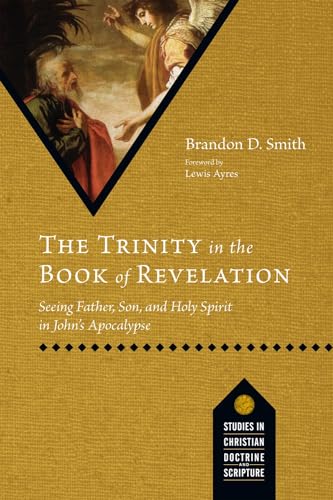
Written by Brandon D. Smith Reviewed By Brian J. Tabb“Doing theology is a holy act that should not be undertaken by the proud or belligerent” (p. 1). So begins this fine exploration of trinitarian theology in Revelation, a revised Ridley College PhD dissertation by Brandon Smith of Cedarville University. He aims “to contemplate and grow in our understanding of the triune God, whom we worship and stake our lives on” (p. 1). He accomplishes this trinitarian reading of the Apocalypse by appropriating “the early church’s classic trinitarian reading strategies and conceptual categories” and carefully analyzing select texts (p. 4). This is a worthy addition to the Studies in Christian Doctrine and Scripture series and should interest New Testament scholars, theologians, and academically minded pastors.
Following a brief yet stirring introduction, Smith’s study unfolds in five chapters. In chapter 1, “Toward a Trinitarian Reading of Revelation,” Smith sets forth his presuppositions and methodology and defines key terms to lay the groundwork for the remainder of the study. For Smith, “A trinitarian reading observes the way in which the Father, Son, and Holy Spirit are of the same divine nature (e.g., a singular will, power, and authority) and yet are also distinct persons in Revelation” (p. 16). He employs a “pro-Nicene toolkit” for this theological project with particular attention to the eternal, ordered relations and the inseparable operations of the Trinity (pp. 19–20). For example, he frequently employs the concept of “redoublement”—speaking about biblical references for God twice over to attend to oneness and threeness of the triune God (p. 20). Smith adopts a “theological-canonical approach” to interpreting Revelation, writing as “primarily a systematic historical theologian who loves the Scriptures and seeks to understand them faithfully and rigorously” (pp. 34–35).
Chapter 2 examines God the Father, whose “boundless majesty and power are on full display in Revelation as he sits on the throne as the perfectly good, wise, and sovereign creator of all that was, is, and will be” (p. 37). Smith overviews patristic conceptions of the Father and then examines three key passages that depict “the Father as the locus of divine activity and his relationship with Jesus and the Spirit” (p. 48): Revelation 1:1–8; 4:1–11; and 11:15–19. Somewhat surprisingly, this chapter does not give much attention to any of the Apocalypse’s five references to God as πατήρ (1:6; 2:27; 3:5, 21; 14:1) or the climactic pronouncement from the one seated on the throne in 21:5–8.
Chapter 3 devotes seventy pages to God the Son, who is “the central figure in John’s vision” (p. 69). Smith writes, “John marries together his visionary experiences with a scripturally soaked imagination to communicate through marvel, metaphor, and midrash the Son’s participation in what is uniquely true of YHWH while also underscoring his divine commission from God and communion with his church” (p. 107). After extensively discussing “Christology in context” and patristic notions of the Son, Smith eventually turns to interpreting key texts that reveal Jesus’s divine nature and relationship to the other divine persons. For example, commenting on 1:1, Smith states that this revelation “is both from and about Jesus, albeit initiated by God” (p. 93). He asserts that “I am the first and the last” (1:17) recalls John 8:58 (“Before Abraham was, I am”) because of the shared phrase ἐγώ εἰμι, though this passage more likely alludes to Yahweh’s assertions in Isaiah 41:4; 44:6; and 48:12. Smith extensively discusses the controversial son of man title and rightly insists that Revelation presents Jesus as a divine being, not an angelic figure, appealing to patristic concepts of redoublement and partitive exegesis. The doctrine of inseparable operations explains Christ’s description as eschatological judge (Rev 2:18; 6:15–17) and as the one who “has the seven spirits of God” (3:1). Curiously, in the book’s longest chapter Smith does not explicitly discuss Christ’s parousia, despite repeated references to his “coming” at key points in the Apocalypse (1:7; 22:7, 12, 20; etc.).
Chapter 4 considers the Holy Spirit, “The Revealer to John and Speaker to the Churches.” Smith vividly presents the Spirit as “the marvelous gatekeeper to God’s throne room, the one who opens John’s eyes to the wonders of heaven, and speaks alongside the Son as the promised comforter” (p. 138). He devotes significant attention to the seven spirits in 1:4, John’s vision ἐν πνεύματι (1:10), and the Spirit’s messages to the churches in Revelation 2–3. While his theological and exegetical conclusions are consistently sound, I would have liked to see Smith expound further on the seven spirits’ location before the divine throne (1:4). Moreover, he sometimes makes claims without providing much supporting evidence, as when he calls Isaiah 11 “a structural key in Revelation 5” (p. 155). He does not discuss the christological title “root of David” (5:5; 22:16), which alludes to Isaiah 11:1 and would have strengthened his argument.
The book’s final chapter offers “a constructive account of how a trinitarian reading of Revelation ultimately contributes to trinitarian theology and exegesis today” (p. 173). He prefers “pro-Nicene” language such as redoublement over modern categories such as “high” and “low” Christology and quibbles with binitarian models that do not adequately address the divine Spirit. Smith concludes by showing how a trinitarian reading of Scripture informs Christian confession, ecclesial reception, eschatology, and the canonical shape of the Scriptures (pp. 190–93). The brief paragraph on eschatology is underdeveloped, with no explicit mention of Christ’s return, the final judgment, or the new heavens and earth.
In sum, Smith’s study offers a fine example of theological interpretation of Scripture (TIS) that is informed by patristic readings, attentive to contemporary scholarship, and sensitive to the biblical text. Smith not only provides careful analysis of Revelation’s portrayal of the triune God but also offers a methodological proposal for blending systematic theology and exegesis informed by patristic retrieval. Readers would profitably examine Smith’s contribution alongside studies such as Thomas Schreiner’s The Joy of Hearing (Wheaton, IL: Crossway, 2021), my All Things New (Downers Grove, IL: 2019), and Richard Bauckham’s The Theology of the Book of Revelation (Cambridge: Cambridge University Press, 1993). Each of these theologies of Revelation includes chapters on the Father, Son, and Spirit, and they make many of the same theological judgments as Smith while employing somewhat different methodologies and connecting Revelation’s portrayal of the triune God with other key biblical theological themes developed in the book. Overall, I am grateful for Smith’s fresh and faithful approach to trinitarian reflection on the Apocalypse and commend it to serious students who seek to hear the book’s urgent message and “worship God” (Rev 22:9).
Brian J. Tabb
Brian Tabb is president and professor of biblical studies at Bethlehem College and Seminary in Minneapolis and general editor of Themelios.
Other Articles in this Issue
Early Christians had to develop and negotiate their (new) identity within a society, to which their beliefs and ethical convictions were largely alien...
Acts of the Apostles reports several uprisings and instances of mob violence that occur across Asia Minor, caused by or related to the evangelistic and missionary endeavors of Paul and his companions in the middle of the first century...
As states continue to decriminalize marijuana and usage escalates in American culture, Christians must increasingly navigate their associations with the drug...
This article seeks to retrieve from the past in order to gain perspective for the present...
The book of Ecclesiastes is essentially a speech...
Other Reviews in this Issue