
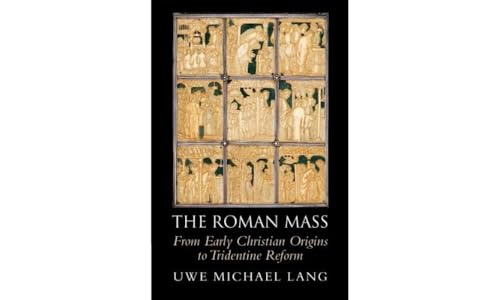
The Roman Mass: From Early Christian Origins to Tridentine Reform
Written by Uwe Michael Lang Reviewed By Thomas Haviland-PabstLang is an adjunct faculty member at the Institute of Theology and Liberal Arts at St. Mary’s University and a priest of the Oratory of St. Phillip Neri in London, and he has written two books on liturgical theology. With this work, he has contributed a liturgical history of the Roman Mass that draws from contemporary scholarship.
Taking a diachronic approach in his presentation of the history of the Roman Mass, Lang lays the foundation for the Mass with the New Testament teaching on the Last Supper and the Eucharist in the early church in chapters 1 and 2, respectively. Then he moves to the further development that took place in the third and fourth centuries (ch. 3), and then into the formation of the Latin liturgy (chs. 4–5), its expansion and adaption in the Carolingian age (ch. 6), and its history from the Ottonian Revival up to the Tridentine Reform (chs. 7–9).
In the introduction, Lang notes his debt to earlier scholarship and his departure from it. First, although it is not his intention to replace the massive work of Josef A. Jungmann titled The Mass of the Roman Rite: Its Origins and Development (New York: Benziger, 1951–1955), he is attempting “to offer a new overview of developments in the Roman Mass” that “will open up insights that can advance scholarly research and debate” (p. 2). Second, his focus is more specific to the Roman Mass than Bryan D. Sprinks’s Do This in Remembrance of Me: The Eucharist from the Early Church to the Present Day (London: SCM, 2013) and less theological than Helmut Hoping’s My Body Given for You: History and Theology of the Eucharist (San Francisco: Ignatius Press, 2019).
Thus, Lang’s goal with this work is to provide “a new, synthetic approach” (p. 3) to the history of the Roman Mass, which draws not only from texts but also incorporates “musical, artistic, literary, social and … religious perspectives,” resulting in a presentation of “liturgical development within the broader historical and theological context that shaped the celebration and experience of” the Roman Mass (p. 3).
Due to the length and depth of this book, I will only take up some of the main features of Lang’s work. In arguing for a normative Christianity that was already formed by the first century of the church and characterized by the three pillars of (1) a “monoepiscopacy and apostolic succession”; (2) “baptismal creed and rule of faith,” and (3) “canon of scripture” (p. 49), Lang adds a fourth pillar, namely, “the Last Supper tradition and the institution of the Eucharist” (p. 51).
He enlists the Epistle to the Hebrews, the Didache, and statements from Justin Martyr to support the concept that the Eucharist was to be understood in sacrificial terms. In his discussion of the epistle to the Hebrews, Lang suggests, following Scott Hahn, that this letter implies that the New Covenant rites effectively “perfect the conscience of the worshiper” (Heb 9:9), unlike the Old Covenant ones. However, while Catholic thinkers may be satisfied with his exegesis of Hebrews, it is uncertain that this was the intent of the author of Hebrews. With the Didache’s assertion that the breaking of the Eucharistic bread is a fulfillment of Malachi 1:11, describing the Eucharist as a sacrifice is further established. Moreover, Justin Martyr corroborates this understanding by seeing “the Eucharist as a priestly and sacrificial action” (p. 66).
Turning to material evidence for this sacrificial understanding, Lang writes, “In the Roman world, sacred objects were carried in procession, including the statues of gods. Against this background, a portable wooden altar that was brought into a Christian meeting place for the Eucharist could nonetheless be considered an altar and be charged with sacredness” (p. 71). One wonders at this point if Lang’s uncritical reliance on Martyr and Roman cultic practices betrays his lack of awareness of the former’s imposing of Levitical categories on the New Testament priesthood of all believers and the possible syncretistic implications of allowing Roman cultic practices to inform one’s understanding of the Eucharist.
Later, in his attempt to root the Latin Rite in the earliest traditions of the church, Lang, commenting on the Apostolic Tradition in his discussion of Eucharistic prayers of the fourth century, notes that “the document does not offer a complete liturgical description of the Eucharist” (p. 85) and states that if a third-century date can be reasonably attributed to the Barcelona Anaphora, then key elements “such as the institution narrative and epiclesis” can be seen as organically developing from earlier liturgy rather than a later, fourth-century “interpolation” (p. 94). The earlier “pre-Nicene” prayers, according to Lang, were enshrined in written texts rather than oral tradition following the “Constantinian settlement,” which, in turn, provided the background and context for the emergence of the Latin liturgy and the “Roman Rite of Mass” (p. 103).
In his discussion of the formation of the Latin liturgy, he notes that, in contrast to the Eastern liturgy, which employed several languages, Latin was the sole language adopted by the Western church due to the “religious prestige of the Roman church and its bishop” and its attempt to evangelize “Roman culture” and attract “the influential elites of the city and the empire” (p. 109). This observation from Lang reflects his awareness of the Byzantine Rite and its departure from, as well as similarities with, the Latin Rite. At various points, Lang compares the two rites as he describes the developments of the Latin Rite. However, in his comparisons, he implies that Latin Rite is the superior one without demonstrating why this is the case.
In conclusion, this is a serious work of liturgical history. Lang draws from a vast array of primary and secondary sources, some of which are works written in German, Latin, and French that remained untranslated into English. Helpfully, he provides a full Latin-English text of the Roman Missal in the appendix. Although not all will agree with the Catholic flavor of this book, this is a serious contribution to the history of the Latin liturgical tradition and is essential reading for any serious student or scholar of the same.
Thomas Haviland-Pabst
Thomas Haviland-Pabst
One Family Ministries
Asheville, North Carolina, USA
Other Articles in this Issue
Early Christians had to develop and negotiate their (new) identity within a society, to which their beliefs and ethical convictions were largely alien...
Acts of the Apostles reports several uprisings and instances of mob violence that occur across Asia Minor, caused by or related to the evangelistic and missionary endeavors of Paul and his companions in the middle of the first century...
As states continue to decriminalize marijuana and usage escalates in American culture, Christians must increasingly navigate their associations with the drug...
This article seeks to retrieve from the past in order to gain perspective for the present...
The book of Ecclesiastes is essentially a speech...
Other Reviews in this Issue