
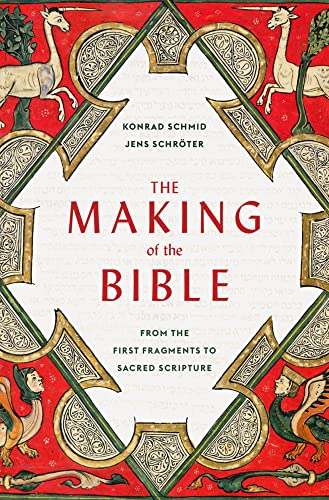
The Making of the Bible: From the First Fragments to Sacred Scripture
Written by Konrad Schmid and Jens Schröter Reviewed By G. Kyle EssaryKonrad Schmid and Jens Schröter have written an engaging and informed book on the origins and canonization of Scripture from a critical perspective. The first chapter suggests that “the Bible” can refer to different translations in different languages, as well as different collections of books, and even different arrangements of those books. For instance, Catholics, Orthodox, and Protestants disagree on the books included in the Bible. According to the authors, biblical books were not written as canonical texts, and this led to dissimilar canons. The critical presuppositions of the authors become evident with statements such as the “authorship [of Deuteronomy] has no more to do with Moses than does … [a] pseudepigraphic text dating from the first century CE” (p. 38). Without argument, they state that “some of the letters of Paul are pseudonymous, as are the letters bearing the names of Peter, John, James, and Jude” (p. 39).
The second chapter introduces Israelite scribal culture. The authors explain the history of writing in Israel, the development of scribal schools, and show how the emergence of written prophets accords with archaeological evidence. The chapter also introduces how critical scholars understand the emergence and compilation of biblical traditions. For readers unaware of critical scholarship from the past few decades, the chapter presents theories of biblical origins according to the latest research among critical scholars. The authors repeat throughout the book that the Bible required constant updating as new situations in Israel caused scribes to reflect upon older traditions. They suggest that the constant updating of biblical texts mitigated against canon formation until at least the Persian empire.
The third and fourth chapters suggest that forms of Judaism arose during and after the Babylonian exile. These groups slowly began to view the Pentateuch as normative. This led to a more stable form of the Pentateuch, as well as the Prophets, although textual updating continued. Divergent forms of the books and religious practice persisted as evidenced by the Samaritan Pentateuch, LXX, Qumran and Elephantine literature. The authors also note that pseudepigraphic and rewritten biblical texts, such as 1 Enoch and Jubilees, flourished after the exile. They maintain that no concept of a set canon formed during this period.
The fifth chapter considers early Christian acceptance of Jewish literature. The authors argue that the earliest Christians had no concept of canon, but still read Israel’s Scriptures as authoritative. However, they read Israel’s Scriptures as prophetic and centered on God’s work in history “through the agency of Jesus Christ” (p. 212). Christians further claimed that Gentiles could unite with God’s people, and this allowed for the reception of Israel’s Scripture beyond Jewish communities.
The sixth and seventh chapters discuss the formation of the New Testament among Christians and the emergence of rabbinic literature among Jews. The authors emphasize that the Scriptures of Christians and Jews arose in dialogue and debate with one another. They also argue that the Christian canon remained fluid for centuries and could have taken a different form. Despite prioritizing evidence that suggests diversity in the early church, they avoid sensationalist claims. For instance, they state definitively that the New Testament Gospels were written first, widely accepted, and viewed as authoritative from an early date. Christians and Jews had distinct reasons for developing their canons of Scripture. Thus, the Jewish canon become standardized by the early 2nd century AD, whereas Christian canon lists disagreed on the inclusion of certain books and forms of those books into the 4th and 5th centuries.
The book’s closing chapter presents the historical influence of the Bible on art, music, and literature. The Bible has significantly influenced history and become the “book of books.” Throughout, the authors contend that, “although the impression has been created, since the invention of printing that ‘the Bible’ is a precisely defined body of scriptures, this impression is soon dispelled when one looks at how the Bible came into being” (p. 279). They even hope that “the increasing use of texts in digital form will help us move away from the image of a defined corpus of scriptures set in stone and toward one that is more flexible” (p. 279).
The authors are accomplished and informed experts on a wide range of topics. At times, they present plausible arguments in support of their claims. At other times, they privilege data that problematizes the uniformity of Jewish and Christian traditions.
The book could have said more about the development and influence of Scripture outside of the West. Although the book briefly mentions the Ethiopian canon, more could have been said about the influence of the Bible on art, music, and literature in Africa, the Middle East, South and East Asia.
Students and seminary professors will find the book valuable as a summary of up-to-date critical scholarship on the origins of Scripture. Too often evangelical students are introduced to forms of critical scholarship that have not been prominent for decades. This book would remedy the problem.
Pastors and theological students should look elsewhere for guidance on these topics. The same topics are considered from an evangelical perspective in John D. Meade and Peter J. Gurry, Scribes & Scripture: The Amazing Story of How We Got the Bible (Wheaton, IL: Crossway, 2022) and Ched Spellman, One Holy Book: A Primer on How the Bible Came to Be and Why It Matters (Cedarville, OH: Codex, 2021). Pastors will find these books more profitable for their ministry.
G. Kyle Essary
G. Kyle Essary
Malaysia Baptist Theological Seminary
Kuala Lumpur, Selangor, Malaysia
Other Articles in this Issue
Early Christians had to develop and negotiate their (new) identity within a society, to which their beliefs and ethical convictions were largely alien...
Acts of the Apostles reports several uprisings and instances of mob violence that occur across Asia Minor, caused by or related to the evangelistic and missionary endeavors of Paul and his companions in the middle of the first century...
As states continue to decriminalize marijuana and usage escalates in American culture, Christians must increasingly navigate their associations with the drug...
This article seeks to retrieve from the past in order to gain perspective for the present...
The book of Ecclesiastes is essentially a speech...
Other Reviews in this Issue