

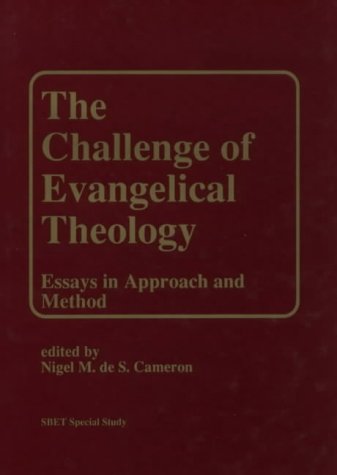
The Challenge of Evangelical Theology: Essays in Approach and Method
Written by Nigel M. de S. Cameron (ed.) Reviewed By Tony BaxterThis volume is a collection of seven essays by evangelical scholars, all but one of which were originally given as papers at the First Edinburgh Conference in Christian Dogmatics held at Rutherford House in the summer of 1985. They are truly international in scope with contributors from Holland, France and the United States as well, of course, as England and Scotland.
The essays are rather diverse and cover a wide range of issues. All deal in one way or another with theological method.
In the first, ‘The Logic of Biblical Authority’, the author, Dr N. Cameron, drawing upon insights gained from Kirsopp Lake (a prominent 19th-century liberal) and the Oxford philosopher H. L. Mansel’s 1858 Bampton Lectures, rejects the view that the evangelical doctrine of Scripture is a novelty which arose in the fundamentalist controversy. He argues that orthodox theology and the orthodox view of Scripture are so interrelated that the one must stand or fall with the other. This is the ‘logic’ of biblical authority which shows us the ‘illogicality’ of the modern eclectic approach which accepts some elements of biblical revelation but rejects others and which is prevalent in evangelical circles as well as liberal.
The second contribution is that of Prof. Henri Blocher, entitled ‘The “Analogy of Faith” in the Study of Scripture’. Prof. Blocher calls evangelicals to reappropriate this significant aspect of their hermeneutical heritage. He goes on to survey the meaning of the analogy of faith in its scriptural and historical uses. He argues that the principle is fully consistent with an evangelical view of Scripture only when understood in the sense of the analogy of the whole of Scripture (analogia totius Scripturae). Other understandings must be subordinate to this. After giving a broader theological justification for this, Prof. Blocher ends by offering us guidelines as to how we should apply the principle today. Though the essay as a whole was illuminating, I found this last section rather sketchy and therefore disappointing.
In the third essay, ‘Unity and Diversity in Old Testament Theology’, Dr J. G. McConville argues that the OT is marked by unity and diversity. Whichever one of these a scholar lays most emphasis on will determine the results of his interpretation. Whilst one who holds to a traditional view of the canon must start by postulating the unity of the OT, he must not ignore its diversity. Building on this argument Dr McConville closes by suggesting three elements which must characterize an adequate OT theology.
The theme of ‘unity and diversity’ is continued in Dr G. Bray’s contribution, ‘Unity and Diversity in Christian Theology’. Dr Bray argues that theology today must respond to two competing pressures: the synchronic (contemporary) and the diachronic (historical). The historical character of revelation forces us to prefer the diachronic option. Though our theology must respond to the needs of the time it must always be firmly rooted in Scripture and tradition. This is where so much modern theology has gone wrong; contemporary pressures are made the basis of the theological agenda and we know with what results! In order to fulfil their theological task, Dr Bray argues, evangelicals must develop a new understanding of tradition as ‘person-to-person contact through the ages’ and Scripture as ‘the living voice of the Spirit’. Though there are some over-generalizations (e.g. on p. 78, ‘charismatics show a theological indifference which makes the World Council of Churches look almost sectarian’—this is by no means true of all charismatics), this is a highly stimulating and provocative essay. Dr Bray offers many interesting insights into the contemporary scene and the development of the Christian tradition.
The fifth contribution, by Professor R. L. Reymond of Covenant Theological Seminary, is somewhat patchy. Entitled ‘The Justification of Theology’, one wonders at the end of the day whether the author has done more than simply explain why he as an evangelical ‘does’ theology. Nevertheless on the way we are given a biblical basis for engaging in theology and offered some interesting observations on Bultmann’s ‘Christology from below’ and Käsemann’s ‘Christology from above’.
Jan Veenhof (Prof, of Systematic Theology in the Free University of Amsterdam) provides a weighty contribution entitled ‘The Holy Spirit and Hermeneutics’. Whilst rejecting the older Orthodox distinction between sacred and profane hermeneutics, so affirming that there is no specific biblical hermeneutics, he accepts the idea that there is another ‘dimension’ of ‘living understanding’ beyond the purely historical one. It is in the theological approach to the Bible that a distinct hermeneutics is needed. Theology comes to the text expecting to encounter God in Christ there. The secret of this event is the work of the Holy Spirit. The Spirit works within us, but in such a way as not to suppress our humanity. This means that he will not lead us to abandon the ‘scientific’ dimension of interpretation, though he will influence the way in which we use such methods.
The final contribution, ‘Calvin’s Approach to Theology’, comes from Professor R. S. Wallace who is well known for his writings on Calvin. In this essay Prof. Wallace offers us some valuable insights into Calvin’s theological method. As well as being scriptural and systematic in form, Calvin’s theology is also marked by a mystical strand. Yet, with his lack of confidence in man as a source of the knowledge of God, Calvin’s theology never becomes merely subjective. God always takes us out of ourselves. The theologian must begin not from a position of doubt, but from faith. Theology for Calvin, as for Anselm, is always ‘faith seeking understanding’. Moreover, Calvin’s theology is carried out in a believing community—the church. It thus always has piety as its goal and is pastoral in its orientation. Because the theologian is concerned with the truth he must inevitably be engaged in conflict with all false theologies. This essay provides a good introduction to Calvin as a theologian, though personally I remain unconvinced that there is a strong mystical element in Calvin’s theology.
On a general level, it is perhaps relevant to observe that one or two errors have crept into the footnotes.
On the whole I found this a worthwhile collection of essays which well lives up to the expectations created by the word ‘challenge’ in its title. The authors are not ashamed of their evangelicalism and tackle some crucial and difficult issues head-on from a robust evangelical perspective.
Tony Baxter
Sheffield
Other Articles in this Issue
Other Reviews in this Issue
Excellence in Leadership
Reviewed by Bill Houston

