
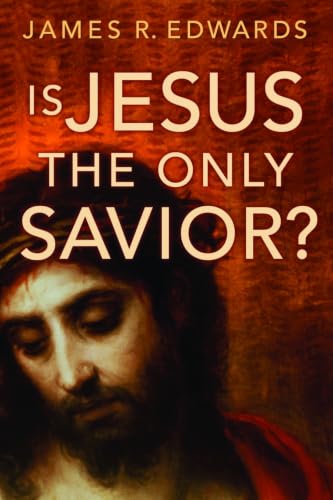
This is a well-written and wide-ranging book, the purpose of which is to ‘to consider whether Jesus is the only savior of the world’ (xi). Edwards has taken on this ambitious task to respond to a range of challenges to the uniqueness of Jesus as Saviour, from both within and without the church (xi). The book has been written with two readerships in mind: believers who have found their faith unsettled by these big questions, and non-believers who wonder ‘if there is anything especially credible to be said for the besieged view that Jesus is the only savior’ (xii). It is a very accessible volume, with few footnotes, but it is not superficial.
The book considers the reasons for affirming or denying Jesus’ unique salvific function. The author does not set out to prove that Jesus is the saviour of the world (he acknowledges that all final judgements of Jesus are faith judgements), but to show that this belief is not arbitrary, but rather is well informed and for which there is considerable evidence (6–7). Edwards argues there are sound reasons for taking the biblical witness to Jesus Christ seriously and he aims to demonstrate that ‘the presumption of the credibility of Scripture is, evidentially speaking, an entirely justifiable presumption’ (7).
The author considers various ‘contemporary movements that account of [for sic] the interest in Jesus today and the widely differing opinions of him’ (7) including: Enlightenment rationalism and the scientific method, the quest for the historical Jesus, pluralism, moral relativism, postmodernism, the quest for peace, and the challenge of other religions. He considers how these factors influence our understanding of the gospel and particularly its central truth claim that Jesus Christ is the sole and sufficient saviour of the World (7).
Edwards writes with a positive tone, and he considers how the various challenges to the uniqueness of Christ can be harnessed by the church, not merely survived by the church (8). There is a strong apologetic thrust woven throughout the book. While this volume does not make any original contributions to the wide range of issues it considers, its value is in bringing together in one volume such a wide range of topics, all of which are handled competently. However, the chapter, ‘How Should Christians Think about Other Religions?’ makes some claims that the current reviewer take issue with. For example, Edwards’ treatment of the Bible’s attitudes towards other religions includes the claim that ‘some religions are seen as playing a foreshadowing role for the gospel of Jesus Christ. The primary example of a foreshadowing religion is Judaism’ (216). While this is undoubtedly the case for OT Judaism, this reviewer disputes that this is so for other religions.
The inclusion of a bibliography, or suggestions for further reading at the end of each chapter would enhance the usefulness of this volume. This reviewer, however, considers it to be a helpful text, particularly at undergraduate level.
Adam Sparks
Adam Sparks completed his PhD (Theology of Religions) at Bristol University in 2007, under the supervision of Professor Gavin D’Costa. He has been a part-time tutor at Bristol University and is currently a part-time sessional lecturer at the University of London (Birkbeck College). This article is an updated section of his thesis.
Other Articles in this Issue
Other Reviews in this Issue