
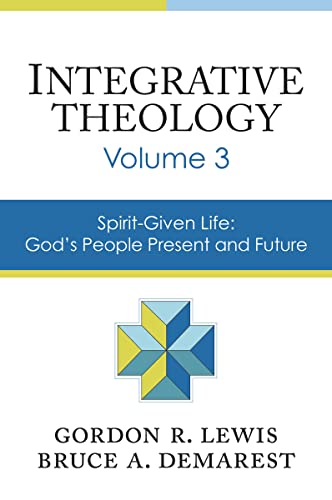
Integrative Theology, Vol. 3: Spirit-Given Life; God’s People Present and Future
Written by Gordon R. Lewis and Bruce A. Demarest Reviewed By K.J. StewartWe should admit at the outset that we do not customarily read theological works by well-known authors for the primary purpose of ascertaining modifications in their views. Instead we expect and grant that theologies will be written from a reasonably settled theological position. But what if two such known authors, taking up a challenge laid down by the late Bernard Ramm in 1983, determine to write an evangelical theology by following a new paradigm, that of the extended integration of the theological disciplines? Will we not reasonably expect that the cumulative consideration of not only an initial theological problem, but past historical reflection on it, biblical teaching bearing on it followed by new systematic, apologetic and pastoral reflection, will break new ground or at least bring some needed theological correction? The much-touted innovation of method would seem to raise expectation of such a result.
A survey of the third and final volume in this project brings me to make the following observations.
Initially we must say that the authors are to be commended for the scope and design of their project; this appears to have comprised a decade of labour. This reviewer was especially appreciative of the incorporation of the considerable historical-theological and biblical-theological material. The value of this has not earlier been denied; but it has not always been incorporated so adequately.
However, it has impressed this reviewer that the determined incorporation of such materials into the process of theological formulation has yielded an extremely limited impact upon the final outcome. Lewis and Demarest have insisted that their method is superior to that of confessional theology (Vol. 1.8). This superiority has not been shown. The authors began their task as evangelical Protestants holding baptistic, immersionist, free-church, Augustinian, non-Wesleyan and chiliastic views. All these convictions are intact at completion. From this datum one can conclude either that these views must represent the ineluctable end to which theology has been meant to run, or that their theological pre-commitments have influenced their sifting of evidence more than they have realized. I opt for the latter analysis and am made to recall Chesterton’s whimsical likening of himself to a navigator who discovered his own land, mistakenly thinking himself in another hemisphere. Integrative Theology may represent terra nova as to method; but as to content the landscape is strictly familiar.
I do not write to denigrate the labour of fellow evangelicals. But they have not succeeded to any observable degree in demonstrating how such improved methods can lead us to transcend long-entrenched positions and correct old misunderstandings. Had the improved method led the authors to any frequent refinement (I do not say repudiation) of their former views, we might reasonably expect that others, holding differing pre-commitments, might follow them expectantly. But the Lewis-Demarest project deserves to be seen as a pioneering effort. They have ably demonstrated the attractiveness of an improved methodology; it may remain to others to demonstrate more fully the fruit achievable by its use.
As the volumes are reprinted, it would be good to see two changes of format. The double column does no justice to the authors’ prose; and the extensive and informative footnotes would be of much greater use printed at each chapter end.
K.J. Stewart
Prairie Bible College and Graduate School, Three Hills, Alberta, Canada
Other Articles in this Issue
Other Reviews in this Issue


Islam
Reviewed by Stephen N. Williams