
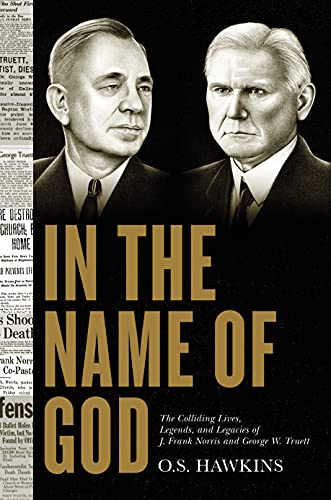
In the Name of God: The Colliding Lives, Legends, and Legacies of J. Frank Norris and George W. Truett
Written by O. S. Hawkins Reviewed By Ray Van NesteO. S. Hawkins has faithfully and significantly served Southern Baptists in several meaningful roles during his lifetime of ministry as a pastor, author, and recently retired president of Guidestone Financial Resources. His newest book is a retelling of a fascinating portion of Southern Baptist history in a rousing form. Southern Baptists have not been good at telling our history, and as a result, many of our people have little sense of rootedness, leading some to look elsewhere to find roots. So, we are indebted to him for an engagingly written account of the basic ministries of two towering figures in SBC life in the early 20th century. I hope coming generations who barely know Criswell and Rogers will, as a result of this book, gather awareness of and appreciation for George Truett and J. Frank Norris.
Hawkins tells the story of each man, dubbing Norris “the Texas Tornado” and Truett “The Eternal Optimist.” He devotes a chapter to the overall story of each and then a chapter specifically on the conflict between them. The sad reality is that far too often, Bible-believing leaders end up in bitter conflict with one another. Hawkins does not shy away from this sad reality and discusses the strengths and weaknesses of both men.
Hawkins is absolutely right that this story is rich with connections to and lessons for today. However, my concern with the book is in the lessons it draws. These deductions are the focus of chapter 5 but can be found sprinkled throughout earlier parts of the book. It becomes clear that one aim of the book is the rehabilitation of J. Frank Norris. This is understandable since Hawkins notes in the introduction that his family’s “spiritual roots” are in the ministry of Norris, including the fact that his father was converted under Norris. We should always be alert to evidence of grace among fellow believers, even those with whom we disagree or who ultimately made a mess of things. So, since Norris has typically been demonized, it is appropriate that we be reminded of the positive contributions he made. However, I think Hawkins goes too far in his rehabilitation. He is correct that Norris shaped quite a bit within the Southern Baptist denomination, but perhaps not as helpfully as Hawkins suggested.
The book takes particular aim at the claim of historian Leon McBeth that Norris made “no contribution to Southern Baptist ministries in this [twentieth] century.” Despite McBeth, Hawkins suggests seven specific ways Norris shaped Southern Baptist life and practice: Sunday School, Cooperative Program, Baptist Faith and Message, Conservative Resurgence, Preaching, Eschatology, and Evangelism and Church Growth. To disprove McBeth, all that is needed is to demonstrate any level of influence, which is a fairly low bar. Still, it seems the book overstates the evidence in several places.
The book’s argument is not so much that Norris led Southern Baptists to do certain things but that the things he did are now the most common methods or ideas in SBC life. Often no real causal connection is made. A more general—and less verifiable—“influence” is what is argued. The strongest argument is Sunday School. It was fascinating to learn that Arthur Flake, architect of the influential Sunday School growth approach, got his start at FBC Fort Worth under Norris. Flake’s method did indeed make a profound contribution to SBC work in the 20th century. Flake’s influence on ministry thinking has largely disappeared today, though. The book’s weakest argument is for Norris’s influence on the Cooperative Program, where its main point seems to be that the failure of the Seventy-five Million Campaign is more the fault of Truett than Norris, even though Norris opposed the campaign, which was a precursor of the Cooperative Program.
Hawkins argues Norris’s relentless challenge to doctrinal slide within the SBC helped prompt leaders to adopt a statement of faith, The Baptist Faith and Message, in 1925. That makes sense. Hawkins also points out that the popularity of expositional preaching, often preaching through books, in the SBC today is much more like Norris’s preaching than Truett’s. That seems to be true, though it is interesting that the argument for Norris making a contribution is cast in terms of Norris vs. Truett. It is not argued that Norris caused the move toward more expository preaching, but merely that there is a resemblance.
In eschatology, Hawkins points out that the majority of Southern Baptists today hold to a dispensational premillennial view of eschatology, like Norris, unlike the postmillennialism of Truett. This is true, though how much Norris has to do with this is not shown. It is odd the book goes on to argue that postmillennialism is what led Truett to “his limited use of reproof,” and Norris’s premillennial dispensationalism led to his more polemical approach. While postmillennialists do claim a more optimistic view (history is headed to the fullness of the kingdom of God before Christ returns), they argue this will come about due to vigorous kingdom work, including preaching. And, as in the Sunday School discussion, it must be noted the dominance of dispensational thought in the SBC has been waning for some time.
The book also argues that Norris contributed to the Conservative Resurgence because its leaders learned from his failure in addressing theological slide in the 1920s. Specifically, Paige Patterson and Paul Pressler “learned what to do and what not to do” from Norris (p. 122). They learned, it says, not to leave the denomination like Norris did but to work from the inside. Positively, they learned to follow Norris’s example in taking the issues to the laypeople. Thus, according to the book, the Conservative Resurgence was the “extension of the methodology” as well as “the ministerial vision” of J. Frank Norris (p. 125). The people I know who were at the center of the Conservative Resurgence repudiate any close connection with Norris and are appalled at the suggestion. The populist impulse is in the DNA of SBC life, even if some oppose it, and cannot be attributed merely to Norris. I have no doubt there are similarities between the controversies of the 1920s and those of the 1970–1980s. But to say “Norris resurfaced … in the very mood, methods, and manners of those who led the Conservative Resurgence” (p. 126) is a large claim. He seems to have in mind Patterson and Pressler, leaving aside many other key leaders. Perhaps he is right that Patterson is the heir of Norris. But that raises the question of whether this is a positive thing or not. There is a darker side to the Conservative Resurgence, where people received threatening phone calls if they ran for office when certain leaders did not want them to do so. That does sound like Norris. It does not sound like the faithful men I know who sought to eschew hyperbole and character assassination, focusing rather on the important theological issues at stake.
Lastly, and related to the earlier Sunday School point, the book argues that Norris contributed to the Southern Baptist emphasis on and pursuit of evangelism and church growth. This is evidenced in the fact that Norris pioneered several methods popular today among Southern Baptists, including the megachurch model, multi-site church, the use of media, and a strong pastor-led model of church government. Norris was a pioneer in the use of media and no doubt significantly shaped Southern Baptists and others in this way. On the other three categories, I have questions. The book states, “The more modern phenomenon of megachurches in almost every city of America today has its origin in the life and ministry of J. Frank Norris” (p. 136). That is a large claim. The only thing approaching support given for the claim is the fact that FBC Fort Worth was the largest Protestant church in America at the time. But there were other very large churches, including Truett’s at FBC Dallas and Spurgeon’s in London several decades earlier.
More concerning is attributing the multisite movement to Norris. Whatever one may think of multisite today, I cannot see that one man in the 1920s could really pastor two churches of multiple thousands of people 1300 miles apart (Fort Worth and Detroit). He could preach to them, but the problem of equating that with pastoring is a topic for another essay. Given Norris’s penchant for self-promotion, this sounds more like the rise of celebrity pastors than anything positive. Connecting this with the point that Norris favored a strong pastor-led governance model can be concerning since the book notes that after one controversy, FBC Fort Worth never again had regular business meetings and that by the end of Norris’s ministry, “no official deacons served the church” (p. 31). Strong leadership is not unaccountable leadership.
This leads me to my central concern about this book. It is a nice read. And, it is right to look for evidence of grace in any brother. But do we really want to hold up J. Frank Norris as a model for pastors? Whether intended or not, the book can be interpreted as a rehabilitation project. If the goal is to acknowledge there were positive outcomes from this flawed man’s life, then good. But, we must also face squarely that he embodies much of what we are still in need of shedding. The book’s portrait of Norris reveals serious problems for one who would be a pastor, even more so the pastor of more than one church, and that with practically full sway in decision-making.
The book says of Norris: “From his pen and pulpit in Fort Worth, he would swoop down out of his own dark cloud, strike with dastardly force, and often leave the ruins of lives and even legacies in his wake” (p. 19, emphasis added). It also notes the comment of Homer Ritchie, who followed Norris as pastor: “Dr. Norris … could be the kindest, most loving person, but if you ever crossed him or embarrassed him, he could be as mean as the devil himself” (pp. 19–20, emphasis added). Later, Hawkins acknowledges, “With the exception of his decades-long associate Louis Entzminger, Norris eventually spewed out his vitriol on everyone with whom he had been associated in ministry” (pp. 46–47, emphasis added). We must be vigilant to guard against doctrinal error, but we must never condone or excuse this sort of behavior.
We need shepherds who are willing to contend for the faith, not ones who are itching for a fight. According to the book, “Frank Norris lived in constant fear that he was going to miss some contentious confrontation or fierce fight” (p. 32). At more length later, Hawkins states,
J. Frank Norris raised the use of exaggeration and hyperbole in the pulpits and the pens of some preachers to a higher art form. He became notorious for cutting, pasting, and doctoring the pictures of his crowds to make them appear larger than they actually were before printing them in his self-promoting tabloids. Such tactics struck at the heart of his character and insecurities. Norris biographer Ray Tatum astutely observes that “regardless of his success, the emotional hunger, the sensational craving for a larger and larger ministry was never satisfied.” His enemies constantly accused him of fabricating and grossly exaggerating his successes, and his own people just smiled and looked the other way. He lived with virtually no accountability. (p. 53)
Sadly, the example of J. Frank Norris carries on in this way far too much among us. Willingness to lie (that’s the proper word) to promote oneself, insecurity leading to a craving for a “larger and larger ministry” ceases to be Christian ministry in any meaningful sense. This sheds a different light as well on the sensationalism of Norris, which seems to be approved of in the book. At some point, such work ceases to be about the good of souls and becomes merely self-exaltation which receives Jesus’s stinging rebuke: “How can you believe, when you receive glory from one another and do not seek the glory that comes from the only God?” (John 5:44). We must not avoid controversy when thrust upon us, but we do need some of the decorum seen in Truett.
In light of this, it is surprising for Hawkins to say Norris led a life of “moral impeccability,” which he explains as staying “free from the slightest hint of scandal in the realms of money or morals” (p. 138). I imagine by “morals,” he means sexual sin, but “morality” cannot be constrained to this realm. Considering such viciousness, slander, and manipulation as something acceptable and devoid of moral weight is one of our problems today.
Hawkins tells a compelling story that deserves to be known. The book begins evenhandedly, but eventually, it becomes an argument for esteeming Norris over Truett. Both men had strengths and weaknesses. Hawkins succeeds in making his point that “Despite his self-promotion, questionable methodologies, and sometimes suspect motives, J. Frank Norris must be listed among the major figures of religious, societal, and cultural discussions of his time” (p. 151). Norris indeed had a significant impact on Southern Baptist life, and we should look to his life for important lessons. How positive that impact and those lessons are is the issue. We still wrestle with the temptation to overlook doctrinal error for the sake of denominational loyalty on the one hand or to devolve into demonizing one another using slander and misrepresentation on the other hand. Neither path is right nor God-honoring. We need faithful, firm, yet gracious guides along this difficult path, and I doubt Norris is such a helpful guide.
Ray Van Neste
Ray Van Neste is professor of biblical studies and director of the R. C. Ryan Center for Biblical Studies at Union University in Jackson, Tennessee.
Other Articles in this Issue
Early Christians had to develop and negotiate their (new) identity within a society, to which their beliefs and ethical convictions were largely alien...
Acts of the Apostles reports several uprisings and instances of mob violence that occur across Asia Minor, caused by or related to the evangelistic and missionary endeavors of Paul and his companions in the middle of the first century...
As states continue to decriminalize marijuana and usage escalates in American culture, Christians must increasingly navigate their associations with the drug...
This article seeks to retrieve from the past in order to gain perspective for the present...
The book of Ecclesiastes is essentially a speech...
Other Reviews in this Issue