
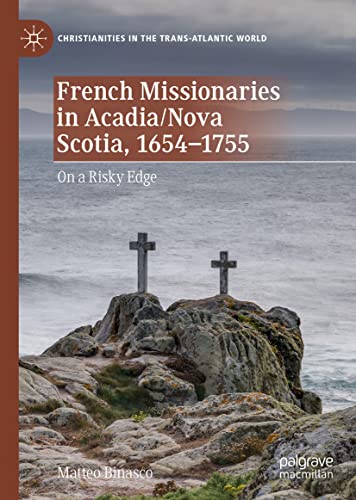
French Missionaries in Acadia/Nova Scotia, 1654–1755: On a Risky Edge
Written by Matteo Binasco Reviewed By J. C. WhytockThis book began as Italian-born Binasco’s MA thesis (2004) in the Department of History at Saint Mary’s University, Halifax, Nova Scotia. Since then, he has returned to Europe, where he is currently an adjunct at Foreigners’ University of Siena, Italy, and principal investigator for the project “The Anglo-Irish communities in the Spanish Caribbean during the early-modern period” at Universidad Pablo de Olavide, Seville, Spain. Binasco clearly brings a wealth of linguistic ability to his research and has traversed both sides of the Atlantic for sources at a most admirable level in France, Canada, and Vatican City.
The thesis of the book is “to investigate the activities and role played by the French missionaries in Acadia/Nova Scotia from 1654, the end of the second Capuchin mission in Acadia, to 1755, the beginning of the great Acadian deportation” (p. 1). The study is thus set within the context of the Anglo-French imperial wars, which had enormous implications for Acadia. Binasco argues that during this time, the Catholic missionaries experienced many changes which affected their strategies for both the indigenous/native peoples and the Acadian settlers.
This work is a regional study of Catholic missionary activity in Acadia in the defined period. We are introduced to the Jesuits, Capuchins, Franciscans, Seculars, Spiritans, Sulpicians, and Recollects. (There are five tables on these categories within appendix 1, “List of Missionaries Active in Acadia/Nova Scotia from 1654 till 1768” (pp. 187–200). The length of the full list (150) certainly makes a statement of the number of Catholic missionaries that spent some time in Acadia—despite one of the conclusions of the book being that the region was understaffed and thus often unable to really advance the mission work.
One area of weakness, especially considering those reading this work who may not be familiar with the various classifications of orders and certain terms (e.g., apostolate) in the Roman Catholic Church, is the limited background on each that could have been woven into the respective chapters. The author very cursorily does this in his introduction, but I suspect elaboration on these orders and terms would widen the appeal of the book. Then again, it does highlight the reality that the work is a specialized monograph and will not be used in popular reading, so understanding the market is key.
The author does allow us to see many complexities which are not always recalled, such as the Abenaki raids with French privateers against New England settlers (pp. 82–83)—the complexities of mission alliances. One will also come away clearly sensing the divisions and competitiveness amongst the various Catholic mission entities. There’s nothing new under the sun, and sadly such strains are often found among Protestants as well.
Though a regional historical study, it takes up themes that cross over into missiology and which are repeated in many contexts globally. For example, the matter of translation of native languages and reducing them to a written form is not unique to this book—though regional, there is also the universal. The author is clearly emphasizing the religious and political history, yet the missiological cannot be ignored or downplayed. In this regard, I would prefer a more interdisciplinary approach, and I think this would create a fuller-canvased conclusion. More specific detail could have been given, which would help the reader to explore areas such as liturgy, translation, syncretism, and conversion. What was the real nature of discipleship in the indigenous communities? Are there indigenous names that could be given more prominence in this period? However, such themes do not seem to be the real focus of this study; another study would be needed as a second volume to deal with the fuller missiological aspects historically.
The book does fill a gap for English readers concerning Acadia, will be of great value for those teaching Canadian church history and history, and no doubt will be added to bibliographies for such courses. It expands this often-ill-considered area of history and will be a helpful supplement to the surveys currently popular by Mark Noll (A History of Christianity in the United States and Canada [Grand Rapids: Eerdmans, 1992]) or Terrence Murphy and Roberto Perin (A Concise History of Christianity in Canada [Oxford: Oxford University Press, 1996]). This book should be taken alongside Binasco’s helpful article, “Few, Uncooperative, and Endangered: The Troubled Activity of the Roman Catholic Missionaries in Acadia, 1610–1710” (Journal of the Royal Nova Scotia Historical Society 10 [2007]: 147–62), a sort of prelude piece to this present work. Binasco also displays great interest in Irish Catholicism and missions amongst his research interests and was an editor for another work, Rome and Irish Catholicism in the Atlantic World, 1622–1908, in this same series, Christianities in the Trans-Atlantic.
I must say, personally, I was delighted to review this book as someone who has lived in, preached to, or visited many of the communities mentioned in the book; it had a particular fascination as a “road trip” in history. In that regard, the map in appendix 2 (p. 201) was disappointing as it was very difficult to read in the shaded areas.
I have only used one or two other books in this series. It appears the series began in 2013 and has since expanded its timeframe (formerly limited to 1500–1800 but now includes subjects into the twentieth century). The series shows much diversity of subject matter; for example, it deals with Samuel Prideaux Tregelles, Quakers, Ulster Presbyterians, Catholicism and missions, and debates about what constitutes Reformed identity. The two editors are worthy scholars for the series.
J. C. Whytock
Haddington House Trust
Charlottetown, Prince Edward Island, Canada
Other Articles in this Issue
Early Christians had to develop and negotiate their (new) identity within a society, to which their beliefs and ethical convictions were largely alien...
Acts of the Apostles reports several uprisings and instances of mob violence that occur across Asia Minor, caused by or related to the evangelistic and missionary endeavors of Paul and his companions in the middle of the first century...
As states continue to decriminalize marijuana and usage escalates in American culture, Christians must increasingly navigate their associations with the drug...
This article seeks to retrieve from the past in order to gain perspective for the present...
The book of Ecclesiastes is essentially a speech...
Other Reviews in this Issue