
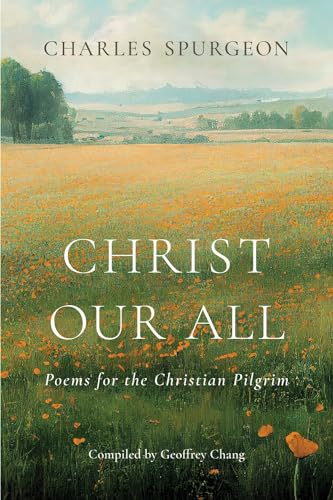
Christ Our All: Poems for the Christian Pilgrim
Written by Charles Haddon Spurgeon Reviewed By Gregory W. MathisIn Christ Our All, Geoffrey Chang has assembled a helpful compendium of C. H. Spurgeon’s poems in one place. Chang is an assistant professor at Midwestern Baptist Theological Seminary and the curator of the Spurgeon Library. Divided into the two categories of unpublished and published works, Spurgeon’s poems are supplemented by suggested Scripture readings for further contemplation, as well as citations of their original appearances where applicable. Assessing this collection requires evaluation on three levels. First, Chang’s editorial comments and decisions require attention. Second, the weighty task of appraising the poems themselves proves necessary. Finally, there is the need to appraise the unique contribution of the book as a whole.
Chang introduces the often-forgotten fact of Spurgeon’s affection for poems and hymns. Seen against the backdrop of the Rivulet controversy, wherein a contemporary pastor caused no little stir when he produced a Christian hymnbook of only ambiguous reference to the God of the Bible, Chang’s portrayal of Spurgeon captured his penchant for combining doctrinal truth with right affections (p. 11). Chang further sets out to “identify a unifying theme for the private poems, and perhaps even for all of Spurgeon’s poetry” (p. 18). The book’s subtitle provides the answer: Spurgeon’s pilgrim outlook. In this venture, Chang succeeds; the sheer volume of Spurgeon’s references to heaven, struggle, victory, sanctification, and experiential Christianity evades easy tabulation. All these themes and more can be captured by Spurgeon’s emphasis on the Christian pilgrim’s journey: perhaps a nod to Spurgeon’s well-known love for and allusions to Bunyan’s Pilgrim’s Progress.
Chang is easily forgiven for not organizing the poems by topical category, a move that might satisfy the preferences of researchers and devotional readers alike. Even a cursory reading of a handful of the poems reveals that such an effort is prevented by its virtual impossibility. For Spurgeon, each devotional thought contained an interconnected web of doctrines. His doctrine of depravity, for instance, yielded self-effacing declarations of the sinner’s utter dependence, even as those very thoughts on dependence gave way to exultations of God’s glory (pp. 70, 99). All this creates an environment in which each poem eludes simple categorization. The inclusion of a topical index at the work’s end, however, is a welcome supplement.
The task of weighing so broad and varied an array of poems—written by the “Prince of Preachers” no less—seems daunting. And yet certain notable patterns rise to the fore when the works are taken in summary. First, the poems frequently reference human frailty (p. 282). This surfaces in Spurgeon’s nearly constant allusions to the believer’s dependence upon God for all good. It likewise appears in Spurgeon’s frequent expectation of death and affectionate heavenward gaze (p. 64). Second, the theme of sanctification proves salient throughout. Spurgeon’s emphasis on the conscience and holiness satisfies those who continue to see in him a Puritan influence, while his plaintive posture toward God often turns to requests for help in growth in grace (pp. 33, 62). More incisive summaries of Spurgeon’s poems may exist, but attempts to identify too many common threads uniting them all are limited by the occasional, topical, and devotional nature of their composition. It is enough to observe, as others have before, that Spurgeon primarily wrote and spoke words because he believed God himself had spoken. It would seem unnatural to conclude that Spurgeon’s reflex to put truth into print would not somehow intersect with his affection for verse.
A few options exist for identifying the unique contributions of this work. One could point to the obvious research gift Christ Our All represents. Here, Spurgeon’s poems—especially the previously unpublished ones—have been liberated from the archives and made available to the popular reader. Moreover, the poems give a unique window into a side of Spurgeon seldom seen elsewhere. Since a healthy majority of those compiled were—after all—unpublished, one wonders what purpose they served. Through his poetry, Spurgeon was able to express his experiential theology and process his relationship with God through verse. For a man so often analyzed only through the lens of his outward-facing writing, Spurgeon’s poems give light to his private approach to devotion. Indeed, only 35 of the 186 unpublished poems do not adopt a first-person perspective. In other words, the overwhelming majority of Spurgeon’s poems arose from how he viewed himself, his church, or his membership as one of the elect in direct relationship to a personal God.
In this work, Chang has provided orienting handles for getting the most out of the primary source content that lies within. Christ Our All provides insights into both Spurgeon’s theology and devotional life. Given how Spurgeon held the two together, such insights are often present in the same poem.
Gregory W. Mathis
Midwestern Baptist Theological Seminary
Kansas City, Missouri, USA
Other Articles in this Issue
The Devil Is Not a Christian: Critiquing Christian Universalism as Presented by David Bentley Hart
by Robert GoldingDavid Bentley Hart’s book entitled That All Shall Be Saved is a powerful argument at first glance for the doctrine of Christian universalism, which is the view that those in hell all eventually enter heaven...
Making the Lion Lie Down Hungry: Forgiveness as Preventative Spiritual Warfare in 2 Corinthians 2:5–11
by Scott D. MacDonaldWhile Christians should understand and practice forgiveness, many of them have not experienced forgiveness from others within the church...
Why a Purely Natural Theology Could Lead Us Astray: Karl Barth’s Response to the Theology of Gender and Marriage Sponsored by the Nazi Party
by T. Michael ChristIn response to the erosion of the biblical paradigm of gender and marriage in modern Western society, some believers are inclined to support any promotion of heterosexual monogamous marriage as a positive moral force...
Throughout his writings, but especially in the presentation of his ecclesiology, John Gill exhibits a steadfast commitment to a theological sensibility today referred to as Baptist catholicity...
How does the author of Hebrews understand Psalm 8? It is a question scholars and other careful readers continue to ask...
Other Reviews in this Issue