
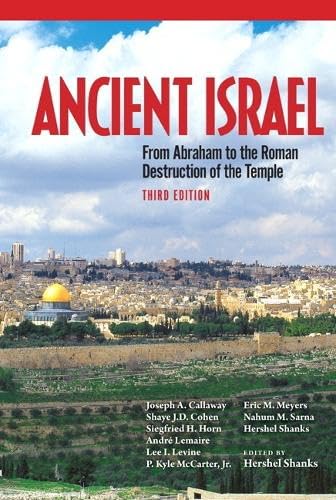
Ancient Israel, From Abraham to the Roman Destruction of the Temple (2nd edition)
Written by Hershel Shanks (ed.) Reviewed By K.A. KitchenThe first edition of this book appeared in 1988, and was reviewed by me and others in Themelios 15/1 (Oct. 1989), 25–28. This version is 90 pages longer, and the colour plates, maps and charts are revised and increased. In most chapters the text is largely the same, with some omission, rearrangement, and introduction of fresh material. Chapter 5 was extensively rewritten.
In this second edition there are undoubtedly gains and losses. First, the bad news. Chapter 1, the Patriarchs (Hendel revising McCarter), shows almost no improvement over its disastrous precursor; my 1989 criticisms remain valid throughout. There are gross untruths, e.g. my treatment of patriarchal names was not based on ‘random finds’ (300, n. 23) but on systematic analysis of several thousand names (cf. Them. 15/1, 25), the Egyptian and Assyrian texts of page 12 are irrelevant to the patriarchs (Them. 15/1, 26), and much else. As a factual guide, the chapter is worthless; it merely showcases a nineteenth-century mind-set in modern clothes. Chapter 2, Israel in Egypt and the Exodus, was first competently done by Sarna; now Hershel Shanks has spoilt it. Important Egyptian-related evidence on the plagues and the Tabernacle has been removed. Massive factual blunders have been added, e.g. the famous Canaanite war-scenes of Sety I (1290 BC) and the Moabite war of Ramesses II (1272 BC) magically become war-scenes of Thutmose III, 15th century BC (48, 50)! And there is worthless speculation for good measure: no ritually-unclean Hebrew could ever have seen the 400 Years Stela of Ramesses II at Tanis. If re-erected there, it was hidden away in inner temple courts, where no foreigners were welcome. But in fact it and other stelae from Raamses were most likely used-up in foundations at Tanis, and were seen by nobody until the last 100 years! Hence this stela has nothing whatever to do with the 400 years from Jacob to Moses. In the first edition chapter 3, Settlement in Canaan and the Judges, Calloway bravely struggled with mutually incompatible views of the Joshua-Judges period and of the two books, but the result was highly unsatisfactory. Miller has equally bravely updated this chaos, usefully in part, but is just as unable to produce a valid synthesis. And his quoting Ahlström regarding the spelling of ‘Israel’ on Merenptah’s famous stela is a major blunder. That stela bears a highly accurately written text, and the determinative (people, not place) is precisely correct.
Now the (mainly) good news. Chapter 4 on the United Monarchy, revised by its author (Lemaire) is a judicious review, appropriately updated, and rightly yields nothing to minimalist fantasies. Chapter 5, Horn’s Divided Monarchy, has been largely rewritten, and vastly improved and updated by McCarter, the biggest and best change in the book. It is not faultless; he is wrong to follow Goedicke’s outdated and erroneous paper on So as Sais (town) instead of Osorkon IV (king)—contrary to McCarter, such names areabbreviated: e.g. Shosh for Shoshenq; Osorkon losing its ‘O’ or its ‘n’. While rightly rejecting two campaigns by Sennacherib, he fails to cope with Tirhaqah’s role (see my Third Intermediate Period in Egypt, 1996 ed.). Chapters 6, 7 and 8 on the Exile and Return (Meyers revising Purvis), the Hellenistic age (Levine) and Roman rule (Satlow revising Cohen) are useful updates of what were originally quite good presentations, though the Nabateans are still missing in chapters 7 and 8. In sum, chapters 1–3 are still too badly flawed, and chapters 4–8 are relatively good updates. The work still remains a curate’s egg: good in most parts, poor at the start.
K.A. Kitchen
University of Liverpool
Other Reviews in this Issue

The Holy Spirit
Reviewed by Carl Trueman
Divine Revelation
Reviewed by Paul Gardner