
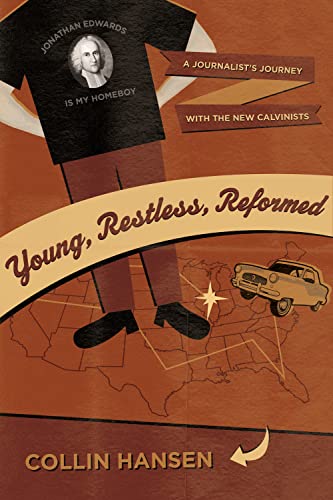
YOUNG, RESTLESS, REFORMED: A JOURNALIST’S JOURNEY WITH THE NEW CALVINISTS
Written by COLLIN HANSEN Reviewed By Andrew David NaselliThis book reads like Hansen’s numerous articles in Christianity Today: popular, relevant, well researched, informative, fascinating, penetrating, and enjoyable (both the content and style). The title borrows from Hansen’s article in Christianity Today in September 2006: “Young, Restless, Reformed.” These three adjectives summarize the group that Hansen probes: they are evangelicals (1) in their teens, twenties, and thirties who are (2) passionate about (3) God’s sovereignty. Large swaths of the rising generation of evangelicals are enthusiastically embracing Reformed soteriology or Calvinism. Hansen applies his journalism skills to find out why.
Hansen travels all over the United States to interview evangelical leaders inspiring “the new Calvinists” as well as dozens of the new Calvinists themselves. He does not shy away from asking tough questions, nor from interacting with other leaders holding opposing viewpoints. The book divides into seven chapters, each focused on a particularly influential aspect of the Reformed resurgence and loaded with bite-sized historical and theological nuggets along the way.
Passion Conference in Atlanta: John Piper’s passionate messages at the Passion conferences influence thousands of teens. This chapter also discusses TULIP, the decline of Calvinism in American history, the prevalence of moralism among teenagers, and Hansen’s personal testimony, including this gem: “I didn’t go looking for Reformed theology. But Reformed theology found me” (25).
Bethlehem Baptist Church in Minneapolis: “Piper is the chief spokesman for the Calvinist resurgence among young evangelicals” (29). His Calvinism is contagious—certainly not the stale “frozen chosen” variety. This chapter also further discusses TULIP, interviews Roger Olson, explains Arminianism and Pelagianism, and explores the relationship of complementarianism to the Reformed resurgence.
Yale University in New Haven, Connecticut: Jonathan Edwards has fueled the Reformed resurgence via his influence on its leaders. Yale is the home of the Jonathan Edwards Center, which possesses ninety percent of Edwards’s actual notes and manuscripts and is publishing his complete works. This chapter considers why Edwards’s image waned and became prominent again, interviews J. I. Packer and Josh Moody, and explores the Reformed University Fellowship at Yale.
Southern Seminary in Louisville: When Al Mohler became the president of the Southern Baptist Theological Seminary in 1993 at age thirty-three, the conservative resurgence got more than they bargained for in a confessionalist committed to Southern’s Abstract of Principles: not only does he staunchly defend the inerrancy of Scripture, he is an unashamed five-point Calvinist. As probably the largest seminary in America today, Southern is training thousands of Calvinists. This chapter wrestles with the implications of Calvinism for evangelism and the Southern Baptist Convention, interviewing Tom Nettles, Timmy Brister, Steve Lawson, Tom Ascol, Tom Schreiner, Steve Lemke, and Fisher Humphreys.
Covenant Life Church in Gaithersburg, Maryland: Charismatic Calvinism is becoming increasingly common, largely due to C. J. Mahaney’s Sovereign Grace Ministries, headquartered at Covenant Life Church. Mahaney founded Covenant Life in 1977 and pastored it until 2004, when his protégé, Joshua Harris, took over. Like Wayne Grudem, Sovereign Grace is “Charismatic” in a very guarded sense compared to typical Pentecostal excesses. Mahaney’s characteristic humility and exaltation of God’s sovereignty permeate the Sovereign Grace network. This chapter highlights the 2006 Together for the Gospel conference, discusses Reformed theology as an entire system (including infant baptism), and interviews Michael Horton.
New Attitude Conference in Louisville: Founded by Joshua Harris, the New Attitude conference’s motto says it all: “humble orthodoxy.” Harris exclaims, “If you really understand Reformed theology, we should all just sit around shaking our heads going, ‘It’s unbelievable. Why would God choose any of us?’ ” (123). This chapter interviews Eric Simmons and discusses Campus Crusade for Christ, University Christian Fellowship, and blogging.
Mars Hill Church in Seattle: Mark Dr iscoll, a lightning rod for controversy, describes his church as “theologically conservative and culturally liberal” (138). He unambiguously teaches Reformed soteriology, which he paraphrases rather crassly: “people suck and God saves us from ourselves” (139). This chapter also investigates Driscoll’s controversial views on women (complementarianism) and culture (noting John MacArthur’s critique and Driscoll’s humble response) and interviews Tony Jones, Gerry Breshears, Jennifer McKinney, and Wendy Alsup.
I am not aware of any other book quite like this one. It will be especially useful to at least three groups who want to understand the new Calvinists better: (1) evangelical leaders, (2) older evangelicals, (3) and younger evangelicals, especially ones who are passionate about God’s sovereignty but are still relatively green on theological terms and history. This book will connect the (Reformed) dots for a lot of people.
As one of the new Calvinists, I concur with Hansen’s overall analysis of why so many young evangelicals enthusiastically embrace Reformed soteriology. I have been profoundly influenced by older theologians like Calvin, Luther, Owen, Edwards, Spurgeon, and Warfield as well as contemporary leaders like Piper, Dever, Mahaney, and MacArthur. In particular, Piper’s Desiring God has been incalculably influential in the resurgence of Calvinism (cf. Hansen, 15, 29, 32). Piper’s richly theological and warmly devotional best-seller has been the means for sending countless Christians on a trajectory towards theology that is increasingly joyful, robust, God-centered, Christ-exalting, and gospel-treasuring. It shaped my attitude towards Reformed soteriology, and Hansen demonstrates that my testimony is not unusual. I joyfully thank God and pray that the new Calvinists will humbly mature and multiply to the glory of God.
Andrew David Naselli
Andy Naselli is assistant professor of New Testament and Biblical Theology at Bethlehem College and Seminary in Minneapolis and administrator of Themelios.
Other Articles in this Issue
One of the most eminent spin doctors of the fourth century, Augustine bemoaned that he was merely a vendito verborum (a peddler of words)...
Hudson Community Chapel is a suburban church in the Midwest that averages a little over three thousand people each weekend...
It must by now be questionable whether the word "mission"retains any residual value for missiology...
"For to freedom you yourselves were called, brothers; only do not use your freedom as an opportunity for the flesh, but through love serve one another...
In the course of Christian history, nowhere has the tension between the teachings of Jesus and valid application of those teachings in postbiblical socio-cultural circumstances manifested itself more clearly than surrounding the issue of violence...
Other Reviews in this Issue