
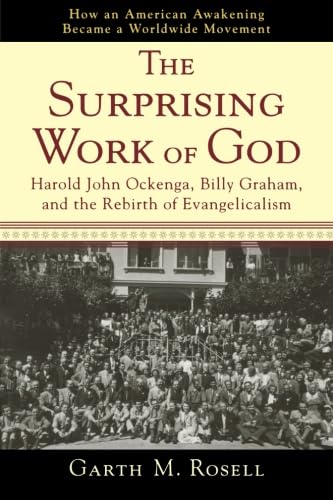
The Surprising Work of God: Harold John Ockenga, Billy Graham, and the Rebirth of Evangelicalism
Written by Garth M. Rosell Reviewed By Nathan A. FinnEvangelicalism is commonplace enough in contemporary America that historian Barry Hankins argues the movement has become mainstream. Insofar as Hankins’s contention is true, it reflects a paradigm shift that took place among conservative Protestants in the 1940s and 1950s. Prior to World War II, terms like “evangelical” and “fundamentalist” were virtual synonyms, reflecting tendencies within one broad movement rather than different (but related) movements. Furthermore, conservative Protestants were anything but mainstream prior to mid-century. In the wake of the Scopes Trial and the denominational wars of the 1920s, evangelicals/fundamentalists were more concerned with building their parachurch subculture rather than engaging the broader culture. But beginning in the early 1940s, a cadre of younger conservatives distanced themselves from the more separatist fundamentalism and launched a “neo-evangelical” movement that gradually brought about the cultural prominence that many evangelicals now enjoy.
It is the story of this “rebirth of evangelicalism” that Garth Rosell tells in The Surprising Work of God, his narrative history of the early neo-evangelical movement. Rosell is uniquely qualified to tell this story. He has taught church history for many years at Gordon-Conwell Theological Seminary, an institution founded by some of the leading neo-evangelicals in New England. Perhaps even more important, he is the son of evangelist Merv Rosell, who was a significant participant in many of the events recounted in the book.
The Surprising Work of God is divided into nine short chapters. The book begins by briefly recounting the origins and nature of American evangelicalism. Like most historians, Rosell argues that movement-evangelicalism is largely a product of the eighteenth- and nineteenth-century awakenings and contends that most evangelicals share some core distinctives about the Bible, salvation, and evangelism. He then focuses the bulk of his narrative on two key figures in the movement’s mid-twentieth-century “rebirth”: Boston pastor Harold John Ockenga and evangelist Billy Graham. Both men are shown to be gifted entrepreneurial leaders who rejected separatist fundamentalism in favor of a more irenic and engaged evangelicalism. Both men enjoyed measurable success in their personal ministries and were concerned to see a new evangelical consensus play a role in ushering in another spiritual awakening that would convert millions of Americans to Christianity. As products of the parachurch movement of the 1930s and 1940s, both men were instrumental in the founding of neo-evangelical parachurch ministries like the National Association of Evangelicals, the Billy Graham Evangelistic Association, Fuller Theological Seminary, Christianity Today, and Gordon-Conwell.
Rosell uncovers very little in the way of new information about the early years of neo-evangelicalism, though there are some helpful contributions to the field. These include the focus on Ockenga and Graham’s friendship, the insights of lesser-known leaders (particularly Merv Rosell), and the central role that world evangelization played in neo-evangelical priorities. At times the author shows a bit too much sympathy for his subjects, perhaps because of his own ties to neo-evangelicalism via his father and his personal relationship with Ockenga and other movement-leaders. But authorial bias does not significantly detract from the book itself.
The Surprising Work of God is a well-written, sympathetic introduction to mid-twentieth-century conservative Protestantism. In many ways Rosell’s work is a model for how to write “insider” history that is well-researched and useful to many in the wider academy. The book would be particularly useful in evangelical college and seminary courses in American religious history. Those interested in a more scholarly historical introduction to the early years of neo-evangelicalism should consult Joel Carpenter’s Revive Us Again: The Reawakening of American Fundamentalism (Oxford University Press, 1997) or Jon Stone’s On the Boundaries of American Evangelicalism: The Postwar Evangelical Coalition (Palgrave MacMillan, 1997).
Nathan A. Finn
Nathan A. Finn is Professor of Faith and Culture at North Greenville University in Greenville, South Carolina.
Other Articles in this Issue
Most of our readers are theological students and pastors...
The Dazzling Darkness of God’s Triune Love: Introducing Evangelicals to the Theology of Hans Urs von Balthasar
by Stephen M. GarrettJürgen Moltmann observes that Christian theology and the Church face “a double crisis: the crisis of relevance and the crisis of identity...
Plots, Themes, and Responsibilities: The Search for a Center of Biblical Theology Reexamined
by Daniel J. BrendselIn the prolegomena to his “approach to biblical theology,” Charles H...
Since the mid-twentieth century biblical scholars have increasingly accepted that the texts of the Bible must be interpreted in terms of their literary genres...
The present age tends to regard polemics, theological controversies, and all-round doctrinal fisticuffs as, at best, a necessary evil, at worst, one of the most revolting aspects of Christianity...
Other Reviews in this Issue