
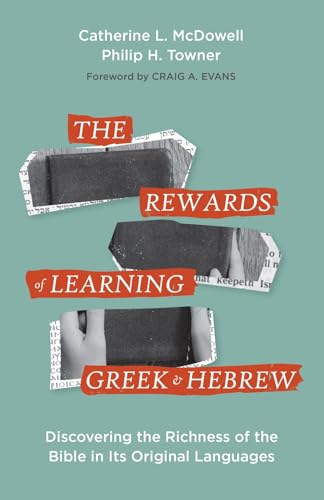
The Rewards of Learning Greek and Hebrew: Discovering the Richness of the Bible in Its Original Languages
Written by Catherine L. McDowell and Philip H. Towner Reviewed By Cristian G. RataIn the past, many teachers of biblical languages relied (at least partly) for the motivation of their more complacent students on the passionate article of John Piper, “Brothers, Bitzer Was a Banker,” in Brothers, We Are Not Professionals (Nashville: B&H Publishing, 2002), ch. 12. Piper persuasively provides examples from church history of people who prized the biblical languages and “contended” with them (e.g., Heinrich Bitzer, Martin Luther, John Newton, George Müller). The writers of this book go in a different direction in their attempt to motivate and encourage students of biblical languages. They give concrete examples, in practical and dynamic ways, to illustrate the benefits and rewards of reading the Bible in its original languages.
The book is divided into nineteen chapters. Catherine L. McDowell writes the first ten with the goal of showing the benefits of learning biblical Hebrew, and Philip H. Towner writes the final nine to argue for the rewards of learning biblical Greek. The authors bookend each chapter, opening with a useful supporting quotation from a language scholar and closing with an inspiring testimony usually from a relatively new student of the biblical languages. These quotations and examples further the argument of the book.
In the first chapter, opened by Bruce Waltke’s call to engage in theology only after the purging “fire of careful exegesis,” McDowell focuses on the Hebrew of Genesis 1:26–28 to explain the difference between Adam and אָדָם. Her point is that the Hebrew term אָדָם “refers both to ‘humanity’ and to the individual man, Adam” (p. 5), depending on the context. She gives relevant examples from other passages to make her point and ends by reminding readers that every translation involves interpretation. Moreover, Hebrew helps to “plumb the depths of God’s self-revelation in ways that are simply inaccessible in translation” (p. 6). The motivating continues by her insisting that learning Hebrew “brings you closer to God’s word and to God himself!” (p. 7). The chapter closes with a very useful quotation from Professor Ethan Jones in which he points out that reading the Bible in Hebrew forces you to slow down and helps savor the Scriptures. He concludes, “I’m forever grateful to have constant access to a de-accelerant in a hurried world” (p. 7).
The second chapter opens with a supporting quotation from Philip Melanchthon: “The Scripture cannot be understood theologically unless it be first understood grammatically” (p. 9). The chapter focuses on the importance of reading well the “imperfect consecutive preterite” for feeling the swiftness and pathos of a sequence of actions. At the end of the chapter, a student confesses that her study of biblical languages made “Scripture come alive” (p. 12).
In the third chapter, the correlation between the task given to Adam in the garden of Eden (Gen 2:15) and the subsequent duties of the priests in the tabernacle is explained through an exploration of how the Hebrew wordplay עבד and שׁמר (work/serve and keep/guard) helps connect the task given to Adam in the garden of Eden (Gen 2:15). Unfortunately, this connection is generally “lost in translation.” In chapter four, “When God Uses Italics,” the author points out how Hebrew emphasizes the subject by including the pronoun in contexts where it is not grammatically necessary. Parts of McDowell’s conclusion are worth reproducing: “We should be aware that translators’ attempts to provide a smooth … translation can, at times, conceal rather than reveal an author’s emphasis…. When the subject is God himself, noticing an emphatic personal pronoun can even lead you to worship!” (p. 20).
The following chapters explain the importance of fronting for emphasis (ch. 5), understanding Hebrew euphemisms and idioms (ch. 6), prophetic sarcasm and insults (ch. 7), various puns which “are fun” (ch. 8), the usefulness of catching the alliteration and/or assonance to perceive a poem’s full sense or dramatic intensity (ch. 9), and how catching allusions (ch. 10) from Genesis 1 (תֹהוּ וָבֹהוּ) helps with the understanding of Isaiah 34:11.
After studying the Hebrew section of this book, every careful reader should agree with McDowell’s conclusion that by “reading and studying the Old Testament in Hebrew, you will have greater access to the connectedness of Scripture and a better sense of how the parts fit together” (p. 53). There is no doubt that there are “hidden treasures” in wrestling with the biblical text in its original languages.
Towner starts the Greek section by admitting that even though he is convinced about the benefits of learning how to read the NT in Greek, it is much harder to demonstrate. I think that is correct. You have to be “already on the inside of the language” (p. 57) as the finer points of grammar are usually taken up only in more advanced Greek exegesis courses.
Chapter 11 shows how reading the NT in Greek brings one closer to original audiences (proximity) but can also disorient and disrupt, thus teaching one the highly useful art of reading closely and slowly (pp. 61–62).
Chapter 12 makes a very powerful argument for the importance of the Septuagint (LXX) for NT studies. The following chapters show the importance of Greek for understanding intertextuality (ch. 13) and for hearing the original text because it was written to be read aloud (ch. 14), the use of wordplay and repetition (ch. 15), the importance of the εὐσέβεια (piety) word group for 1 Timothy (ch. 16), some examples of the ambiguities in the original text (chapter 17), the “poetics of divine wrath” (chapter 18), and ends with a useful preview of “coming attractions” (ch. 19). For those who are willing to get a hold of the “master key” (Greek), it will unlock many more doors to the discipline of New Testament studies, including textual criticism.
In an age when many seminaries are cutting back on courses in the biblical languages, there is an urgent need for a book like this—one which demonstrates so convincingly the rewards of the original languages of the Bible. The expertise of both writers in their fields, along with their passion and obvious love for the subject, significantly enhance the value of the book.
While I found myself disagreeing on occasions on minor points and found a few arguments questionable, I highly recommend this book to all teachers who need additional help to motivate their students of biblical languages, as well as to any student who is not yet convinced about the rich rewards of learning Hebrew and Greek.
Cristian G. Rata
Cristian G. Rata
Training Leaders International
Minneapolis, Minnesota, USA
Other Articles in this Issue
Menzies responds to Tupamahu’s post-colonial critique of the Pentecostal reading of Acts and the missionary enterprise...
The Lamblike Servant: The Function of John’s Use of the OT for Understanding Jesus’s Death
by David V. ChristensenIn this article, I argue that John provides a window into the mechanics of how Jesus’s death saves, and this window is his use of the OT...
Geerhardus Vos: His Biblical-Theological Method and a Biblical Theology of Gender
by Andreas J. KöstenbergerThis article seeks to construct a biblical theology of gender based on Geerhardus Vos’s magisterial Biblical Theology...
Is the One God of the Old Testament and Judaism Exactly the Same God as the Trinitarian God—Father, Son, and Holy Spirit—of the New Testament and Christian Creeds?
by John Jefferson DavisThis article argues that the One God of the Old Testament and Judaism is exactly the same God as the Trinitarian God of the New Testament and Christian creeds...
A well-known Christian intellectual and cultural commentator, John Stonestreet, has often publicly spoken of the need for Christians to develop a theology of “getting fired...
Other Reviews in this Issue