
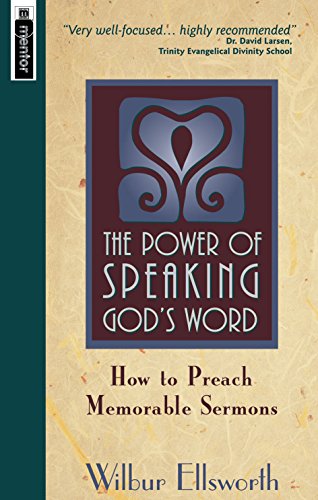
The Power of Speaking God’s Word
Written by Wilbur Ellsworth Reviewed By Peter AdamThis book is an argument that preaching should be formed by ‘orality’ (spoken language) rather than ‘literacy’ (written language).
At a practical level Wilbur Ellsworth wants us to avoid using notes in our preaching. At a deeper level he wants to think about preaching and prepare and present our sermons as speakers for those who will hear, not as writers for those who will read.
He claims in chapter 2 that ‘orality’, spoken language, will be dialogical, communal, formulaic, descriptive, situational, and acoustic. He points out that the spoken word must be instantly intelligible, and cannot depend on the ability to scroll back and review the argument so far. He rightly points out that the gap between spoken language and written language is immense. Spoken language reads badly when transcribed, and written language sounds badly when heard.
The point that Wilbur Ellsworth is making is an important one. Think of the gap between the style of a written review and a spoken reply to the question: What did you think of this book?
I reckon that the problem is increased by five factors:
One: We no longer read aloud (Augustine was amazed to see Ambrose reading silently!), and so the gap between written language and spoken language has increased.
Two: The production of many cheap copies of the Bible means that for us it is a book we read, rather than a book we hear read, as it was for most of its original audience.
Three: Students who study for the ministry from churches where there is little Bible teaching learn the Bible in the context of college lectures and essays. If they teach the Bible in their ministry the model they use is that of the academy.
Four: The use of word-processors means that the essay style can be easily, but unfortunately, transferred to the pulpit.
Five: The price of academic respectability is an academic style, which does not always take into account the hearer or listener.
His quotation from Robin Meyers’ With ears to hear summarises the message of the book:
Perhaps the biggest failure in the teaching of preaching is that young ministers are not fully impressed with the difference between textuality and orality. Shaped by mountains of books, called upon to write scores of papers, and graded largely by what they commit to the page, aspiring preachers train the eye but neglect the ear.
We could change those last words to ‘train the eye and typing hand but neglect the ear and speaking mouth’.
As one who loves the company of books, I was helpfully challenged by Ellsworth’s ideas. He wants me to think ‘orality’ from the beginning of my sermon preparation, to work hard all the way through on the questions: How will I say it? and How will they hear it?
We should be able to do without notes. If the preacher cannot remember the sermon, how will the hearer remember it? This does not mean that I can skimp on my preparation: it does mean that I must not be so formed by the written word that I sound like a book and not like a person. Written words are good servants but bad masters.
God wants preachers, not walking books or talking computer screens!
Peter Adam
Peter Adam
St. Jude’s Carlton
Melbourne, Victoria, Australia
Other Articles in this Issue
Other Reviews in this Issue
Justice that Restores
Reviewed by Dewi Hughes