
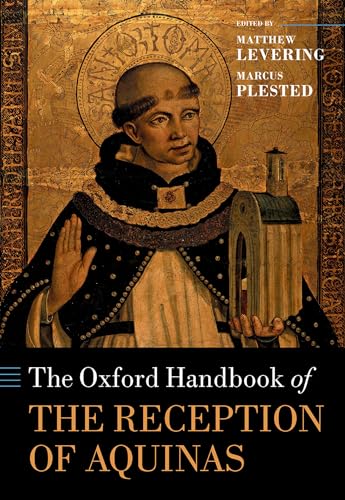
The Oxford Handbook of the Reception of Aquinas
Written by Matthew Levering and Marcus Plested, eds. Reviewed By David HainesTracing the history of philosophy and theology can be a daunting task for any scholar. It is all too easy to miss key historical moments or figures, or worse, to misread key historical authors and misunderstand the significance of historical events. Being so enveloped in our times, we often read our views into the past or look to the past for a golden age that is not there. In light of the difficulties associated with introducing the voices of the past into contemporary conversations, a book that “impartially” traces the influence of so important a scholar as Thomas Aquinas is of obvious importance. This task was set before the editors and authors of this collaborative work on the reception of Aquinas. As a collaborative work, not every article is of equal importance and will not be of equal interest to all readers. However, the editors have succeeded in providing the reader with a veritable gold mine of articles tracing the development of Thomistic thought and non-Thomistic interaction with the thought of Aquinas from the thirteenth century to the present day. The authors of the forty-four articles are all specialists in their fields and represent a wide variety of religious and non-religious traditions. For example, articles examining the reception of Aquinas in the Reformed tradition are written by Reformed theologians and historians (i.e., Carl Truman, Steven Duby, David Van Drunnen, David Sytsma, and others); articles looking at the reception of Aquinas in Lutheran traditions are written by Lutheran scholars (such as David Luy and Benjamin Mayes); and so on.
The book is divided into eight main parts. Part 1 deals with the medieval reception of Aquinas from the thirteenth to the fifteenth centuries. Part 2 deals with how Aquinas was received during the sixteenth and seventeenth centuries by reformation and counter-reformation theologians. Part 3 concentrates on the seventeenth-century reception of Aquinas. Part 4 looks at the eighteenth and nineteenth centuries, and parts 5 to 8 consider the reception of Aquinas from the early twentieth century to the present day. With forty-four articles covering nine centuries and the space constraints of this review, I cannot provide a balanced overview of every single article in this book, as this would amount to listing the titles of the articles. As such, this review concentrates on some of the essays most likely to interest the readers of this journal: those discussing the protestant reception of Aquinas throughout the centuries.
In the first part of the book, we discover that Aquinas was not necessarily readily accepted in his own time but was something of an innovative thinker. Corey L. Barnes, in the first chapter of the book, notes that Aquinas would have been considered somewhat progressive due to his interaction with Aristotle. He goes on to show that scholars of the thirteenth century interacted critically with the writings of Aquinas on several key issues, including the real distinction between esse and essentia. As Barnes rightly notes, Aquinas was a thirteenth-century scholar amongst thirteenth-century scholars. Other articles in this first part point towards the critical reception of Aquinas in the fourteenth and fifteenth centuries. Richard Cross, for example, in the fourth chapter, notes how Scotus and Ockham developed their views largely in opposition to Aquinas. As the fifteenth century progressed, however, interest in Aquinas grew, leading us to the second part of this book.
Part 2 of this book turns to the reception of Aquinas in the sixteenth century, beginning with Lutheran and Reformed interaction with Aquinas. David Luy, in chapter 8, begins with an excellent discussion of Luther’s interaction with Thomistic thought. He argues that contrary to the received wisdom, which would see Luther as fully opposed to Aquinas both in general and in particular doctrines, the situation is significantly more nuanced. A couple of key points worth mentioning include the suggestion that Luther’s primary polemical contention was that Aquinas should not be taken as so authoritative that his opinion was sufficient to extinguish all debate. He notes that Luther conceded the importance of Aquinas and Bonaventure, their relative authority, but sought to keep their views on the level of important opinions on theological matters. Luther also disagreed with key doctrinal claims in Aquinas’s work, such as questions related to the sacraments and church authority. However, rather than outright rejection, Luther showed himself ready to admit that, for example, Aquinas’s views on the Eucharist had some merit. Luy notes further that modern Lutheran scholarship painted Luther’s critiques of Aquinas in metaphysical and epistemological terms when they were, in fact, primarily soteriological. Luy also rightly notes that Luther’s Aquinas was not so much the Aquinas that we find in primary source material (such as the Summa Theologiae), as the Aquinas which was put forward by scholars of Luther’s own time (such as Gabriel Biel and Andreas Karlstadt). As such, Luther’s critiques of Aquinas do not always hit Aquinas himself. In fact, on some points, one might almost suggest that Luther and Aquinas would have agreed with some of the critiques that Luther leveled against the scholastic theologians of his own time. He concludes with a helpful discussion of contemporary debates concerning whether or not Luther and Aquinas would have agreed.
Chapter 9 turns to a helpful survey by David Sytsma of recent research into the Reformed reception of Aquinas. Sytsma helpfully points out that rumours of a strong discontinuity between late medieval and early Reformed thought, along with the outright rejection of the ideas of Aristotle and Aquinas, have been greatly exaggerated. Sytsma points us towards a number key sixteenth-century Reformed theologians (such as Bucer, Zwingli, Oecolampadius, Bullinger, Calvin, Vermigli, and Zanchi) and clarifies how much they probably knew or understood Aquinas, demonstrates that they generally considered Aquinas to be one of the best of the medieval scholastics, and illustrates where they agreed with, nuanced, or disagreed with Aquinas. In relation to doctrinal agreement, Sytsma concentrates primarily upon questions of theological prolegomena, biblical hermeneutics, the doctrine of God, human nature, the nature of the law, and elements of Christology. He shows that though dependence upon Aquinas cannot always be proved, general agreement with Aquinas can be illustrated on these subjects and many more. He concludes that the major Reformed theologians of the sixteenth century, by and large, saw Aquinas as an ally, frequently drew upon his work, and developed Reformed doctrine in ways that tended to agree with Aquinas more than it disagreed.
In part 3, Carl R. Trueman, in chapter 14, argues that though one may only tentatively trace the influence of Aquinas on seventeenth-century Reformed scholars (due to the wide variety of ways in which his work had been appropriated and developed since the thirteenth century), we do see his influence in the development of Protestant universities and academic practices, in Reformed interaction with questions related to metaphysics, theology proper, predestination, divine sovereignty, human nature and free will, and natural law and moral philosophy. Benjamin T. G. Mayes notes, in chapter 15, that seventeenth-century Lutherans often interacted with Thomists of the time. The Lutherans tended to warn against scholastic theology in general, and Aquinas was a part of this group. However, though Lutherans often disagreed with the scholastic method, Mayes notes that they agreed with Aquinas on a wide variety of theological issues, such as the primacy of theology, proofs for the existence of God, theology proper, and questions of moral philosophy. There were, of course, many disagreements as well, and some Lutherans warned against reading Aquinas altogether. Mayes rightly notes that unless we find direct quotations, it is easier to prove agreement in doctrine rather than direct influence or reception. This chapter is a wide-ranging and in-depth consideration of seventeenth-century Lutheran interaction with Aquinas, which could be summarized by saying that some Lutherans appreciated Aquinas, others saw him as one voice among many, and others disliked him. There was no predominant approach to Luther amongst seventeenth-century Lutherans.
In part 4, chapter 21, Steven J. Duby notes that Protestants received or rejected Aquinas in a wide variety of ways in the eighteenth and nineteenth centuries. He critically considers the way that Charles Hodge, Herman Bavinck, some Anglican theologians, and Isaak Dorner (Lutheran) interacted with Aquinas. He summarizes his research by suggesting that these theologians interacted appreciatively and critically with the work of Thomas Aquinas. In part 5, chapter 28, James Eglinton considers how Abraham Kuyper interacted with Aquinas, and in chapter 29, Kenneth Oakes discusses Karl Barth’s approach to Aquinas. In part 7, chapter 37, David VanDrunen discusses contemporary uses of Aquinas in relation to the natural knowledge of God, taking the time to analyze contemporary Protestant “attacks” on Natural Theology in Barth, Van Til, and Plantinga and then noting how Aquinas can be used to helpfully discuss the role, nature, purpose, and sufficiency of this natural knowledge of God.
This book is an excellent contribution to contemporary discussions concerning Thomas Aquinas’s continuing influence and importance. Though I have concentrated my review on the interest this book may hold for a Protestant audience, it is worth noting that articles in this work also discuss the reception of Aquinas in Roman Catholic and Orthodox theology and in contemporary discussions of theological and philosophical import. This book will be a helpful, perhaps necessary, addition to the library of any scholar who wishes to engage with the thought of Thomas Aquinas today.
David Haines
David Haines is assistant professor of philosophy and theology at Bethlehem College and Seminary in Minneapolis, Minnesota.
Other Articles in this Issue
The Spirit of God and the Religions of the World: A Response to Amos Yong’s Claims
by J. David WilloughbyAmos Yong, an acclaimed Pentecostal scholar, argues for what he calls a pneumatological theology of religions...
Pastoral Pensées: “We Do Not Lose Heart”: Theological Encouragement for Endurance and Opportunities for Reflection from 2 Corinthians 4:1–16
by Cody WilbanksBurnout is an evergreen threat for those in Christian ministry...
Contraception and the Church: Making Sense of the Debate and Some Pastoral Advice
by Dennis M. SullivanThis article reviews the ethical and theological issues surrounding birth control, with an emphasis on hormonal methods...
“Union” has become an increasingly valuable tool in discussions of atonement and soteriology...
Other Reviews in this Issue