
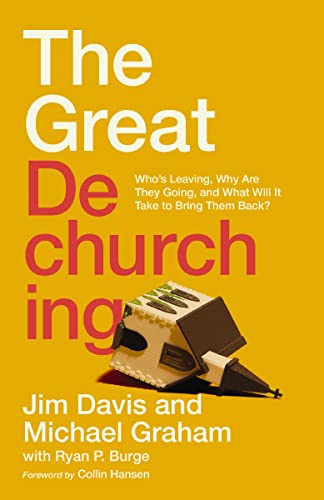
The Great Dechurching: Who’s Leaving, Why Are They Going, and What Will It Take to Bring Them Back?
Written by Jim Davis and Michael Graham with Ryan P. Burge Reviewed By Scott LuckyAre there any advantages to growing up in a family that did not attend church? A life spent pursuing the fleeting pleasures of sin, the flashiness of the world, and the vanity of attempting to make a name for oneself often brings shame and guilt when I think about my own past. I wish I’d never known a day when I was not attending church, hearing the gospel, and living for Christ. Imagine the dual culture shock I experienced when I was converted a month before turning 25 and moved from California to Mississippi. By God’s grace, he gave me a hunger for his Word and a natural insight into the mind of someone far from God.
I grew up in unchurched California but now serve in what Flannery O’Conner called the Christ-haunted South. In Mississippi, church buildings line the landscape but are rarely full. Church members are often discouraged and wonder when their church will experience the glory days of the past. So, when I heard about The Great Dechurching by Jim Davis and Michael Graham with Ryan P. Burge, I was eager to read their assessment of this momentous shift in the religious history of the United States.
Jim Davis is a teaching pastor at Orlando Grace Church and hosts the As in Heaven podcast. Michael Graham is the program director for the Keller Center of Cultural Apologetics and executive producer of the As in Heaven podcast. Ryan P. Burge is a pastor, an assistant professor of political science at Eastern Illinois University, and author of The Nones: Where They Came From, Who They Are, and Where They Are Going (Minneapolis: Fortress, 2021). Their book analyzes the current religious landscape, offers tips for preventing more from leaving the church, and provides helpful suggestions to reach the countless family members, friends, and neighbors who are now dechurched.
The need for this book arises in the context of American religious history. There have been three periods of rapid growth in church attendance in the United States—the First Great Awakening (1730s–1740s), the Second Great Awakening (1790–1840), and the four decades after the Civil War (1870–1906). As important as these increases were, the most significant shift has occurred over the last 25 years. Forty million people in America have stopped attending church. 15.5 percent of American adults have dechurched. Shockingly, “more people have left the church in the last twenty-five years than all the new people who became Christians from the First Great Awakening, Second Great Awakening, and Billy Graham crusades combined” (p. 5, emphasis original). The Great Dechurching identifies who is leaving the church in the United States, where they are going, and what it will take to bring them back to church.
After a brief foreword by Collin Hansen and an introduction, the book divides into four sections. The authors indicate their research methodology in the introduction. Davis and Graham enlist the expertise of sociologists Ryan Burge and Paul Djupe, who conduct their research in three phases. In phase 1, researchers seek to discern how big the problem of dechurching is. A dechurched person is “someone who used to go to church at least once per month but now goes less than once a year” (p. xxi). Phase 2 surveys dechurched people from all religious traditions and finds “no theological tradition, age group, ethnicity, political affiliation, education level, geographic location, or income bracket escaped the dechurching in America” (p. xxiii). Phase 3 focuses on people who dechurched from evangelical churches.
“Part 1: Meet the Dechurched” introduces the reader to America’s forty million dechurched people. The authors give historical context and reasons for the shift beginning in the 1990s, including the link forged between the words American and Christian during the Cold War, the fallout from a polarized religious right, and the advent of the internet. While dechurching is happening everywhere, surveys indicate that not everyone is leaving for the same reasons. Surprisingly, their research reveals that “in every tradition, the more education people have, the more likely they are to stay in church” (p. 25), and those making less money are likelier to dechurch than those who make more (p. 26).
Davis and Graham offer descriptions of the dechurched in “Part 2: Profiles of the Dechurched.” They provide a sketch of five groups discerned from their research: (1) Cultural Christians—the largest group showing little evidence of conversion; (2) Dechurched Mainstream Evangelicals—a group high in orthodoxy, but who stopped attending due to a move or change of habit; (3) Exvangelicals—a group who have consciously and permanently left evangelical churches; (4) Dechurched BIPOC—a group describing those who are black, indigenous, and people of color who dechurched; and (5) Dechurched Mainline Protestants and Catholics—those who dechurched from mainline denominations or Catholicism.
In “Part 3: Engaging the Dechurched,” the book moves from description to prescription. While realizing the magnitude of American adults who have dechurched in the last 25 years is devastating, Davis and Graham believe there are ways to win them back. The church must appropriately apply its doctrines to see the 51 percent of dechurched evangelicals who state they are open to coming back (p. 120). The authors advocate an engagement that exhibits a quiet, calm curiosity and embodies an ever-increasing awareness of God, self, others, emotions, relations, and culture (p. 145). Christians should work to improve their relational intelligence and understand that generational hand-offs of the faith are more likely to be missed during certain life stages. Crucial transitions include entering high school, college, and young adulthood. Readers are also encouraged to follow Paul’s model in Acts 17 of comprehending, commending, and critiquing in order to engage the dechurched helpfully.
“Part 4: Lessons for the Church” provides a way forward for the church. Davis and Graham discuss the necessity of spiritual formation and the need to monitor our information diets so that we will not be more influenced by artificial intelligence and algorithms than by Christian teaching. The way forward will include being confessional and missional; that is, churches must grow theologically and grow in their desire to see the people led to Christ. The book concludes with a general encouragement for believers to get used to living at the cultural margins and with five exhortations to church leaders.
Not all readers will be equally persuaded by everything the authors describe or suggest in their book. For instance, I found the sketch of the exvangelical a bit sensational for an average illustration of someone in this category. I also thought the Two-Chapter vs. Four-Chapter Gospel section could do with more explanation and argumentation (pp. 190–92).
With that said, I commend The Great Dechurching for three reasons. First, I appreciate the authors calling those who can meet in person but only worship online dechurched. They write: “We have enough data now to see that streaming fuels consumeristic church, enables laziness, and fools people into thinking they’re being nourished and built up. Online church is the CliffsNotes of worship. It’s a cheap substitute” (p. 172).
Second, there is great benefit to having research that backs up impressions and anecdotes about people who are no longer attending church. Moreover, the authors make the research accessible and understandable with plenty of graphs and charts. The surveys help Christians and churches understand why people left and what it will take to see them return. The stories further help to put names and faces on the statistics.
Third, while being research-oriented, the authors offer numerous practical suggestions throughout the book. For example:
If there is one single application from our research that you walk away with, please let it be this: invite your dechurched friends back to a healthy church with you. But unlike a simple nudge to go back to the gym, we would do well to open the doors to our homes and chairs at our table. We aren’t just telling them they should go back to church; we are inviting them into our lives, which includes church. (p. 123)
I plan to guide our church leaders through a discussion of this book. Not only is its analysis insightful, but its suggestions are helpful, and most are simple to implement. But this book is not only for those in leadership. Its clarity and practicality make it suitable for use in a small group or as a discipleship tool. The Great Dechurching is a timely and hopeful book that will help us to re-church the dechurched from California to Mississippi.
Scott Lucky
Scott Lucky
Parkway Baptist Church
Clinton, Mississippi, USA
Other Articles in this Issue
Menzies responds to Tupamahu’s post-colonial critique of the Pentecostal reading of Acts and the missionary enterprise...
The Lamblike Servant: The Function of John’s Use of the OT for Understanding Jesus’s Death
by David V. ChristensenIn this article, I argue that John provides a window into the mechanics of how Jesus’s death saves, and this window is his use of the OT...
Geerhardus Vos: His Biblical-Theological Method and a Biblical Theology of Gender
by Andreas J. KöstenbergerThis article seeks to construct a biblical theology of gender based on Geerhardus Vos’s magisterial Biblical Theology...
Is the One God of the Old Testament and Judaism Exactly the Same God as the Trinitarian God—Father, Son, and Holy Spirit—of the New Testament and Christian Creeds?
by John Jefferson DavisThis article argues that the One God of the Old Testament and Judaism is exactly the same God as the Trinitarian God of the New Testament and Christian creeds...
A well-known Christian intellectual and cultural commentator, John Stonestreet, has often publicly spoken of the need for Christians to develop a theology of “getting fired...
Other Reviews in this Issue