

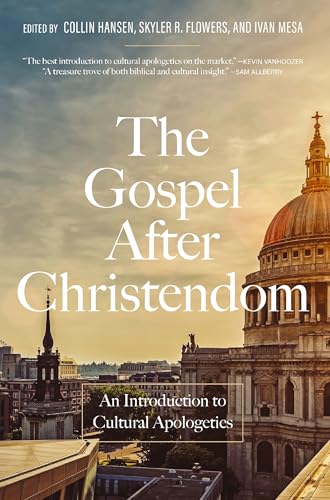
The Gospel After Christendom: An Introduction to Cultural Apologetics
Written by Collin Hansen, Skyler R. Flowers, and Ivan Mesa, eds. Reviewed By Eric W. ParkerAccording to the Keller Center’s “2024 Year-End Report”, the Center wants “to help church leaders around the world through three approaches: our convening, our cohorts, and our content.” The Gospel After Christendom: An Introduction to Cultural Apologetics, edited by Collin Hansen and Skyler R. Flowers, is a welcome delivery on their “content” promise. The editors should be commended for marshaling the Keller Center Fellows around this important project, as it will surely be a gift to the church for years to come.
As the name indicates, this volume serves as an introduction to the field of cultural apologetics. This is an emerging field of apologetics and ministry being defined in real time. This book is well-positioned to influence the direction of the field, as many of its contributors are seasoned practitioners and thought leaders working on the front lines. Naturally, as an introduction, the book aims to define what cultural apologetics is, explain how it’s done, describe its concerns, and determine its boundaries. They do this across thirteen essays divided into four parts. Their stated hope is to “inspire cultural apologists in local churches, in their neighborhoods, in their classrooms, and in their workplaces” (p. 10), as well as to “reawaken the memory of Christianity and the hope of a new heaven and new earth to come with Christ” (p. 196).
Part 1 brings together a series of essays that define the field. Here, cultural apologetics is presented as a tool to be used (Trevin Wax), authorized by biblical testimony (Christopher Watkin), and developed over the centuries (Joshua Chatraw). Part 2 is oriented around issues of methodology. Alan Noble argues that cultural apologetics should not fall into the twin ditches of either accommodation or condemnation. Instead, what is needed is “a posture of grace [that is] bold and humble, confident and gentle, wise as serpents and innocent as doves” (p. 72). Unlike many works that emphasize what cultural apologetics accomplishes, why it is needed, or what it hopes to achieve, Daniel Strange’s “subversive fulfillment” instead describes how it actually works (p. 81).
Part 3 addresses the concerns of cultural apologetics, specifically truth, goodness, and beauty. Rebecca McLaughlin, with her typical erudition, exposes the common belief among secular people that Christianity, in general, and Christian ethics, in particular, are the foil to everyone’s plotlines. She demonstrates that Christianity has been a driving force behind much of the good accomplished in Western civilization (pp. 122–25). Rachel Gilson offers the profound insight that “our emotional responses to beauty reveal who we are” (p. 129). Insights like this are Gilson’s way of illustrating the connection between our aesthetic sentiments and moral compass. Finally, Derek Rishmawy insists that Jesus cannot be reduced to a mere truth claim, for his truth extends to all of reality. In chapter 10, he writes, “Presenting Jesus as the whole Truth … is a way of ensuring that people are confronted with the fullness of what they are being asked to trust in” (p. 150).
In the last section, part 4, each chapter aims to establish the boundaries of cultural apologetics by grounding the discussion in concrete contexts. James Eglinton develops the metaphor of “front porches” as “half-way places between the insides of the homes and the streets” (p. 175), highlighting apologetics as a relational endeavor that should often occur in highly relational contexts. Sam Chan closes the final part of the volume with a consideration of everyday cultural “texts”—films, books, habits—as sites of engagement.
The Gospel After Christendom succeeds in presenting cultural apologetics as a necessary and distinctive form of witness in our secular age. Its strengths lie in its definitional clarity, its emphasis on posture and narrative, and its appeal to truth, beauty, and goodness. The editors articulate a clear vision in the introduction: “to define cultural apologetics, explain its biblical and historical grounding, and demonstrate how it is important for the church today” (p. 10). The essays largely cohere with this vision. The four-part heuristic is effective, moving readers from conceptual foundations to practical outworking. The volume feels like more than just a collection of standalone essays, which should be considered an editorial success.
Having said that, there are different areas where the book could have been stronger. The most pressing of these is its lack of sustained theological substructure. Cultural apologetics typically relies on specific frameworks that were not fully developed here: natural law, with its attendant nature–grace distinction; hamartiology, or the doctrine of sin; and the neo-Calvinist tradition, which has profoundly shaped this approach and undergirded much of Keller’s own work. A fuller engagement with these categories would have grounded the volume’s vision more securely. It would have been helpful, for instance, to see a chapter devoted explicitly to these themes or to see them woven more substantively through select chapters where they naturally apply. Without this kind of theological ballast, cultural apologetics risks leaning too heavily on cultural theory without clarifying the theological foundations that make such engagement possible.
This introduction will serve as a helpful entrée into the conversation as it stands. It will help the attendant reader learn the language and categories of the field. Most of all, though, it will point future practitioners to the most needed areas of attention in bringing about a spiritual renewal in the post-Christian West.
Eric W. Parker
Highlands College
Other Articles in this Issue
This essay develops a distinctly Christian theology of free speech in response to mounting threats of censorship across Western societies...
In every generation and in every place, there is a need to identify, equip, and encourage new leaders for Christ’s church...
Missio Trinitatis: Theological Reflections on the Origin, Plan, and Purpose of God’s Mission
by Brian A. DeVriesTrinitarian theology provides the basis for understanding missio Dei...
This essay argues that monogamous sexually-differentiated marriage (MSDM) is uniquely revealed through Christ’s relationship with the church in Ephesians 5:30–32...
Other Reviews in this Issue

Genesis
Reviewed by Dustin Burlet