
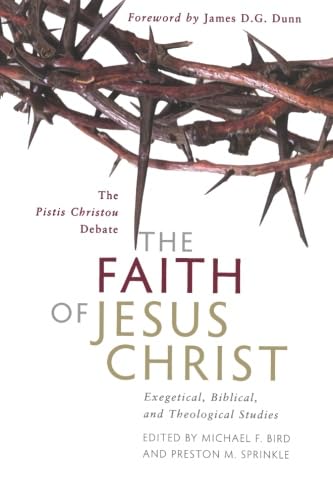
The Faith of Jesus Christ: Exegetical, Biblical, and Theological Studies: The Pistis Christou Debate
Written by Michael F. Bird and Preston M. Sprinkle, eds. Reviewed By Moisés SilvaThis anthology consists of a foreword by James D. G. Dunn and seventeen essays, the first of which is a helpful introductory chapter by Michael F. Bird that summarizes the rest of the papers. The initial section, entitled “Background of the Debate,” includes two essays: one by Debbie Hunn reviewing the history of the controversy and another one by Stanley E. Porter and Andrew W. Pitts arguing that a grammatical analysis of the phrase pistis Christou supports the so-called objective genitive interpretation (Christ as the object of faith).
The second section, “Pauline Texts in Contention,” begins with an essay by Douglas A. Campbell, who asserts that a subjective genitive understanding (Christ’s faithfulness) of Rom 3:22, “coupled with a messianic construal of Habakkuk 2:4 in Romans 1:17b [i.e., referring to ‘the Righteous One’], … is the only interpretation” that explains all the data (p. 66). In contrast, R. Barry Matlock, focusing on four passages that include additional uses of the noun pistis or the verb pisteuō (Rom 3:22; Gal 2:16; 3:22; Phil 3:9), argues that this repetition of the vocabulary clearly selects the correct sense, i.e., Christ as the object of faith. The next two essays, by Paul Forster and Richard H. Bell respectively, focus on Eph 3:12 and Phil 3:9 and reach opposite conclusions—Foster arguing for “Christ’s faithfulness” and Bell for “faith in Christ.”
Section 3 purports to present “Mediating Proposals and Fresh Approaches.” Mark A. Seifrid prefers to understand the phrase as a genitive of source, depicting Christ as the author of faith (pistis referring, however, to our act of believing, not to Christ’s faithfulness). Francis Watson, highlighting the expression ek pisteōs (“by faith”), seeks to refute the messianic interpretation of Hab 2:4, thus undermining the subjective genitive understanding. Preston M. Sprinkle argues for a “third view,” namely, that pistis Christou refers to the eschatological Christ-event proclaimed in the gospel, as expressed especially in Gal 3:23–26. Finally, Ardel B. Caneday discusses the broad argument in Galatians, emphasizing the contrast between pistis Christou and erga nomou (“works of law”), and concludes that the former “placards the faithfulness of Christ Jesus who accomplishes what the Law could not” (p. 203).
The fourth section considers “The Witness of the Wider New Testament.” It begins with an essay by Peter G. Bolt, who argues that the “narrative substructure” of the Synoptics and Acts “supports, or even demands” the subjective genitive interpretation (p. 222). Willis H. Salier deals with the Fourth Gospel, which stresses the importance of both Jesus’ obedient work and the act of believing (thus John “has interesting and important things to say on both sides of the wider issues involved,” p. 237). Bruce A. Lowe discusses Jas 2:1 in detail and concludes that a rhetorical reading of the passage “suggests convincingly” that the phrase “the faith of our Lord Jesus Christ” refers to Jesus’ trust in God (p. 256). The book of Revelation, argues David A. deSilva, uses pistis in the sense of faithfulness shown by Christians to Jesus.
The final section of the book includes two essays dealing with “Historical and Theological Reflections.” Mark W. Elliott deals briefly with attempts in the patristic, medieval, and modern period to “reintroduce” the concepts of Jesus’ faith and faithfulness, even though such attempts are not in step with the tradition of Christian theology. Finally, Benjamin Myers provides a substantial discussion of Karl Barth, whose work suggests that it is a mistake to pit anthropological and christological readings of Paul against each other.
The book as a whole is certainly worth reading (in spite of some minor carelessness here and there, as in the table of contents), and a few of the articles serve scholarship well. For instance, Preston Sprinkle’s suggestion of a “third way” deserves careful reflection. To be sure, I do not see his proposal as a true alternative to the two positions being argued these days (to his credit, he is upfront in recognizing that a reference to the Christ-event just does not work in such a key passage as Phil 3:9; see p. 183). But Paul’s striking language regarding the eschatological arrival of pistis (Gal 3:23, 25) needs to be taken more seriously than it has been in the past. Because the expression is clearly parallel to that of the arrival of the seed (3:19; cf. also eis Christon in 3:24), Paul surely personifies pistis here as a reference to Christ, who is the object of faith (note the smooth transition from tois pisteuousin in 3:22b to tēn pistin in 3:23a). Yet that is not enough to account for the remarkable character of his language. I would argue that not only the coming of Christ but also the very reality of faith must be viewed as a redemptive-historical event. Of course, it is not that people did not believe prior to the first century, but that their believing would be meaningless without the manifestation of Christ, who alone makes true faith possible.
One could make other positive comments about several of the essays. It is most doubtful, however, that this volume will alter the structure or physiognomy of the debate. Indeed, it may only add to the confusion. For reasons that can probably be identified only by a psychoanalyst, the topic has become more and more intractable, and one cannot help but wonder whether well-meaning scholars have begun to spin their wheels, searching for any faint evidence that might support their position while ignoring or minimizing the obvious and indisputable. In some cases, unusual and highly unlikely proposals are made that give the superficial impression of being plausible, and no doubt there are readers who will be impressed by them—all of this is a kind of confirmation that if you set your mind to it, you can “prove” pretty much anything.
Consider, for example, Mark 11:22, echete pistin theou. Virtually every standard commentary and translation understands this clause to mean, “Have faith in God” (though a fanciful preacher here and there has been known to encourage congregations to appropriate the very faith that God exercises). Because the standard interpretation is well-nigh universal among scholars, some years ago I thought it might provide a useful illustration of the factors that play a role in forming interpretative consensus (M. Silva, “Faith versus Works of Law in Galatians 2–3,” in Justification and Variegated Nomism, vol. 2: The Paradoxes of Paul [WUNT 2.181; ed. D. A. Carson et al.; Tübingen: Mohr Siebeck, 2004], 217–48, esp. 231). Peter Bolt, however, turns the tables (pp. 212–14 in his article) by addressing the very factors I listed and seeks to demonstrate that in fact the clause should be rendered, “You have God’s faithfulness” (meaning, we are told, that the disciples are able to depend on the faithfulness of God). Bolt recognizes that “the occurrence of this phrase is unusual,” but in fact “unusual” here is a very generous adjective. Is there any other example of people being said to “have” a comparable divine attribute (e.g., You have the kindness of God, or We have the patience of God)? But improbabilities do not seem to matter, and the fact that, for example, echō plus pistin elsewhere refers to people believing and never to God’s faithfulness (see esp. echete pistin in Mark 4:40) has no apparent function in Bolt’s exegesis.
With regard to the debate as a whole, I happen to believe, naively perhaps, that the evidence is not all that ambiguous—or to put it more accurately, that the ambiguities in the data are plainly resolved by Paul’s many unambiguous statements. If by pistis Christou (which in isolation can indeed signify any number of things) the apostle had meant either “Christ’s faith” or “Christ’s faithfulness,” it would have been ridiculously easy for him to make that point clear beyond dispute. Among various possibilities, he could have, for example, indicated—in the same contexts—one or two ways in which Jesus believed and how those acts of faith were relevant to the matter at hand. Or he could have told us—again, in the same contexts—that his message of dikaiosynē(“righteousness, justification”) is true because Christos pistos estin (“Christ is faithful”). What could have been simpler? And considering the theological importance of this issue, one would think that he might have made a special effort to clarify matters.
Instead, if some scholars are to be believed, Paul did not have enough sense to realize that the phrase pistis Christou is ambiguous. And to make matters worse, he unwittingly misled his readers by using the verb pisteuō with Christos as direct object again and again in the very same passages that have the ambiguous phrase! His bungling proved spectacularly successful, for in the course of nearly two millennia, virtually every reader—including ancient scholars for whom Greek was their native language—understood the phrase to mean “faith in Christ” and gave no hint that it might mean something else. (I might add that when Campbell, in a footnote on p. 67 of his article, seeks to undermine the linguistic argument in view here, he shows only that he has not quite understood that argument.)
Although I am not hopeful that this collection of essays will bring a resolution to the impasse, it remains true that there is much to be learned from the volume, and the editors deserve our thanks for bringing it to fruition.
Moisés Silva
Litchfield, Michigan, USA
Other Articles in this Issue
Most of us, I suspect, develop fairly standard ways, one might even say repetitive ways, to appeal to the motivations of our hearers when we preach the gospel...
How to Write—and How Not to Write—A Review: An Appreciative Response to Reviews of Ancient Near Eastern Themes in Biblical Theology by Dempster and Edgar
by Jeffrey J. NiehausI want to thank Themelios for the unusual opportunity to interact with two reviewers of my book Ancient Near Eastern Themes in Biblical Theology...
Parallels, Real or Imagined? A Review Article of Jeffrey J. Niehaus, Ancient Near Eastern Themes in Biblical Theology
by William EdgarWhen I came to Westminster Theological Seminary in Philadelphia as a young student in the 1960s, two things struck me...
Why Evangelicals Should Ignore Brian McLaren: How the New Testament Requires Evangelicals to Render a Judgment on the Moral Status of Homosexuality
by Denny BurkIn 2006 on Christianity Today’s leadership blog, Pastor Brian McLaren urged evangelical leaders to find a “Pastoral Response” to their parishioners on the issue of homosexuality...
A Member of the Family or a Stranger? A Review Article of Jeffrey J. Niehaus, Ancient Near Eastern
by Stephen DempsterWe cannot overstate how important knowing the context is for understanding the significance of any communication, whether that is a simple word, sentence, paragraph, larger text, sign, photograph, or cultural cue...
Other Reviews in this Issue