

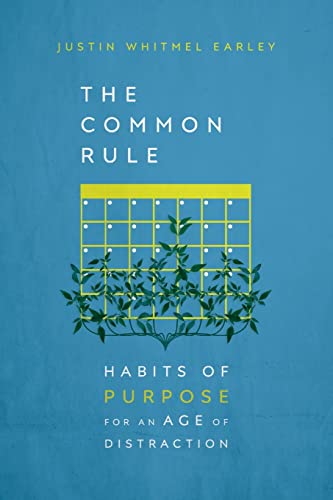
The Common Rule: Habits of Purpose for an Age of Distraction
Written by Justin Whitmel Earley Reviewed By Colin R. McCullochWithout a proper structure, buildings crumble. So also with human lives, argues Justin Earley. In his book The Common Rule: Habits of Purpose in an Age of Distraction, Earley exhorts his readers to consider the habits that structure their lives to discern whether or not they will enable them to withstand the pressures of our rapidly changing world. Earley knows firsthand the pressures that can cause a poorly-structured life to crumble. As a former missionary to China, he experienced the struggle of seeking to do the work of God while mastering a language and culture not his own, and few would argue that his current profession as a mergers and acquisition lawyer comes without heavy demands. In fact, it was his own experience that led Earley to write The Common Rule because he came to a place in his pursuit of what he knew to be right and biblical where his bad habits began to undermine his ability to function properly as a Christian. He explains, “while the house of my life was decorated with Christian content, the architecture of my habits was just like everyone else’s. And that life had been working for me—until it collapsed” (p. 4).
So, how can Christians keep their lives from coming to the brink of collapse even as they seek to dedicate their lives to pursuing what is good. Earley’s answer is that we must push back against the pressures of the world through cultivating proper habits. And these habits must not only help us resist worldly pressures; they must also aid us in embracing our God and the calling he has given us to love our neighbors.
The Common Rule is divided into two parts. In part one Earley explains what he means by rule, which he defines as “a set of habits you commit to in order to grow your love of God and neighbor” (p. 21). He also gives an overview of the eight habits that he has developed in his own life in order to resist evil and embrace love of God and love of neighbor. These habits are broken up into four daily habits and four weekly habits. The four daily habits are as follows: (1) kneeling prayer at morning, midday, and bedtime; (2) one meal with others; (3) one hour with phone off; and (4) Scripture before phone. The four weekly habits are these: (1) one hour of conversation with a friend; (2) curate media to four hours; (3) fast from something for twenty-four hours; and (4) sabbath. Part two makes up the bulk of the book in which Earley discusses the benefits of each of these habits and how they can be practically implemented.
Each chapter in part two is devoted to one of the habits, and Earley explains how each habit relates to resistance, embrace, love of God, and love of neighbor. The daily habit of prayer reminds us of our finitude and helps us to cast ourselves upon the mercy of our infinite God, thereby cultivating our love for him. Having a daily meal with others helps us to cultivate love of neighbor as we embrace the communal nature with which God has created us. The habits of turning off our phone for an hour a day and reading Scripture before we turn to our phones in the morning are both habits of resistance. The first helps us to love our neighbors through turning our attention away from technology and toward people, and the second helps us to turn our attention away from technology and toward God. With regard to the weekly habits, eating with a friend and curating media both cultivate love for neighbor, and fasting and observing sabbath draw us to God as we recognize our dependence upon him.
With any attempt at helping people to structure their lives for spiritual growth writers always run the risk either of setting the bar so high that it seems unattainable or of fostering a sort of works-based righteousness that leads people to trust in their own effort rather than God. However, by connecting these eight habits to love of God and love of neighbor, Earley has written something that is not only immensely practical but also rightly directed toward the end for which all humans were created. Furthermore, with the summaries and charts at the end of each chapter and the resources at the end of the book, IVP and Earley have produced a book that is highly usable and aesthetically beautiful.
The Common Rule is gospel-centered in that Earley makes a number of connections to Christ’s work on the cross. For example, in his chapter on the Sabbath he explains the significance of the completed work of Christ enabling his people to rest in him (p. 148). What is missing, however, is a fuller portrayal of the “bad news” of the gospel. From what has God in Christ saved us? Earley certainly mentions sin, but it is not just our sin from which we need to be saved but the just punishment for our sin. It is through recognizing that Christ saves us from God’s wrath that we come to the fullest understanding of his love. When we begin to embrace his love in this light, we can better point our neighbors to that love. Such an understanding seems to be implied in Earley’s work, but a more explicit presentation of the significance of the work of Christ would only serve to strengthen Earley’s point that, without structuring our lives to embrace the love of God and neighbor, we will inevitably crumble.
Colin R. McCulloch
Colin R. McCulloch
The Southern Baptist Theological Seminary
Louisville, Kentucky, USA