
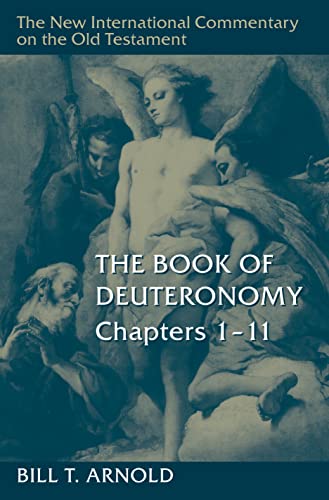
The Book of Deuteronomy: Chapters 1–11
Written by Bill T. Arnold Reviewed By S. D. EllisonBill T. Arnold is the Paul S. Amos Professor of Old Testament Interpretation at Asbury Theological Seminary, where he has served since 1995. He has published widely in Old Testament studies, including work on Biblical Hebrew, introductory and background material, various commentaries, and a wide selection of articles and essays. Arnold is also general editor (Hebrew Bible/Old Testament) for the New Cambridge Bible Commentary series (NCBC), editor of the Baker Commentary on the Old Testament: Pentateuch (BCOTP), and series editor of the New International Commentary on the Old Testament (NICOT).
In the volume under review, Arnold tackles the unenviable task of replacing Peter C. Craigie’s excellent contribution on Deuteronomy in the NICOT series. Despite being concise (just over 400 pages) and nearly 50 years old, Craigie’s commentary has stood the test of time and remains an important volume on Deuteronomy that rewards its readers. As intimated above, however, Arnold is well placed to proffer a fresh NICOT volume on Deuteronomy.
There is one note of caution to raise in what will otherwise be a very positive review. Arnold’s discussion of authorship (pp. 9–18) implicitly weakens a robust evangelical doctrine of Scripture. He advocates a move from Mosaic authorship to Mosaic origin of Deuteronomy (p. 10), concluding: “It has become increasingly clear that compositions like the book of Deuteronomy were produced by many hands over a period of many years in a process” (p. 11). Later he endorses the proposal that Deuteronomy was largely written by “Mosaic scribes” who serve as the “voice of Moses” by placing words on the lips of Moses (p. 17). The implication of such a view of the composition of Deuteronomy is a weakened authority in the application of Scripture (pp. 65–66), exemplified in Arnold’s persistent designation of Deuteronomy as Divine Will—surely a stronger designation would be better. While it is not impossible that the Spirit sovereignly overrules in the lives of many different authors to produce an inspired, inerrant document—consider the Psalter, or the canon itself—authors placing their thoughts and words on the lips of another (arguably superior) individual is ethically dubious. It is not unlike the approach of the apocryphal Gospels. It seems to me that even if Moses did not personally write Deuteronomy, it should be viewed as faithful reportage of what he actually said, much like the Gospels and Acts record of Jesus’s and the apostles’ teaching. Otherwise, its presentation as the words of Moses is disingenuous (Deut 1:1).
The above note of caution taken, there remains much in this commentary to commend it. Arnold is a tremendous writer. Few introductory sections of commentaries are compelling, fast paced, and innovative, but this is. This commentary will not bore its reader. Arnold’s ability with prose is further applied in a fresh translation of the Hebrew text. It is important to consult Arnold’s rationale for judging text critical issues (pp. 39–47), but his fresh translation provides a productive friction for those familiar with a single translation. The extensive notes on translation are an excellent resource on their own. Indeed, the notes on translation are but one example of the thoroughness of the commentary—which should be unsurprising given it is the first volume and runs to more than 700 pages (almost double the length of Craigie’s volume on the entirety of Deuteronomy). As further examples of its meticulousness, see the beautifully nuanced discussion of genre that presses beyond the mere vassal treaty designation (pp. 2–3) or the extensive treatment of the Shema (pp. 376–404). Furthermore, all these features are enhanced by the breadth of Old Testament knowledge Arnold exhibits and applies to his work on the text of Deuteronomy. Indeed, in light of the centrality of Deuteronomy to the Scriptures, both Old and New, it is vitally important to witness and comprehend its influence elsewhere. Arnold’s commentary, and particularly the introduction, enables the reader to see this more clearly.
I am yet to be left disappointed after engaging Arnold’s work. I am certainly not always in agreement with him, but he is a fruitful conversation partner. As a result, I am convinced that this new NICOT volume (and its forthcoming companion) will be the new standard for engaging Deuteronomy. While the size of these volumes might restrict their usefulness for the preacher, going forward they will undoubtedly serve as essential readings on Deuteronomy for scholars and students alike. Given the fundamental nature of Deuteronomy for all of Scripture, we must be grateful for Arnold and his contribution to Deuteronomic studies with this volume.
S. D. Ellison
Davy Ellison holds a PhD in OT biblical studies from Queen’s University, Belfast and serves as the director of training at the Irish Baptist College, Moira, Northern Ireland.
Other Articles in this Issue
Editorial: Announcing the Carson Center for Theological Renewal
by Brian J. Tabb and Benjamin L. Gladd
A Change in Kind, Not Degree: Labels, Identity, and an Evaluation of “Baptistic Congregationalists”
by Nathan ShermanHow do we decide what to label people of centuries past when they had no clear labels for themselves? Should we describe seventeenth century Baptists as “Baptists” if that was not what they called themselves? Matthew Bingham has recently argued that instead of using the label “Particular Baptists” for the English Calvinistic Baptists of the 1640s and 50s, historians would more clearly describe their subjects as “baptistic congregationalists...
Filial Revelation and Filial Responsibility: (Dis)obedient Sonship and The Religious Leaders in Matthew 11–16
by Adam FriendSonship appears in every section, at every turning point, and on the lips of every character in Matthew’s Gospel...
This paper articulates a provisional thesis, namely, that we need a pedagogical category within our biblical theological frameworks, on the basis that such a category was in the New Testament authors’ minds...
Scholars disagree about the precise nature of the sin that provokes God’s wrath in Genesis 19...
Other Reviews in this Issue