
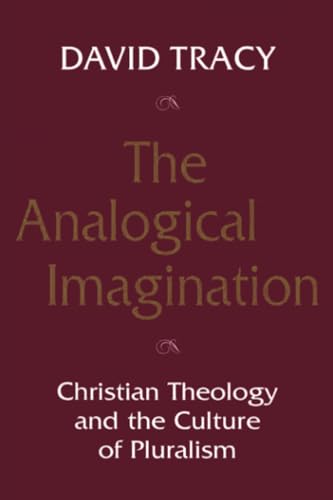
The Analogical Imagination: Christian Theology and the Culture of Pluralism
Written by David Tracy Reviewed By Richard BauckhamDavid Tracy is one of the most important of contemporary American Roman Catholic theologians. Indeed, this impressive book establishes him as a systematic theologian of international and ecumenical importance.
In this book Tracy is not ‘doing’ systematic theology, but describing what systematic theology is and should be, its task and methods, its criteria of adequacy, its place within the total theological enterprise, and its place in a pluralistic culture. This last consideration really sets the agenda. In the intellectual pluralism of modern culture, the danger is that all intellectual traditions concerned with meaning and values, as theology is, come to be seen as merely matters of private taste, without genuine, public claims to truth. Tracy attempts to develop a strategy which will avoid this danger of privatization, while accepting pluralism itself as a welcome and enriching state of affairs. Christian theology, by its very nature and the nature of the God it claims to speak of, must engage in public discourse, addressing not only the church, but also the intellectual community and society at large. He allows that systematic (as distinct from fundamental or practical) theology has the church as its primary audience, but it cannot therefore opt out of the need for publicness if it is to make real claims to truth. But if Tracy is anxious to combat the lazy tolerance of a pluralistic society which reduces religion to a private consumer product for those who happen to like it, he is equally anxious to avoid the authoritarian assertion of one’s own position as the only one having a real claim to truth. A pluralistic culture should not be a mere battleground of entrenched and competing monisms, but the opportunity for genuine conversation.
But how can Christian systematic theology enter such a conversation? What is its claim to attention in the realm of public discourse? Tracy’s answer is to see systematic theology as ‘fundamentally hermeneutical’: its task is the interpretation of ‘the Christian religious classic’, which as a classic belongs in the public realm of culture. A classic, in Tracy’s definition, is a work of art, a literary text, a symbol, or even an event or a person, which transcends its particularity, the limitations of its time and place of origin, and even the particularity of the cultural tradition it may have formed or influenced, and addresses all people in all historical circumstances. It has a surplus of meaning which proves continually fruitful of new interpretations and new insights in new situations. It exerts a non-authoritarian, non-violent kind of authority: ‘We all find ourselves compelled both to recognize and on occasion to articulate our reasons for the recognition that certain expressions of the human spirit so disclose a compelling truth about our lives that we cannot deny them some kind of normative status’ (p. 108). Such classics invite ‘the risk of interpretation’, in which we enter a conversation with the classic, an attempt at critical understanding in which, of course, we come to it with our own preunderstanding of its subject-matter, but in which we are also provoked, challenged and transformed by the classic. In the case of a classic the interpreter will himself by interpreted as he struggles to interpret. The real authority of the classic is acknowledged neither by the person who (applying purely historical and social-scientific methods of interpretation) retains his complete autonomy over against it, nor by the person who merely repeats the classic in an authoritarian, ‘fundamentalist’ way, but by the person who enters a genuine conversation with the classic and thereby produces a new interpretation of the classic out of his own lived experience of it. In all of this, of course, Tracy is taking up elements of the hermeneutical theories of Gadamer, Ricoeur and others.
The classic of the Christian religion, Tracy claims, is the event of Jesus Christ, available to us primarily in the classic Christian text: the New Testament. Systematic theology is conversation with this classic. This does not make the systematic theologian merely a biblical exegete, in the narrow sense, because the essence of hermeneutics is new interpretation for a new situation. This demands not only interpretation of the classic text but also interpretation of the situation and the mutual interaction of the two.
In this understanding of the publicness of Christian theology as resting on the Christian classic’s claim to attention as a classic, some evangelical readers may fear that the idea of divine revelation is being soft-pedalled. But Tracy stresses that the religious classic must be encountered on its own terms, as religious, and therefore as claiming a disclosure of God by God (‘a claim to truth as the event of a disclosure-concealment of the whole of reality by the power of the whole’). It seems to me that his notion of the classic is a fruitful approach to understanding how revelation happens in the very human way in which, on the Christian understanding, it does happen.
My criticisms would concern more detailed points which there is no scope here to develop. I have outlined only the central focus of the argument of the book, which also contains much else. The parts which in fact I found most stimulating and illuminating were Tracy’s account of the steps of interpretation (3. iii), his typology of forms of religious expression, which clarifies a great deal (5. ii), his brilliant account of the literary forms of Christian religious expression in the New Testament and their relationship (6), and his perceptive analysis of the contemporary ‘postmodern’ cultural situation (8). In all these chapters Tracy’s easy mastery of an immense literature is dazzling, and his ability to create new syntheses out of much previous work perhaps his most impressive talent. It is a pity that the opening two chapters, though important, make dreary reading, and that the final chapter is a sad anticlimax.
As well as his positive appraisal of pluralism in culture generally, Tracy is equally positive about the pluralism within Christian theology itself, and labours hard to reduce the chaos of theological controversy to the order of mutually enriching conversation. I have seldom read a theologian who is so positively appreciative of all Christian theological traditions and all the major trends in contemporary theology. He is careful not to eliminate conflict, but his instinct is for the inclusive approach which finds a place for every tradition and every insight within a more comprehensive picture. The problem of such inclusiveness, of course, is that in attempting justice to every position it may have to relativize some beyond recognition. However, conversation is certainly the only strategy with any future. It enables a tradition to remain itself while exposing itself to others. It is a strategy which the best evangelical theology has long employed, but sometimes too apologetically. In a pluralistic world where every tradition is, as Tracy says, inevitably ‘porous’ to other traditions, it is much better to engage wholeheartedly in that authentic conversation in which ‘the subject-matter takes over’ (Tracy).
I should add that this is an extremely demanding book, often very technical (sometimes unnecessarily jargonistic), making few concessions to readability apart from clarity. Most theological students will find it very difficult reading, but those who persevere (not necessarily quite to the end) should find it rewarding.
Richard Bauckham
Professor of New Testament Studies at the University of St. Andrews
Other Articles in this Issue
Other Reviews in this Issue