
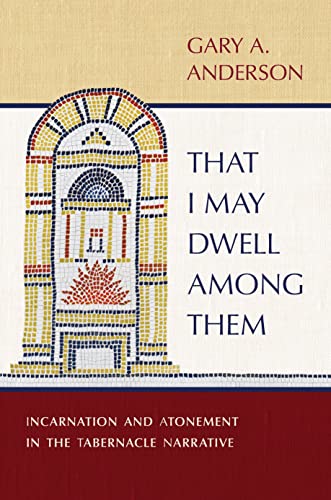
That I May Dwell Among Them: Incarnation and Atonement in the Tabernacle Narrative
Written by Gary A. Anderson Reviewed By Mark Steven FrancoisFor many readers, the Tabernacle Narrative of Exodus 25 to Leviticus 10 is both impenetrable and uninteresting. Readers often find themselves bogged down in the detailed instructions for building the tabernacle, ordaining priests, and offering sacrifices to YHWH—details that seem somewhat irrelevant on this side of the cross. In his recent book, That I May Dwell Among Them, Gary Anderson helps readers penetrate these details and shows that these chapters are anything but irrelevant for Christian readers.
That I May Dwell Among Them is a refreshing and theologically rich exploration of the tabernacle narrative interpreted within the context of the two-part Christian Bible. Drawing heavily on the canonical approach of Brevard Childs, Anderson acknowledges the use of sources in the composition of the tabernacle narrative (priestly vs. non-priestly) and insists that each source should be read with its own integrity without artificially harmonizing each unit (pp. 147, 162). Despite this, Anderson insists on going deeper to understand the theological significance of how these sources were arranged in their final form (p. 3). For example, in chapter 7, Anderson indicates that the story of the golden calf (Exod 32–34) and the chapters about the tabernacle (Exod 25–31; 35–40) come from separate, unrelated sources (p. 147). When read on its own, the story of the golden calf might simply be read as a story about Israel’s idolatry. However, when placed in its current position, the story serves to underscore the gravity of Israel’s sin—they built the golden calf while Moses was receiving instructions about building the tabernacle—and the depths of God’s grace when he, nevertheless, chose to dwell in the tabernacle and give Israel guidance in the wilderness (pp. 153, 159).
In the first half of the book, Anderson deals with five key topics in the priestly sections of the narrative: the building of the tabernacle (ch. 2), the relationship between God and the tabernacle furniture (ch. 3), the significance of the tamid sacrifices (i.e., the daily offerings; ch. 4), the inauguration of the priesthood (ch. 5), and the mysterious deaths of Nadab and Abihu (ch. 6). The second half deals with important themes in their wider canonical context: the sin of the Golden Calf in its present literary context (ch. 7), the relationship between the near sacrifice of Isaac and the tamid sacrifices (ch. 8), the tabernacle and the incarnation of Jesus (ch. 9), and Old Testament sacrifices and the death of Jesus (ch. 10).
In each chapter, Anderson includes fascinating information from non-Old Testament sources to illuminate his material. For example, Anderson points to a coin from the Bar Kokhba revolt that depicts the table of presence at the entrance to the temple in the same place where pagan coins would depict pagan gods (pp. 65–66). This, along with material from the Old Testament and post-biblical Judaism, showcases the intimate relationship between the furniture of the temple and God himself (p. 55). Since the furniture of the temple was infused with God’s presence, seeing the furniture of the temple was tantamount to seeing the face of God (p. 67). Anderson connects this with the rabbinic tradition that said that Jews could fulfill the command to see the face of YHWH three times a year (Exod 23:17) by a special viewing of the temple furniture during their festivals (pp. 63–64). Although Anderson does not believe this reflects the practice of the First Temple period, he suggests that the detailed descriptions of the tabernacle in Exodus functioned similarly: by reading or hearing these chapters about the tabernacle, the Israelites could behold “the grandeur of their God” (p. 75).
In several places, Anderson draws important connections between passages of Scripture that Christian readers might not normally observe. For example, in chapter 2, Anderson draws several important links between the building of the tabernacle and the account of creation in Genesis 1:1–2:3. Anderson notes that according to Exodus 40:2, the tabernacle was erected on the first day of the first month, which rabbis later connected with the first day of creation (pp. 21–22). In addition, Anderson points to significant verbal similarities between the report of creation being completed (Gen 1:31–2:3) and the report of the tabernacle being completed (Exod 39:32, 43; 40:9, 33; p. 23). He also points to patterns of seven in both the creation account and the construction of the tabernacle that are quite compelling (pp. 25–33).
Despite these many strengths, three drawbacks should be noted. First, although Anderson includes helpful information about how figural reading of the Old Testament (i.e., typology) can illuminate the incarnation and the atonement, evangelical readers will be less attracted to its application to Mary as the ark of God and its implications for the veneration of Mary (p. 201). Second, many readers will be uncomfortable with Anderson’s views of the atonement. In line with Pope Benedict XVI, Anderson views the idea of Jesus dying on the cross to satisfy divine justice as unworthy of God (pp. 210–11). Finally, in line with many rabbis, Anderson believes that the building of the tabernacle is presented as the goal and completion of creation (pp. 23, 103). However, the strict restrictions depicted in the tabernacle narrative make it clear that there was a barrier that separated human beings from God. The goal of creation, anticipated by the tabernacle, lies much further in the future.
Mark Steven Francois
Mark Steven Francois
Colorado Christian University
Lakewood, Colorado, USA
Other Articles in this Issue
The Spirit of God and the Religions of the World: A Response to Amos Yong’s Claims
by J. David WilloughbyAmos Yong, an acclaimed Pentecostal scholar, argues for what he calls a pneumatological theology of religions...
Pastoral Pensées: “We Do Not Lose Heart”: Theological Encouragement for Endurance and Opportunities for Reflection from 2 Corinthians 4:1–16
by Cody WilbanksBurnout is an evergreen threat for those in Christian ministry...
Contraception and the Church: Making Sense of the Debate and Some Pastoral Advice
by Dennis M. SullivanThis article reviews the ethical and theological issues surrounding birth control, with an emphasis on hormonal methods...
“Union” has become an increasingly valuable tool in discussions of atonement and soteriology...
Other Reviews in this Issue