
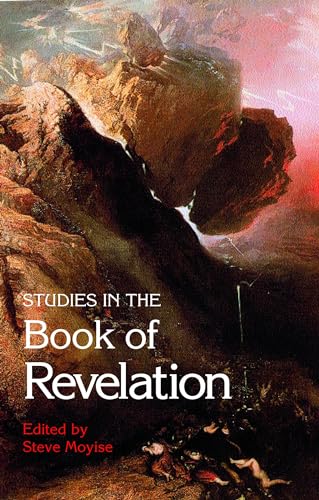
STUDIES IN THE BOOK OF REVELATION
Written by Steve Moyise (ed.) Reviewed By Gordon CampbellMost readers of the Book of Revelation that I know, admit that they could do with some help in interpreting it! So the bottom line here is whether the present volume of essays constitutes a helpful read. The answer has to be an unambiguous ‘yes.’ However, this verdict needs immediate qualification. These essays are not an easy read; the complex interpretative issues covered mean that the PhD student will probably derive more benefit from their content than the undergraduate. Any budding exegete or theologian who reads this book can therefore expect to be stretched.
The editor, Steve Moyise, unites his efforts with those of eleven other scholars; some are well-known to students specialising in the Book of Revelation and related areas; others whilst serving in ministry in their respective Churches are billed as working ‘at the cutting edge of research’. It falls to Christopher Rowland, belonging in the former category, to whet the reader’s appetite in a foreword which faces up to a paradox: The Book of Revelation is enjoying a new lease of life in recent scholarship, as the present volume itself bears witness, yet contemporary theology still functions as though the Apocalypse were not mainstream but marginal—as if Western culture did not owe this text an immense literary, artistic and theological debt. The collected essays mount a sort of cumulative case to protest that today’s Christian theologian needs to take on board what current scholarship is saying about the Book of Revelation. So each essay, to some degree, attempts to make the sceptical theologian sit up take notice.
To give a flavour of the twelve contributions, we sample just three which this reviewer had cause to read again while writing a paper on Revelation for a forthcoming interdisciplinary symposium on Religion and Violence. Three scholars choose to grapple with the difficulty of interpreting some of Revelation’s more violent imagery. In one essay, the problem of what we are make of Babylon the Great (Rev. 17) is helpfully spotlighted by a history of the metaphor’s varied effects upon diverse readers. In another, the question of what sort of Lamb can behave like a lion leads to consideration of how one might interpret apocalyptic violence in an ethically responsible way. A third, more demanding discussion, strives to see how the Apocalypse can be ‘authoritative’ today and to do so, examines the text’s stance over against the prevailing world-view and its rhetoric of persuasion for impacting the reader. All three efforts tackle and overcome some interpretative obstacles en route to suggesting positive ways in which Revelation may have contemporary relevance as a document of faith. Each writer is saying ‘there are problems, but they aren’t insurmountable’ and this approach characterises the whole volume.
For a collection assembled at scholarship’s cutting edge, there is at least one gaping whole in this book’s coverage of Revelation: Virtual omission of any treatment of the Apocalypse against a Jewish background. That being said, the editor is committed to multidimensional approaches to this text and has found space for feminist, political or millennialist readings of Revelation as well as for literary concerns such as inter-textuality and imagery or for theological categories like Christology. For the student, teacher or researcher who wants to think constructively about Revelation and the challenges it poses, this volume sustains interest. Our shelves need more like it!
Gordon Campbell
Belfast
Other Reviews in this Issue