
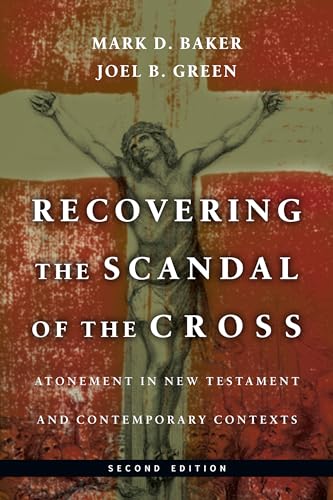
Recovering the Scandal of the Cross
Written by Joel B. Green and Mark D. Baker Reviewed By Andrew EvansThe Scriptures as a whole provide no ground for a portrait of an angry God needing to be appeased in atoning sacrifice.
(Recovering the Scandal of the Cross, 51)
Penal substitution is an indispensable part of the scriptural revelation.
(Where Wrath and Mercy Meet, 68)
Two books, both of which come from evangelical publishing houses, and arrive at fundamentally different conclusions about the significance of the cross of Christ.
In Recovering the Scandal of the Cross Joel Green and Mark Baker set out to show that a penal substitutionary understanding of the work of Christ on the cross is both a misinterpretation of the biblical evidence and an unnecessary stumbling block to people from many cultures, including, increasingly, Western ones, coming to faith.
Three chapters survey the understanding of the death of Jesus in his own words and in those of the NT writers and summarise the saving significance of Jesus’ death in the NT. A chapter which analyses the strengths and weaknesses of various atonement models (Irenaeus, Gregory, Anselm, Abelard and Hodge) is followed by four which look at different ways of communicating the significance of the cross to different audiences and cultures today.
The central aim of the book—to help Christians explain the cross in ways that will both resonate with and challenge the world in which we live—is admirable. Nevertheless this reviewer has a number of concerns about Green and Baker’s work, helpful though it is in provoking reflection on things many of us assume every time we read the Bible. They start from the premise that for many Western Christians penal substitutionary atonement is the only model for understanding the cross. Whilst this may be the case in certain parts of American evangelicalism, in British evangelicalism most thinking about the cross is far hazier than that and often could not be said to conform to a particular ‘model’ at all.
Secondly it is never entirely clear in the book whether Green and Baker are arguing against a penal substitutionary model per se or against populist illustrations and explanations of penal substitution which make it appear that Christ is the innocent (and possibly unwilling) victim of an angry Father. This tends to lead them to interact principally with caricatures of penal substitution rather then with more thoughtful explanations (John Stott’s The Cross of Christ, for example, has only one footnote in the book). In fact one has to read as far as page 90 before finding a reasonably dispassionate summary of what the doctrine of penal substitution actually is.
Much of the material argues that penal substitution grew out of a Western worldview with particular notions of individual responsibility, punishment and justice. This is then compared with other cultures where such concepts have less resonance. It is unfortunate that the authors never consider whether it is possible that these values in Western culture spring, at least in part, from 2000 years of Christian influence and therefore from a Biblical world view rather than being merely a grid through which the Bible is interpreted. Most importantly there are a number of omissions in the analysis of the Biblical material.
In their NT chapters Green and Baker make little reference to texts that are important to those who hold penal substitution to be a central or primary model by which to understand the cross. So, for instance, 1 John 1:9 and Hebrews 2:17 are not to be found in the index of Scripture verses. In the very brief discussion of Romans 3:21–26 (104) it is simply asserted that, ‘What is required is not a transformation within God’s heart towards sinners but a transformation of their sinful existence before God’.
More broadly, there is little interaction with wider Biblical themes that suggest the necessity of punishment for sin. Genesis 3 is dealt with in just eleven words; there is no exploration of the substitutionary elements of Passover and no attempt to link the doctrine of the atonement to ideas about God’s justice and about death and hell.
By contrast Where Wrath and Mercy Meet is a collection of essays delivered at the Oak Hill Summer School in 2000. This book attempts to mount a defence of penal substitution in the face of challenges such as those by Green and Baker (the book interacts with some of Green’s earlier work).
Two chapters by David Peterson reflect on atonement in the Old and New Testaments, the former focussing especially on Isaiah 53 and the way in which the Servant of the Lord’s death is substitutionary and sin bearing.
Garry Williams’ essay narrows the focus to look at the Biblical evidence for penalty bearing and the nature of the law and punishment in Scripture. In doing so he deals with the objections that the doctrine of penal substitution is mechanistic and impersonal. Mike Ovey examines the cross in relation to the renewal of creation and concludes that this ‘is not merely consistent with penal substitution, but actually requires it’. (104). Finally Paul Weston’s essay helps us to see how penal substitution can be preached from the text of the Gospels—he focuses particularly on John 19—and Alan Stibbs’ essay on Justification by Faith is reprinted as an appendix.
Each essay deals helpfully with the subject under consideration and the authors have avoided unnecessary overlap. Peterson and Williams in particular look at objections to the doctrine of penal substitution and produce material that is both clear and biblically compelling. Most of the essays helpfully retain their original lecture style, making them accessible to the non-expert.
There are some minor defects. It would have been nice to have much better indexing, particularly of Scripture references. The questions for further study at the end of each chapter seem to be written at a far more basic level than the essays—there is not much here to stretch most of those who are likely to be reading this book. Finally it is a pity that the price is so high as the book deserves a wide readership. These are small quibbles however, and this book will certainly repay careful study by both scholar and preacher.
At a much more introductory level Mark Meynell’s Cross Examined seems to be aimed at both the new and the non-Christian. Its vivid illustrations and accessible style will make it useful also to home group leaders, preachers and general readers.
Most of the short chapters are based around a passage of Scripture (some are more expository than others), possibly reflecting sermonic origins. The introductory encouragement to the reader to read through these passages before starting the chapter is welcome, though printing the passages might have been more effective in achieving the author’s aim.
The first five chapters outline the historical events of Jesus death and the Biblical understanding of sin and God’s justice. Four chapters look at the promise, execution, blood and triumph of Christ before Meynell moves on to two chapters of implications; ‘A Life Made Possible’ and ‘A Cross Shaped Life’.
Meynell ably defends penal substitution as the primary model by which to understand the cross. Interestingly however he exhibits one of the faults Paul Weston warns against in his essay in Where Wrath and Mercy Meet—he tries to clinch his explanation of substitution using an illustration rather than the Biblical narrative itself. That said, Meynell’s countering of the argument that penal substitution is barbaric and the way in which he sketches the differences between Christian and pagan concepts is particularly helpful (90f).
The case for understanding bloodshed in a substitutionary sense is made well and the survey of the significance of ‘blood’ in the Bible (106ff), though brief, is clear and useful. The sections on justification, reconciliation, redemption and cleansing achieve their aim of making it ‘obvious’ that penal substitution is the model on which all other models depend (108). However, some readers who are not as willing to be convinced as this reviewer might feel that obviousness is a slightly overstated claim.
Each chapter is summarised in bullet points and some have diagrams to recap the material covered. The book could easily be turned into a series of Bible studies, though in this regard it would have been helpful if some study questions had been included along with the chapter summaries.
This excellent little book plugs a significant gap in the literature on the cross and will be ideal for anyone who would struggle to complete The Cross of Christ or who would like a refresher on this most wonderful of Christian doctrines.
Andrew Evans
Ellesmere Port
Other Articles in this Issue
Other Reviews in this Issue
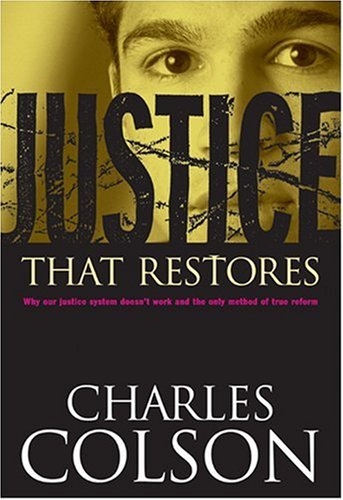
Justice that Restores
Reviewed by Dewi Hughes