
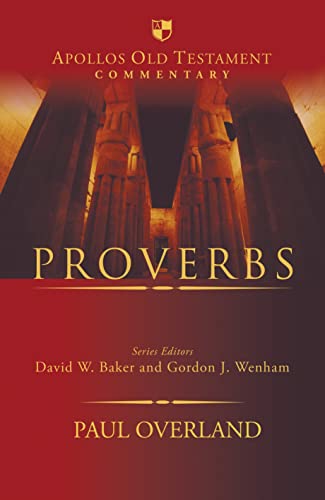
“You’re preaching from Proverbs? You’re going to preach it topically, aren’t you?” If a pastor takes it as his usual tack to preach serially through books of the Bible, and decides to embark upon a series on Proverbs, he will likely get such a question. In general, most people see the section of Proverbs 10–29 (at least) as an assortment of sayings collected much like a box of LEGOs. The box is full of various types of blocks, and it is the role of the builder to somehow piece them together into a cohesive unit. Hence, the preacher rummages through the box of proverbs on topics such as anger, speech, friendship, marriage, and more, collecting them into a coherent presentation for the congregation. As a preacher and scholar, however, I have always wondered why this is the de facto approach. Given the great thought and care evident in the structure of many other books of the Bible, why would one assume Proverbs is any different? Why, necessarily, should these proverbs be unrelated to those around them?
Paul Overland has produced a commentary almost entirely built on showing how the proverbs connect to each other and form a coherent structure as a book. In doing so, the author brings to culmination decades of study on Proverbs and contributes another excellent addition to the Apollos OT Commentary series.
Overland’s commentary is unique in his approach. He spends very little time on critical issues. Although Overland has convictions on authorship, date, and text, these are stated as his conclusions rather than extensively argued. He cites few scholars throughout his commentary, with Bruce Waltke (The Book of Proverbs, Chapters 1–15, NICOT [Grand Rapids: Eerdmans, 2004]; The Book of Proverbs, Chapters 15–31, NICOT [Grand Rapids: Eerdmans, 2005]) and Michael V. Fox (Proverbs 1–9, AB 18A [New York: Doubleday, 2000; Proverbs 10–31, AB 18B [New York: Doubleday, 2009]) as the most frequent references. This is not to say that Overland’s work is unscholarly. He is clearly aware of all the issues and the bibliography is extensive enough.
However, Overland’s commentary is laser-focused on how one ought to read the book. He spends more time showing the literary features of the text and explaining the text’s meaning. The introduction focuses on teaching how to read Proverbs “cohesively” (p. 6). Each section of commentary then follows this format: an overview of the text (one paragraph), preceding and ensuing context, “what to watch for” (notes on repeated or contrasted themes or words), translation and outline, notes on the text, form and structure (including borders, macrostructure, and microstructure), comment, and explanation. The explanation at the end, referring to the meaning, usually occupies a few paragraphs, although most of the work has already been done in the previous sections.
At times, the commentary becomes repetitive. For example, “notes on the text” naturally bleed into “comment,” and “what to watch for” is often similar to discussion of structure. Nevertheless, the reader can appreciate a fresh type of commentary, one that does not simply delve into long discussions of a particular translation nuance or the historical-critical question du jour.
Overland reads Proverbs (and teaches us to do the same) by observing various aspects of the text. These include beginnings and endings (the biblical writer brings up initial topics in concentrated form at the end [p. 8]), coherence (thinking about how nearby proverbs could relate to each other), apparent versus actual discontinuity (he argues that apparent discontinuity actually makes the point [p. 10]), primary concepts, and progression of thought. Overland also proposes a larger progressive structure for Proverbs (pp. 12–17). The first nine chapters motivate the student to seek wisdom and enroll in learning. Chapters 10–24 consist of advice for the apprentice. Chapters 25–29 prescribe wisdom for the “journeyman sage,” the one in the royal court and now out of the shadows of his mentor. Finally, chapters 30–31 provide advice for commoner and king. By the end of the book, then, the apprentice has become a monarch.
Overall, I found many of Overland’s arguments convincing. I read this commentary continually intrigued by how he creates a story out of (roughly) a chapter of Proverbs. One caution, though, is that interpreting Proverbs is highly dependent on one’s translation. As Overland admits, “Perhaps no biblical genre suffers loss through translation as does the compact wisdom poetry of Proverbs. Richness returns as we read isolated sayings in close correlation with the original language” (p. 2). Sometimes Overland offers unique translations that yield an entirely different meaning. For example, he translates Proverbs 28:1 as, “They had fled since no one was pursuing the guilty person” rather than the traditional, “The wicked flees though no one is pursuing.” From Overland’s translation, the fleeing ones are not the guilty but the moral. From this he builds a “story” in Proverbs 28–29 of a society falling apart and how it may be rectified.
This Proverbs commentary, then, provides an excellent and unique look at this wisdom book. Waltke and Overland are two of the few scholars who have sought to interpret Proverbs using this method of seeing cohesiveness within chapters 10–29. Overland guides readers to the meaning of the text and reveals all kinds of riches therein. Students and scholars must consult this work. Preachers should have this commentary on hand when teaching Proverbs. Who knows? One may even decide to preach through the whole book verse-by-verse.
Drew N. Grumbles
Albany Baptist Church
Albany, New York, USA
Other Articles in this Issue
The Spirit of God and the Religions of the World: A Response to Amos Yong’s Claims
by J. David WilloughbyAmos Yong, an acclaimed Pentecostal scholar, argues for what he calls a pneumatological theology of religions...
Pastoral Pensées: “We Do Not Lose Heart”: Theological Encouragement for Endurance and Opportunities for Reflection from 2 Corinthians 4:1–16
by Cody WilbanksBurnout is an evergreen threat for those in Christian ministry...
Contraception and the Church: Making Sense of the Debate and Some Pastoral Advice
by Dennis M. SullivanThis article reviews the ethical and theological issues surrounding birth control, with an emphasis on hormonal methods...
“Union” has become an increasingly valuable tool in discussions of atonement and soteriology...
Other Reviews in this Issue