
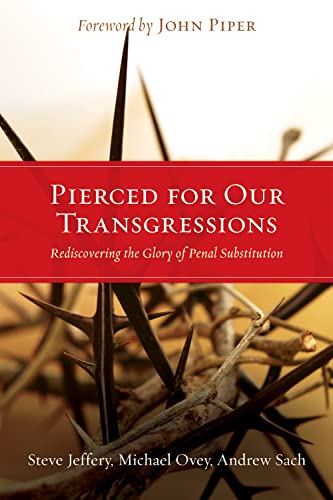
Pierced for Our Transgressions: Rediscovering the Glory of Penal Substitution
Written by Steve Jeffrey, Michael Ovey, and Andrew Sach Reviewed By Scott HarrowerPierced for Our Transgressions (POT) is a welcome contribution to the evangelical response to both Steve Chalke and Alan Mann’s The Lost Message of Jesus and N.T. Wright’s approval of such a work.
The thesis of POT is that penal substitution is clearly taught in scripture, that it has a central place in Christian theology, that a neglect of the doctrine will have serious pastoral consequences, that it has an impeccable pedigree in the history of the Christian church, and that all the objections raised against it can be comprehensively answered (p. 31).
The authors define penal substitution (PS) as follows: “God gave himself in the person of his Son to suffer instead of us the death, punishment and curse due to fallen humanity as the punishment for sin” (p. 21). PS is not the only aspect of the cross (pp. 33–34), and it is moreover the foundation of the other aspects of the cross (pp. 138ff.).
The authors of this work were at the time of publication a student, the principal, and a former student from Oak Hill Theological College in London. The theological outlook of Jeffery, Ovey, and Sach clearly stands in continuity with the Anglican evangelicalism of Leon Morris, John Stott, and J.I. Packer. The intent of the authors is twofold: first, to examine the exegesis and biblical theology related to Christ’s penal and substitutionary work accomplished in the cross; and second, to engage the purported biblical and cultural arguments for rejecting the doctrine of PS. Therefore, this work has two parts.
The first part of POT (“Making the Case”) argues primarily for the veracity of penal substitution in the Old and New Testaments, its practical usefulness, and the centrality of the presence and character of PS in the theology of major historical figures. Following a brief introduction to the present state of the issues (chapter one), “Part One: Making the Case” begins in chapter two by arguing for the presence and primacy of PS on the basis of the following passages or entire books: Exod 12, Lev 16, Isa 52:13–53:12, the gospels of Mark and John, Romans, Gal 3:10–13, and 1 Pet 2:21–25 and 3:18. Chapter three is a very introductory work on a theological framework for apprehending and interpreting penal substitution. Chapter four outlines some pastoral implications of penal substitution, such as “the assurance of God’s love,” “confidence in God’s truthfulness,” “passion for God’s justice,” and “realism about our sin.” Chapter five is a historical survey of PS in the theology of prominent theologians across the ages. The persons in mind include, among others, Justin Martyr, Eusebius of Caesarea, Augustine, Thomas Aquinas, John Calvin, John Owen, John Stott, and recent statements of faith by evangelical fellowships such as the Evangelical Alliance. Drawing together much of the work in the chapters preceding it, this chapter tries to prove a point made at the book’s outset: “That the Lord Jesus Christ died for us—a shameful death, bearing our curse, enduring our pain, suffering the wrath of his own Father in our place—has been the wellspring of the hope of countless Christians throughout the ages” (p. 21).
The second part of POT (“Answering the Critics”) is a response to various objections to penal substitution. An introductory chapter (chapter six) outlines their methodology used to counter popular contemporary arguments against PS: they listen to an objection to PS and then respond by using the Bible, metaphysics, and illustrations from everyday life. The objections to PS and the responses are grouped into themed chapters. Chapter seven, “Penal Substitution and the Bible,” deals with the role of PS in the Bible. Chapter eight, “Penal Substitution and Culture,” interacts with questions such as those relating to metaphors and cultural relevance. Chapter nine, “Penal Substitution and Violence,” addresses the violent nature of the cross and includes a section dealing with the charge of PS as “cosmic child abuse.” Chapter ten, “Penal Substitution and Justice,” counters objections to the fairness of PS. The doctrine of God is treated in chapter eleven, “Penal Substitution and Our Understanding of God.” Chapter twelve engages issues revolving around “the Christian life” such as PS and the responses to evil and oppressive regimes. Chapter 13 will strike a deep note within most readers as it deals with both the “Vague Objection” and the “Emotional Objection” to PS. These are probably the most popular objections that many of us encounter. This chapter is carefully written and provides great examples of each approach and thoughtful responses. The Appendix, “A Personal Note to Preachers,” is also excellent. It explores the problems inherent in many preaching illustrations that relate to PS and proposes seven points to keep in mind when preaching on the atonement.
Positive aspects of this book include the following:
- The courage to engage a live and difficult issue: The authors model for us a theology of engagement with the world and the church. This work is not shrinking evangelicalism; rather it is an engagement that requires their sleeves to be rolled up for hard work and their backs to be stiff and thickened in order to bear the inevitable criticisms that will come their way.
- Well rounded aim: POT successfully attempts to put forward a biblical case that is reflected by establishing PS in biblical theology and the great figures in history. PS can be discussed healthily in the contemporary setting and also has clear practical outworkings in the lives of Christians. This is a great aim!
- Biblical foundations: Biblical exegesis and the narrative of scripture are taken as foundational to the resolution of central Christian questions. This is a healthy methodological reminder to all Christians dealing with difficult issues in a hostile contemporary setting.
Negative aspects of this work:
- The first ten pages consist of repetitive recommendations for the book. Though this may be a feature of Crossway’s marketing strategy, these recommendations also play another subtle yet more significant role. The recommendations tell the reader that the “who’s who” of the conservative evangelical world approves of this work, and thus there is a significant community that would expect a fellow orthodox evangelical to arrive at similar conclusions to theirs. The danger of this situation is that POT may be treated more as an evangelical manifesto and less as a scholarly work, and therefore it will probably receive less scrutiny by fellow evangelicals than it deserves.
- Though there are disclaimers about the multi-faceted nature of the atonement, the authors do not show how PS is foundational to other aspects of Christ’s work. Therefore, the systematic case for the centrality of PS is undermined. As evangelicals we must recognize that there is a difference between biblical theology and systematic theology. Though systematic theology takes a step beyond biblical theology, it is right to do so, and we must be brave enough to do so for the sake of a vital faith in the church and the clarity of its mission in the world. POT does not sufficiently take these steps with regards to penal substitution.
- The doctrine of God is treated in chapter eleven, “Penal Substitution and Our Understanding of God.” This is perhaps the weakest chapter of the book as it strays into a reductionist form of Trinitarian theology that does not in practice take into account either (1) the tempering effect the incarnation has upon what we may say of intra-Trinitarian relations with reference to the cross or (2) the fact that in the Bible’s treatment of the cross, the stress lies primarily in that it is an event that takes place between the one, Triune God and the Messiah. Given the strict biblicism that governs this book, speculation about intra-Trinitarian relations is quite surprising and seems at odds with the remainder of the book.
- The appeal to history is superficial and circular. It is superficial because the authors do not sufficiently address the real issue with regards to the historical centricity of PS in Christian theology: the issue is the dogmatic weight that PS had or did not have in the theologies of great Christians over time. The presence of the doctrine in a person’s theology is not sufficient to show that their theology held PS as a, or the, central locus of the work of Christ. The appeal to history is circular because what the authors are in effect doing is (1) selecting persons of varying theological acuity who held to PS, (2) stating these people are major historical figures, and (3) concluding that we have evidence for the centrality of PS throughout time. Historical figures who were omitted from this list yet who merit discussion in an honest evangelical work must include Martin Luther and Karl Barth, who does not even make it into the bibliography.
- Though the purpose of POT is clear, the audience of this work is not. Is it a popular book, or should this work be treated as a scholarly work and thus bear the scrutiny such a status rightly deserves? Unfortunately, the answer lies somewhere in between. The authors are to be commended for trying to pitch this book at a wide audience, however, just as a broadly pitched sermon will not meet specific needs, neither does this broadly pitched book. This means POT will be an unsatisfactory treatment of PS for many readers.
POT has many admirable features that deserve to be heard in the present debate, but it also leaves something to be desired on other important fronts. It can be read profitably as an introductory work to more substantial treatments of the topic such as Brian Vickers, Jesus’ Blood and Righteousness: Paul’s Theology of Imputation (Wheaton: Crossway, 2006) and The Glory of the Atonement, edited by Charles E. Hill and Frank A. James III (Leicester: Apollos, 2004).
Scott Harrower
Melbourne, Australia
Other Articles in this Issue
Though his primary concern was how to persuade people from diverse backgrounds to embrace the gospel of Jesus Christ (1 Cor 9:12, 23), Paul, nonetheless, embodies a principle common to all who would provide leadership to a community comprised of a multiplicitous collection of rigid truth claims and behaviors...
The Ethnic Enemy—No Greek or Jew . . . Barbarian, Scythian: The Gospel and Ethnic Difference
by Keith FerdinandoWhatever 'globalisation' may be, it has been accompanied by insistent and sometimes violent affirmations of ethnic identity...
Despite a small flurry of attention over the past decade, Adolf Schlatter (1852–1938), Tübingen professor of New Testament and author of more than 440 written works, remains one of the most neglected yet illuminating theological voices of the past one hundred years...
Commentators have customarily interpreted Phil 2:12 as a reference to "working out" one's personal salvation...
Salvation History, Chronology, and Crisis:1 A Problem with Inclusivist Theology of Religions, Part 1
by Adam SparksA fundamental requirement in an inclusivist understanding of the relationship between Christianity and other religions is evidence of God's salvific activity outside of any knowledge of Christ...
Other Reviews in this Issue