
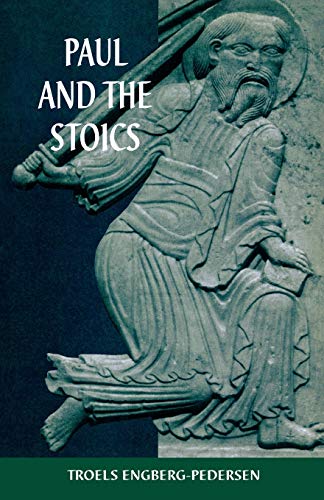
Engberg-Pedersen finds the key to a ‘comprehensive and coherent understanding’ of Paul in Stoicism. He abstracts from it and from three Pauline letters—Philippians, Galatians, and Romans—a heuristic model that he thinks underlies Stoic ethics and much of Paul’s thought.
Chapter 1 provides Engberg-Pedersen’s stance vis-à-vis Paul and Pauline scholarship. He is interested in how insiders (himself included) might appropriate Paul today, but he argues that before one can go there, one must read Paul critically and ‘coolly from the outside’ (2). Chapter 2 focuses on the model and what he hopes it will achieve. He believes there is a payoff for reading ‘Paul—the whole of Paul, not just this or that fairly restricted motif—in the light of Stoicism and the ancient ethical tradition generally’ (1). A respectful and sympathetic interpretation will be obtained, one which sees a ‘sufficient degree of coherence’ between the theological and practical levels of Paul’s discourse, and which takes him seriously as a thinker who was ‘accustomed to thinking along ancient Greek philosophical lines’. Chapter 3 fleshes out his model in relation to Stoic ethics as may be relevant for studying Paul. Chapters 3 to 10 analyse Philippians (two chapters). Galatians (two chapters), and Romans (three chapters). Some thought-provoking interpretations are served up throughout. In his discussion of Romans 6–8, for example, he argues that Paul claimed for the baptised a state of actual, realised sinlessness, based, not so much on any substantive changes that took place in baptism, but on the ‘logical category of the understanding’. Chapter 11 provides a summary of the theses presented earlier.
Five years previously. Engberg-Pedersen wrote. ‘The last fifteen years of scholarly research on Paul have seen the breakdown of the traditional monolithic contrasts—between Paul and Judaism (taken as one simple block) and between Paul and Hellenism (again taken as one simple block)’ (Engberg-Pedersen, ed., Paul in His Hellenistic Context, 256). He reaffirms this in Paul and the Stoics. In view of this much to be welcomed shift away from the conventional approach to reading Paul, this reviewer wants to see what the author’s comprehensive and coherent interpretation of Paul might look like were it to incorporate, not just the apostle’s relationship to Stoicism, but also his connection to Judaism and other contours in Hellenistic thought. Engberg-Pedersen concedes that his book should be read alongside others that stress Paul’s ‘Jewish profile’ (ix), and he does not deny significant differences between Paul and the Stoics; Paul’s apocalyptic world-view is illustrative. Yet when he sets the relevance of Paul’s apocalypticism apart. I am left to ponder whether he has allowed the Stoic viewpoint to take over altogether. Something similar may be seen in the way he handles the substantive categories in Paul’s thought. Engberg-Pedersen says they are there, but he believes they are not a ‘real option for us’. At the level of exegesis, however, he does not remain open to the place the substantive language might play in his interpretation. Based on the selectivity of his approach. I wonder whether he has not left me with a skewed interpretation of the data.
Be this as it may, Engberg-Pedersen’s risky and daring (in the best sense of these words) approach makes transparent many connections between Paul’s hortatory practice and the ancient ethical tradition and his application of his model generates an overabundance of exciting questions.
Kenneth A. Fox
Canadian Theological Seminary, Calgary
Other Articles in this Issue
Other Reviews in this Issue
When Science Meets Religion
Reviewed by John Taylor