
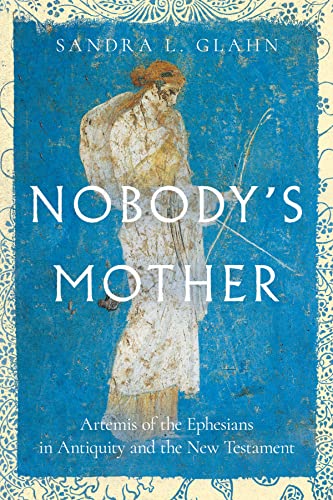
Nobody’s Mother: Artemis of the Ephesians in Antiquity and the New Testament
Written by Sandra L. Glahn Reviewed By Benjamin LairdOne of the greatest challenges facing contemporary readers of the New Testament is ascertaining how the canonical writings would have been understood in their original contexts. Paul’s instruction in the first canonical writing to Timothy is one such example. Just what did he mean when he stated that women will be saved through childbirth (1 Tim 2:15)? Surely Paul was not suggesting that there is a link between a woman’s ability or willingness to bear children and her salvation. But if we are to reject this notion then what exactly was his point? A variety of proposals have been advanced over the years that attempt to account for this perplexing statement, yet no single solution has proven entirely convincing to the majority of scholars.
According to Sandra Glahn, much of the confusion relating to this passage can be resolved by an informed understanding of the influence of the goddess Artemis within the cultural context of the original readers. Glahn, who currently serves as Professor of Media Arts and Worship at Dallas Theological Seminary, is no stranger to the study of the Artemis cult. In fact, much of her academic work over the last decade or more has focused on ancient witnesses to Artemis and the relevance of this background for the study of the New Testament. In addition to her doctoral dissertation, Glahn produced two articles on the subject of Artemis: “The Identity of Artemis in First-Century Ephesus,” BSac 172 (2015): 316–34; and “The First-Century Ephesian Artemis: Ramifications of Her Identity,” BSac 172 (2015): 450–69. Those familiar with her prior research will recognize that much of the content in these articles was reproduced in the present volume.
The association of the Artemis cult with Ephesus is well known, though, as Glahn explains, there have been unfortunate misunderstandings about the origin of the goddess and her role in human affairs. Contrary to the common notion that Artemis was a fertility goddess, Glahn provides compelling evidence that she was perceived instead as “a virgin goddess specializing in several things, including painless delivery or painless deaths, especially related to childbearing” (p. 54). Rather than looking to Artemis to conceive, Glahn explains, ancient women often trusted her to guide them safely through childbirth—a significant and constant concern in the first century—or at least to grant them a quick and painless death if they were not to make it through delivery. This understanding of the cult is supported by a robust and clearly presented survey of the relevant historical evidence from literary (ch. 3) and epigraphic (ch. 4) sources as well as from ancient architecture and art (ch. 5).
Following her study of the role played by Artemis within the world of the original readers, Glahn discusses several words and phrases in 1 Timothy that may have been intended to capture the attention of those familiar with Artemis. She also considers how Paul’s readers (Pauline authorship is assumed) would have understood his instruction about women. Among other things, she argues that Paul’s instruction was likely addressed specifically to wives, not to women in general (pp. 134–35), that the frequently discussed prohibition in verse 12 should be understood as Paul’s personal advice for a particular situation rather than as a universal principle (pp. 137–40), and that his appeal to Eve was designed to counter “a false story [about Artemis] with a true one” (p. 143). With regard to the assertion that women will be delivered or saved in some sense through childbirth (v. 15), Glahn concludes that the Greek verb σῴζω should be understood in the sense of “deliver” or “preserve” rather than in a final eschatological sense. She then concludes that Paul offers assurance to his readers that it was Jesus, not Artemis, who will preserve women of faith during the birth of their children.
The idea that Paul is referring to the deliverance of women through childbirth is not an altogether new interpretation, of course. Interestingly, some interpreters have made this conclusion without appealing to the Artemis cult. Moyer Hubbard, for example, reaches the same basic conclusions as Glahn in his article “Kept Safe Through Childbearing: Maternal Mortality, Justification by Faith, and the Social Setting of 1 Timothy 2.15,” JETS 55 (2012): 743–62. In contrast to Glahn, however, Hubbard focuses primarily on the use of σῴζω in other New Testament passages and the theological basis of Paul’s instruction. Whereas Glahn emphasizes the contrast between the protection offered by Artemis and Christ, Hubbard places a greater emphasis on the connection between the curse related to childbearing found in Genesis 3:16 and the assertion in 1 Timothy 2:15 that those in Christ will be safely protected.
Readers are sure to benefit from Glahn’s even-handed and careful analysis of the relevant background related to Artemis. However, some may wish for additional clarity on how these insights inform our understanding of the ongoing implications of Paul’s instruction. For Glahn, the promise of protection during childbirth appears to be time-bound and limited in application to Christian women in first-century Ephesus. It is not, as she explains, “a universal statement that would be true of all women in all eras. Rather, it would be true in the case of Timothy and his congregation in the short term” (p. 146). But this raises several questions. Were Christian women in first-century Ephesus supernaturally protected in a way that Christian women in other locations or other periods of history were not? Was Paul simply making a proverbial statement that is generally true of Christian women in all contexts? In short, what, if anything, does the text assure readers today about God’s care and provision for women who continue in faith, love, and holiness, particularly with respect to childbirth? Glahn concedes in the final pages of the volume that “the author’s corrective does have universal implications” (p. 155), though readers may struggle to determine the specific ways that she believes the text applies to women reading Paul’s words in a modern context.
While Glahn does not answer every question related to this notoriously challenging passage, there is certainly much to commend in this intriguing study. In addition to her clear and wide-ranging survey of the primary sources related to the Artemis cult, Glahn provides a wealth of insight related to the historical context behind 1 Timothy and how many of the original readers would have understood Paul’s instruction. The work will serve as a valuable resource to pastors, scholars, and lay readers alike and is sure to prompt fresh discussion regarding the background and meaning of one of the most disputed texts in the Pauline corpus.
Benjamin Laird
Benjamin Laird
Liberty University
Lynchburg, Virginia, USA
Other Articles in this Issue
Editorial: Announcing the Carson Center for Theological Renewal
by Brian J. Tabb and Benjamin L. Gladd
A Change in Kind, Not Degree: Labels, Identity, and an Evaluation of “Baptistic Congregationalists”
by Nathan ShermanHow do we decide what to label people of centuries past when they had no clear labels for themselves? Should we describe seventeenth century Baptists as “Baptists” if that was not what they called themselves? Matthew Bingham has recently argued that instead of using the label “Particular Baptists” for the English Calvinistic Baptists of the 1640s and 50s, historians would more clearly describe their subjects as “baptistic congregationalists...
Filial Revelation and Filial Responsibility: (Dis)obedient Sonship and The Religious Leaders in Matthew 11–16
by Adam FriendSonship appears in every section, at every turning point, and on the lips of every character in Matthew’s Gospel...
This paper articulates a provisional thesis, namely, that we need a pedagogical category within our biblical theological frameworks, on the basis that such a category was in the New Testament authors’ minds...
Scholars disagree about the precise nature of the sin that provokes God’s wrath in Genesis 19...
Other Reviews in this Issue